Showing posts with label selkirk settlement. Show all posts

Sunday, April 15, 2012

Curious Measurements in Canadian First Nations History

The standardization of arbitrary measurements can be traced back to ancient times, with the Greek and Romans using the foot as a measurement.  In the middle ages, Charlemagne used the "toise de l'Écritoire" which was the distance between the fingers of a man's outstretched arms.  Several moments in Canadian First Nations history show that the practice of using what was available, was the norm before standardized surveying tools were available.
Ancient Metrology John NealTheSecret Academy
One particularly arbitrary measurement was used in the determination of lands purchased from the Mississauga tribe in the early nineteenth century.  The Mississauga territories were located west of Lake Ontario including where the city of Mississauga is today.  The treaty of the land surrender was know as the "Gunshot Treaty", as the depth of the land purchased went back as far as a musket shot could be heard on a clear day.  (J.Miller, Skyscrapers, p.84)
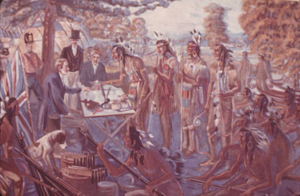
Missisauga Treaty signing August 1st, 1805George McElroy Missisauga Library
Date     1881
Source     Royal Society of Canada
Author     George Bryce
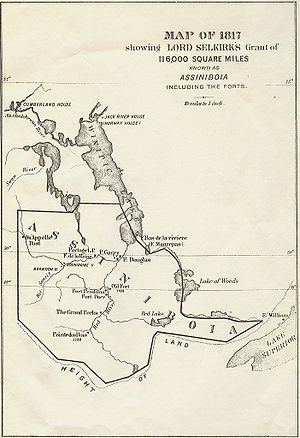
Another instance of using the familiar for measurement is found in the land purchase for the Selkirk colony in Red River.  These lands were to stretch back two English statute miles from the Red and Assiniboine Rivers.  (Miller, 133)  When the Ojibwa and Cree asked how far a statute mile reached, they were informed "it was the greatest distance, at which a horse on the level prairie could be seen, or daylight seen under his belly between his legs."

Wednesday, February 1, 2012

Buffalo Wool at the Selkirk Settlement

Merino Ram.  Powerhouse Museum 1953 Samuel Sidney.
The problems of transportation and production were major factors in the slow start of Lord Selkirk's Red River Colony.  Early frosts and drought meant that, in the words of A.S. Morton, "transforming the prairies into fields of golden grain" was not an option. (Morton, History of Prairie Settlement, 26)  Morton notes that wheat and flour were much too bulky, and their low price not worth shipping back to Britain. Attempting to get a herd of cattle established proved equally difficult. Selkirk turned his mind to wool, as industrial machinery in England had outpaced supply, and it was fetching a good price.  Merino sheep from Spain had, at this time been sent to Austrailia, and Selkirk would attempt to export some to his far distant colony.  Morton claims that the lack of industry and intelligence of the settlers, however, led to the experiment's ruin.

George Back Sketchbook 1820-21  Credit: Library and Archives Canada, Acc. No. 1994-254-1.53R
An attempt to use the resources at hand is observed in the founding of the Buffalo Wool Company to use buffalo hair as a weavable garment.  Morton notes that the mix of fine and coarse hairs made weaving difficult, and the wool's dark colour would not dye easily.  Chester Martin in his "Dominion Lands" Policy (1938) wrote that the Buffalo Wool Company was "the first and surely the most bizarre industrial venture of the West.  Lady Selkirk introduced the buffalo wool shawl into Scottish society but though remarkably soft and durable it would not take the vegetable dyes of those days." (Martin, 206)  The idea was eventually abandoned.  Interestingly, a modern company seems to have taken up the name, and sells buffalo yarn and garments, noting the institution was established in 1812, and re-established in 2011.

Further attempts to get sheep to the settlement met with disaster.  When a flock of over one thousand  was purchased in Kentucky and driven across country, they travelled through country rife with spear grass.  As Morton notes "the spears entered their flesh in such quantity as to make the whole body a festering sore.  The carcasses of the dead marked the way across the plains northward." (Morton, 27)   Morton sums up these efforts with a grim assessment: "all attempts to find an exportable product thus failing, the colony was necessarily reduced to playing the modest part of handmaid to the furtrade."

Tuesday, January 31, 2012

Beasts of the Selkirk Settlement, 1813

Stock-raising is an important facet of subsistence farming, especially when the nearest market is hundreds of miles away.  At the Selkirk Settlement on the Red River, an early attempt at an agrarian settlement in Western Canada, the first livestock were transported by the legendary fur-trader and explorer Peter Fidler. A.S. Morton, in his classic History of Prairie Settlement (1938) notes, the bull and two cows "must have been brought in as calves in the canoes.  They would be taught to jump in and out, and would be driven over the portages." (Morton, 10)  One can only wonder of the difficulties of transporting cattle in this manner.
Selkirk Settlement. National Archives of Canada / C-008714
Getting cattle to the colony proved near impossible.  Another bull and heifer were brought in by Miles Macdonnell, who picked them up from the Hudson's Bay Company at Oxford House.  Morton describes the ill fortune of these animals once arriving at the colony. He notes that Fidler's bull,

"proved vicious and was killed, though the scarcity of food may have had as much to do with its end as its viciousness, and, calamity upon calamity, the first, now the only remaining, bull was drowned while drinking at the water-hole in the ice on the river.  Selkirk urged Miles Macdonell to send out horsemen to drive quietly into the settlement a herd of heifer buffalo (they grazed apart from the bulls except in the rutting season), and to attempt a cross with a European bull.  This surely was a counsel of despair." (Morton, 16)

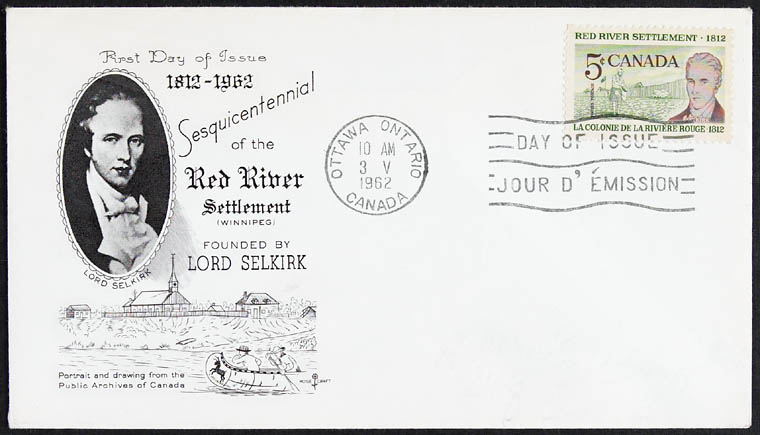
150th Anniversary Stamp. Credit: Library and Archives Canada  Copyright: Canada Post Corporation (stamp)
Copyright: Isobel M. Assad (cover)
Little did Morton realize that crossing cattle with buffalo was indeed feasible, however, the successful hybrid took much experimentation in animal husbandry to perfect.  By some accounts success was not gained in the endeavour until 1957.

It was not until 1821 that a substantial herd of cattle was brought in from the United States.  Livestock numbered 3 bulls, 6 oxen, 45 cows, and 39 calves with a number of sheep, horses and pigs as well.  As Morton notes, it took eleven years and much suffering to establish a healthy herd of livestock at the Selkirk Settlement.