 |
| An unidentified parachute candidate undergoing a medical examination at A35 Canadian Parachute Training Centre, Camp Shilo, Manitoba, Canada, 20 March 1945. Credit: Capt. Frank Royal / Canada. Dept. of National Defence / Library and Archives Canada / PA-188829 |
Friday, October 7, 2011
An Ignorant Hobo that Needs a Good Thrashing: Canadian Army Medical Jargon, 1942
Copp and McAndrew's Battle Exhaustion, now over twenty years old, is still the only serious work on Canadian medical psychiatry in the Second World War. The work is full of interesting information regarding the fledgling psychiatric organization in the Royal Canadian Army Medical Corps, and their attempts to run a system which sorted the mild and amenable stress cases from those irreparable psyches which required permanent evacuation from the combat zone. One noted difference between the Canadian and British psychiatric establishments was that the British linked psychiatry with personnel selection and psychology, whereas the Canadians associated their psychiatrists with the medical side of war. These difference withstanding, the Canadian Army did use some psychiatric principles in efforts to psychologically screen personnel. Copp and McAndrew's feelings about personnel selection can be summed up as such: "In Canada, staff officers of the personnel selection directorate - young men given commissions on the basis of university degrees or some university attendance - were testing, interviewing, and diagnosing other young men with the kind of assurance that only profound ignorance can provide."
In 1942, problems were identified with the young personnel examiners using pseudo-medical jargon in their assessment forms. Bill Line, having credentials from the Toronto National Committee for Mental Hygiene, urged the examiners to avoid "diagnostic terms (or phrases that smack of diagnosis) [such as] psychopathic inferior, feeble minded, mental defective, moron, imbecile, neurotic, hysterical, sexual pervert, psychotic, [and] insane." Line had to further outline several slang phrases of the day which should not be written in records which soldiers may have had access to. Strictly forbidden were the phrases, "ignorant hobo", "needs a good thrashing", and "should be put through the mill." (Copp, 34).

Sunday, September 18, 2011
Italian Campaign - 1 Canadian Corps Jeep Platoon
The jeep was a versatile vehicle which aided mobility in a Second World War campaign which was notorious for poor vehicle going. With high clearance and four-wheel drive, the jeep was able to go places where other vehicles were mired in the Italian muck. The Canadians in Italy never formed a permanent jeep-equipped unit for supplying troops at the frontlines, but an ad hoc unit was established for use in the Hitler Line that was disbanded during the pursuit, and reincarnated during the Gothic Line attack. The No. 1 Canadian Corps Jeep Platoon had thirty jeeps and around forty-five soldiers, which was attached directly to the battalion and company headquarters of the infantry. Arnold Warren wrote his RCASC history that the sections identified with the units they served whilst hauling anti-tank guns, ammunition, and hot rations. Innovation was no stranger to the group, who placed wet sandbags on the floors of their jeeps to protect the driver from mines.
An excerpt from the war diary after the breaking of the Gothic Line shows that the group saw no shortage of incoming fire:
"14 Sep 44
...One L/Cpl having to dive for a ditch receives a cut on forehead from heel of boot of a man trying to beat him to it. Our DR, Pte Sage A., never before under shell fire, leaves his MC in a hurry, dives into ditch to save himself and finds two other men there. He turns to say it rather hot, but it turns out they are both dead; presto, leaves for more pleasant company. One man finds it very comfortable to get jeep moving slowly ahead and driving it from the ditch on hands and knees."
Pictures at Library and Archives Canada show that the jeep was a prevalent vehicle in many organizations.
The medical corps was another formation which used the manoeuverability of the vehicle offroad to extract casualties under fire.
 |
| Personnel of the Loyal Edmonton Regiment filling a jeep with gasoline, San Lorenzo in Monte, Italy, ca. 22 September 1944. Canada. Dept. of National Defence / Library and Archives Canada / PA-177531 |
An excerpt from the war diary after the breaking of the Gothic Line shows that the group saw no shortage of incoming fire:
"14 Sep 44
...One L/Cpl having to dive for a ditch receives a cut on forehead from heel of boot of a man trying to beat him to it. Our DR, Pte Sage A., never before under shell fire, leaves his MC in a hurry, dives into ditch to save himself and finds two other men there. He turns to say it rather hot, but it turns out they are both dead; presto, leaves for more pleasant company. One man finds it very comfortable to get jeep moving slowly ahead and driving it from the ditch on hands and knees."
Pictures at Library and Archives Canada show that the jeep was a prevalent vehicle in many organizations.
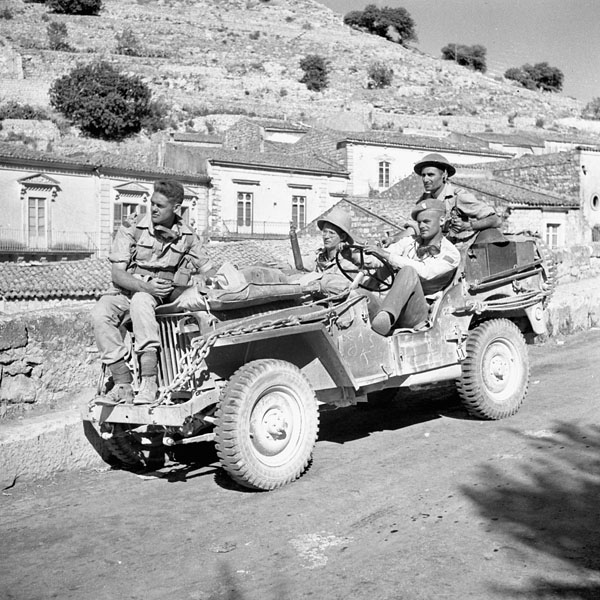 |
| Canadian war correspondents in a jeep, Modica, Italy, 13 July 1943. (L-R): Peter Stursberg, Canadian Broadcasting Corporation; Ross Munro, Canadian Press; Captain Dave MacLellan, Public Relations Officer; Lieutenant Al Fraser, Canadian Army Film and Photo Unit. Credit: Capt. Frank Royal / Canada. Dept. of National Defence / Library and Archives Canada / PA-204808 |
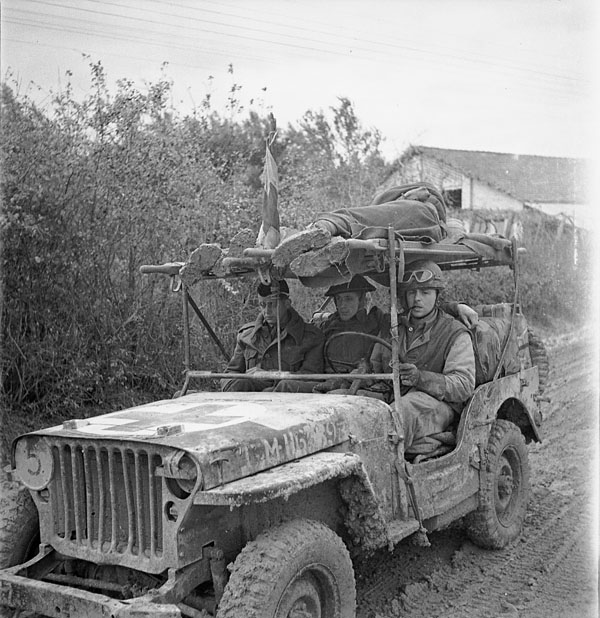 |
| A jeep ambulance of the Royal Canadian Army Medical Corps (R.C.A.M.C.) bringing in two wounded Canadian soldiers on the Moro River front south of San Leonardo di Ortona, Italy, 10 December 1943. Credit: Lieut. Frederick G. Whitcombe / Canada. Dept. of National Defence / Library and Archives Canada / PA-180097 |
Sunday, September 4, 2011
Lord Strathcona's Terrifying Eyebrows
 |
| Sir Donald Smith, Lord Strathcona, Montreal, QC, 1895 Wm. Notman & Son II-110266.0 © McCord Museum |
 |
| Manitoba Historical Society |
"There was something a little frightening about Donald A. Smith. Perhaps it was the eyebrows - those bristling, tangled tufts that jutted out to mask the cold, uncommunicative grey eyes and provide their owner with a perpetual frown. At fifty-eight, his face leathered by the hard glare of the Labrador snows, his sandy locks and flowing beard frosted by the years, Smith had the look of a Biblical patriarch."
 |
| Glenbow Museum Archives NA-2597-13 Lord Strathcona and Father Lacombe, Edmonton, Alberta. September 7, 1909 Photographer/Illustrator: Byron-May Company Limited, Edmonton, Alberta |
Thursday, August 25, 2011
Germany's Synthetic Oil Industry in the Second World War
When Nazi Germany needed the rubber to hit the road, as imports of valuable raw materials were restricted, they turned to their old stalwart, the IG Farben chemical syndicate.
As Adam Tooze notes in Wages of Destruction, it was the commitment of the IG Farben firm to synthetic chemistry that earned it the place of "the closest and most important industrial collaborator of Hitler's regime." In 1926, IG set up the first coal hydrogenation plant which could turn coal into gasoline. The firm also promised to create synthetic rubber, which would provide another vital component of motorized warfare.
When the German Army invaded Russia, industrial priorities shifted to the air war. Operation BARBAROSSA was intimately linked with hopes for an expanded output of aviation fuel from 1 million to 3 million tons. The high costs of the hyrdogenation process, however, meant that it was unrealistic to hope for this massive increase through processing German coal alone. As Tooze writes, "here was the perverse logic of Barbarossa in a nutshell. The conquest of the oilfields of the Caucasus, 2,000 kilometres deep in the Soviet Union, was not treated as the awesome military-industrial undertaking that it was. It was inserted as a precondition into another gargantuan industrial plan designed to allow the Luftwaffe to fight an air war, not against the Soviet Union, but against the looming air fleet of Britain and the United States." (Tooze, 452)
Donald Caldwell and Richard Muller, in their work The Luftwaffe Over Germany : Defense of the Reich (2007) attribute a lack of aviation fuel as a major source of inefficiency of the Luftwaffe's defence of the Reich. This dearth of fuel was heightened in 1944 with the bombing of synthetic oil refineries. While the German aviation industry kept pace in terms of production numbers, lack of fuel (along with declining pilot quality and attrition, and planes destroyed in accidents and by strategic bombers) meant that the Jagdgruppen could not reap the benefits of factory output. A lack of aviation fuel for training purposes was particularly stifling in the long run. On 12 May 1944, the bombing of five synthetic oil refineries is portrayed by Caldwell and Muller as a major turning point in the capabilities of German air defence.
Figures for 1945, gleaned from the New York Times by Alex Constantine, state that IG Farben's outputs were, "100 percent of German synthetic rubber, 95 percent of German poison gas (including all the Zyklon B gas used in the concentration camps), 90 percent of German plastics, 88 percent of German magnesium, 84 percent of German explosives, 70 percent of German gunpowder, 46 percent of German high octane (aviation) gasoline, and 33 percent of German synthetic gasoline."
Interestingly, the Fischer-Tropsch process of coal liquefaction has recently been applied to turning natural gas to diesel fuel, but is being resisted due to its potential environmental degradation. Considerations of its base ethical roots as a key factor in the Nazi war industry will undoubtedly be trumped by the utilitarian ethics of energy demand.
Extra Reading on IB Farben and the Nazis from Anti-Fascist Encyclopedia
Excerpt on Synthetic Oil and Bombing Effects on Industry from United States Strategic Bombing Survey
 |
| IG Farben Office. Anti-fascist Encyclopedia. |
When the German Army invaded Russia, industrial priorities shifted to the air war. Operation BARBAROSSA was intimately linked with hopes for an expanded output of aviation fuel from 1 million to 3 million tons. The high costs of the hyrdogenation process, however, meant that it was unrealistic to hope for this massive increase through processing German coal alone. As Tooze writes, "here was the perverse logic of Barbarossa in a nutshell. The conquest of the oilfields of the Caucasus, 2,000 kilometres deep in the Soviet Union, was not treated as the awesome military-industrial undertaking that it was. It was inserted as a precondition into another gargantuan industrial plan designed to allow the Luftwaffe to fight an air war, not against the Soviet Union, but against the looming air fleet of Britain and the United States." (Tooze, 452)
Donald Caldwell and Richard Muller, in their work The Luftwaffe Over Germany : Defense of the Reich (2007) attribute a lack of aviation fuel as a major source of inefficiency of the Luftwaffe's defence of the Reich. This dearth of fuel was heightened in 1944 with the bombing of synthetic oil refineries. While the German aviation industry kept pace in terms of production numbers, lack of fuel (along with declining pilot quality and attrition, and planes destroyed in accidents and by strategic bombers) meant that the Jagdgruppen could not reap the benefits of factory output. A lack of aviation fuel for training purposes was particularly stifling in the long run. On 12 May 1944, the bombing of five synthetic oil refineries is portrayed by Caldwell and Muller as a major turning point in the capabilities of German air defence.
 |
| "The Man from I.G. Farben" Spitfire List |
Interestingly, the Fischer-Tropsch process of coal liquefaction has recently been applied to turning natural gas to diesel fuel, but is being resisted due to its potential environmental degradation. Considerations of its base ethical roots as a key factor in the Nazi war industry will undoubtedly be trumped by the utilitarian ethics of energy demand.
Extra Reading on IB Farben and the Nazis from Anti-Fascist Encyclopedia
Excerpt on Synthetic Oil and Bombing Effects on Industry from United States Strategic Bombing Survey
Sunday, July 17, 2011
Harold Innis drops a footnote
When Harold A. Innis wants to cite some evidence on the power relationships between late nineteenth capitalists, he does so with authority. His 1923 work, A History of the Canadian Pacific Railway, is a dense economic history which argues that the company brought civilization to the Canadian West at the cost of Westerners. Note that not only does the single footnote on American railway interests run for three pages, the sentence which it provides evidence for, has a further two footnotes!


 Four pages Professor Innis?! Your passion for the politico-economic background to the Pacific Scandal has no bounds!


Subscribe to:
Posts (Atom)