Showing posts with label military history. Show all posts

Saturday, December 13, 2014

Drugging Soldiers: Bennies and Battle

Using mind-altering substances to promote combat motivation and performance has been a longstanding feature of warfare.  While the practice of drugging soldiers wasn't widespread until the Second World War, the use of alcohol to boost morale and calm nerves long precedes modern drug use.  Pharmaceutical amphetamines, however, were an innovation of the interwar years.  In 1933, Benzedrine, was first marketed as a nasal decongestant.  The euphoric effects of "Bennies" were quickly seized upon by recreational users, and it did not take long for military forces to consider their use in battle.

Vendel Era Bronze Plate
Precedents certainly exist for  non-pharmaceutical military drug use. If one expands beyond the amphetamine category, lore has it that mind-altering "drugs" go back at least to the middle ages.  The most popular legend of  stoned soldiers tells of blood-crazed Viking beserkers eating dried fly agaric (the hallucinogenic mushroom Amanita muscaria) to inspire their savage attacks.  While drugging a medieval warrior and inciting him to behave like a bear might improve his will to fight, one has to wonder about the effects on hand-eye coordination.  Instead, the adrenaline-like effects of therapeutic doses of amphetamine, such as wakefulness, increased muscle strength, improved memory, and cognitive control, made the drug much more useful on the modern battlefield than hallucinogens.

Use of amphetamines by the military, then, began in the Second World War.  Richard Holmes, in Acts of War: The Behaviour of Men in Battle (1985), writes that in that conflict, Benzedrine was commonly administered to soldiers of various nations, noting ten percent of American soldiers used amphetamines in the conflict. 

An excellent treatment of Allied research and use of amphetamines is found Nicolas Rasmussen's 2011 article "Medical Science and the Military: The Allies' Use of Amphetamine during World War II" Journal of Interdisciplinary History 42:2 (Autumn 2011) Rasmussen suggests that despite the popular conception that drugs were prescribed by the Allies as physically performance-enhancing, the reasons behind amphetamine distribution was based on mood-altering effects such as "increased confidence and aggression" and the promotion of morale.  Until very late in the war, research had yet to conclusively prove the physical effects of the drugs.

Amphetamine Molecule
Nazi Germany was the first state to embrace military amphetamine use, to keep soldiers awake.   Rasmussen notes that during the Blitzkrieg of 1940, the German's took the lead in methamphetamine distribution to soldiers, with 35 million tablets distributed in three months from April-June 1940, and a sharp decline in use thereafter.  

Spiegel
As Adam Tooze wrote in  Wages of Destruction (2006), the intense operational tempo during the Fall of France led to the need for stimulating expedients.  With the call for German armoured forces to push constantly for three days and nights, armoured crews needed "uppers" to continue operating.  As Tooze writes, "to ensure that the drivers could go without sleep, the quartermasters of the advanced units stocked up with tens of thousands of doses of Pervitin, the original formulation of the amphetamine now know as 'speed', but more familiar in the 1940s as 'tank chocolate' (Panzerschokolade)."  Amphetamine use was reported in the press which intensified research interest for the Allies.

Rasmussen records that General Bernard Montgomery was an early enthusiast for amphetamine prescription after observing the results of field trials.  A drugged ambulance unit had proven quicker on the march when administered Benzedrine, and an infantry squad had not only won a race against a "sober" squad in a variety of military tasks, but had also proven to have a certain "snap and zest". (Rasmussen, p. 216) For the 1942 Battle of El Alamein, large quantities of amphetamine were authorized.
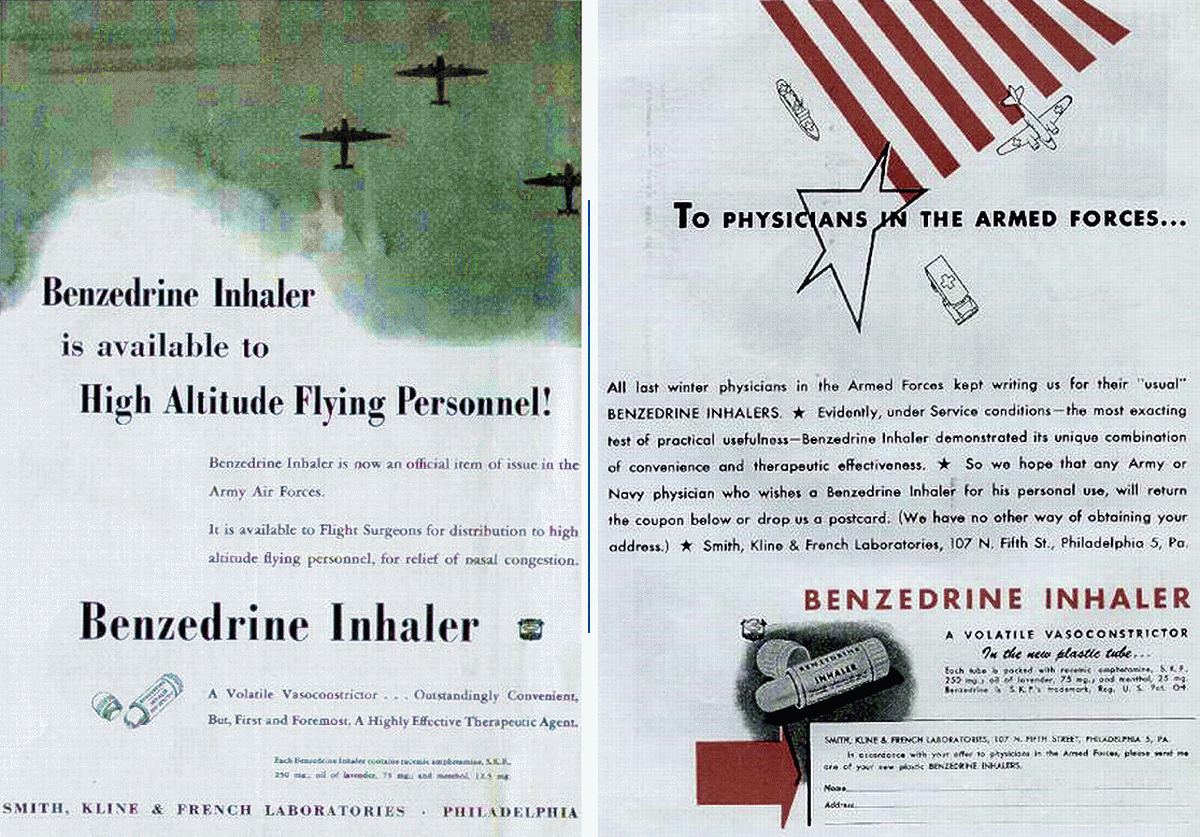
Benzedrine advertisements, 1943 & 1944.
Journal of the American Medical Association, Vol. 123, No. 10; Vol. 124, No. 12.
http://www.bonkersinstitute.org/medshow/benzedrinearmy.html

In 1943, the Americans came to the same conclusion on Benzedrine sulphate "pep pills" as a boost to morale and alertness and began to distribute them widely to all services. When Eisenhower learned that 100,000 six-tablet packages of "Bennies" were available for the North African theatre, he immediately requested 500,000. (Rasmussen, p. 226)  Rasmussen suggests that the drugs were widely abused for recreational purposes and may have been the cause of battlefield atrocities in the Pacific theatre.  (Rasmussen, p. 230-32)
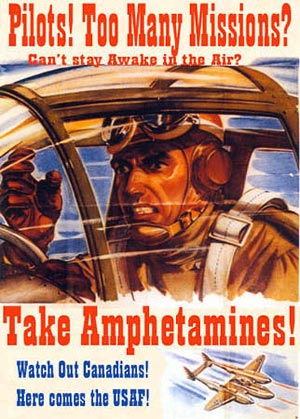


Remixed Propaganda by Micah Wright
The use of drugs by the military continues to the current day.  The American practice of popping amphetamines like candy was continued in Korea and Vietnam, where soldiers were administered Dexedrine before action.  More recently, lawyers for two American pilots who bombed Canadian soldiers in Afghanistan, argued that errant judgment may have been impaired by amphetamines.

Drugs, then, have a long relationship with the military, especially in years after 1940 as the pharmaceutical industry and pharmacological practice expanded at pace.  Beyond stimulants for combat, medical use has been made of barbiturates, sedatives and pain-killers.  Illicit, recreational drug use extends beyond amphetamines as well, with marijuana and heroin use in Vietnam as the most notorious example.  One need not look too far to find accusations regarding the negative effects of this military narco-love-affair.  

A version of this page was first posted on 28 July 2011.

Tuesday, November 18, 2014

Monumental Sherman

Mewata Barracks,
 Calgary, Alberta
If you are a Canadian, whether you know it or not, you have likely had a run-in with a Sherman tank.  The Sherman tank was ubiquitous on the battlefields of the Second World War.  With over 50,000 tanks produced during the war, and a bad reputation for losses when going head-to-head with those big German cats (Tigers, and Panthers, and Nazis oh my!) the Sherman has been used as an example proving the Brute Force concept of Second World War historiography, associated with John Ellis' book of the same name.   This line of reasoning claims that while the Sherman was inferior to the later model panzerkampfwagens, the Allies eventually used their sheer numbers to overcome the Wehrmacht. A handful of historians challenge this popular version of the Sherman's failings and claim that in certain terrain, and commanded by skilled operators, the Sherman could best the hallowed panzers.  Like the armoured fighting vehicles that they defend, these revisionists are facing an uphill battle.


A Sherman Firefly at
 Trois-Rivieres, QC


Shermans are also ubiquitous in Canadian memorials across the country and overseas.  The vast majority of these memorials are not, however, the M4A4 model Sherman, which was widely used by British and commonwealth formations during the second world war, but M4A3E8s, used in the closing months of the war by Americans and in the post-war era by Canadians.  The so-called "Easy Eights" had a smoother suspension and larger gun than the early 6 pounder or 75mm variants.  Giveaways for later model identification, include muzzle-breaks on 76mm guns and the Horizontal Volute Spring Suspension (HVSS).

HVSS was used on later model Shermans, while
 Vertical Volute Spring Suspension was used on models
 used by Canadians in the Second World War.  Image
"Athena" Memorial in Ortona, Italy. 75mm gun
There is an interesting story behind one of the more well-known Canadian tank memorials found in Italy.  The "Athena" tank memorial is situated in the town of Ortona, where the Three Rivers Regiment's (TRR) troopers helped the infantry regiments of the 1st Canadian Divisions take the town in house-to-house fighting in December of 1943.  The tank, while being the correct model that the TRR fought with, is not a relic of the street-battle of Ortona.  A few years ago, members of the regiment shopped around looking for a suitable tank, and purchased "Athena", previously dubbed "Cookie" from the Dutch War and Resistance Museum in Overloon, Netherlands.  The tank had served with the 7th American Armoured Division until turning over in a ditch.  In 2006 the tank, freshly painted with Canadian insignia, was presented to the town of Ortona.  As preservedtanks.com reports, 
The installation of the tank in the Piazza was intended to be temporary, pending the creation of a suitable site. This was planned to be on a pedestal north of the Piazza, overlooking the beach. In the meantime the tank has been moved to a grassy area nearby.
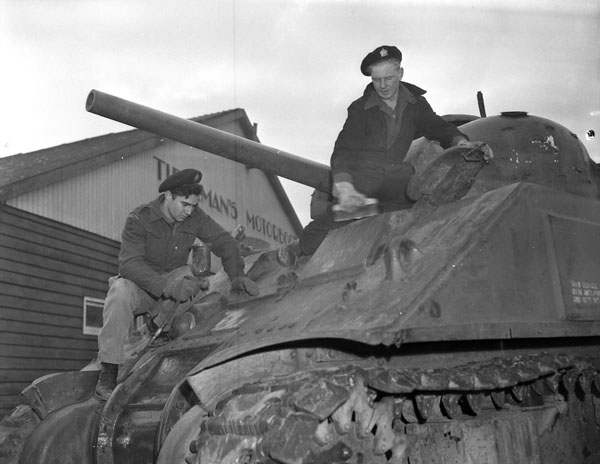
Most origins of memorials are likely lost to the public record, squirreled away in Legion Branch filing cabinets or fading with the memory of the "Greatest Generation". An interesting image in the Library and Archives Canada shows men preparing a Sherman as a memorial in "Fort Garry Park, Doetinchem, Netherlands" in late 1945.

Trooper J.L. Dumouchelle and Corporal W.L. Corn cleaning a Sherman tank of The Fort Garry Horse used as a monument in Fort Garry Park, Doetinchem, Netherlands, 22 November 1945. Photo Credit: Capt. Ken Bell / Canada. Dept. of National Defence / Library and Archives Canada / PA-131691
The tank still remains in what is now known as "Canada Park" in the town.  The name change is interesting, in that what once was a tribute to a specific action by a specific regiment has now been nationalized using a name that the average Dutch citizen is much more likely to identify with.  It is hard to say how the troopers polishing the tank back in 1945 would react to the removal of the regimental name.  Did they invest great importance in the notion that the tank would stand as a memorial to their specific regimental family?  Who knows, they may have just been tasked with polishing up the tank due to some minor disciplinary infraction and were looking forward to attending a dance with local Dutch women.


M4A3E8 in Kelowna, BC. 76mm gun
That Sherman tanks are popular as memorials speaks both to their widespread availability after the war, and their iconic appeal as one of the quintessential Allied weapons of the Second World War.  It certainly is not hard to find them across Canada.  The use of these machines as memorials, however, seems to draw away from their purpose.  These memorials are to the soldiers who fought and died for their various regiments, yet there is little to remind one about the human experience of war in the display of a vehicle.  True, dedication plaques often mention those that served in the vehicles, but to often form their crews appear in the histories as silent ghosts in the machine.  Like Cartesian body and mind, it is difficult to determine where and how the two interact. 


Charlottetown, PEI. 76mm gun
M4A4 in Normandy. 75mm gun
[A previous version of this post was originally published on 22 August 2010]


Monday, December 24, 2012

Scorched Earth: Kitchener's Boer War Counterinsurgency


A large group of horsemen of the Imperial
Yeomanry galloping over a plain. © IWM (Q 72318)
The old myth of the Boer War as one of the last gentlemanly wars, tied to romantic visions of honourable combatant knights, has long been revised and retired.  The conflict had no lack of ferocity and destruction, and the line between combatants and non-combatants was very much blurred.  The guerilla tactics of Boer commandos from 1900 posed a serious difficulty to the British Army. Attempts to curb the mobility of small groups of mounted riflemen included the use of blockhouses and barbed wire, with mobile columns attempting to press the Boers towards these defences. Ian Beckett notes in Modern Insurgencies and Counterinsurgencies(2001) that a more controversial method was the establishment of “concentration camps”, the destruction of houses and crops and the removal of livestock.

After the fall of Bloemfontein in the spring of 1900, Field Marshal Lord Roberts had ordered the protection of Boer property and allowed Boers considered loyal to return to their homes. After guerrillasbegan to emerge in the summer, however, Roberts ordered the destruction of houses close to vulnerable communications infrastructure. Other efforts to detract from guerrilla attacks were collective fines and the compulsion of Boer civilians to ride on trains.
 
Kitchener
Roberts policies may be deemed moderate. He rescinded less discriminate policies, and ordered the destruction of only those houses which were proven to be used by Boer fighters. From December of 1900, however, Roberts' successor Lord Kitchener extended the internment system to includeboth military prisoners and civilian refugees. Kitchener attempted to remove the entire Boer population from the veld. As he wrote in March 1901, "The refugee camps for women and surrendered boers [sic] are I am sure doing good work[;] it enables a man to surrender and not lose his stock and movable property . .. The women left in farms give complete intelligence to the boers of all our movements and feed the commandos in their neighbourhood". (Krebs, History Workshop, No. 33, p. 41)  
Kitchener’s internment policy was aimed at women as well, who were thought to be key figures in motivating the Boers. Women were originally rounded up to prevent them from spying for the Boers.  Yet as Paula Krebs suggests, this motivation was kept quiet, as it would admit that the women were incarcerated due to their military activities.  (Krebs, p.42)  Liberals and Irish M.P.s had been arguing that those in the camps were prisoners of war, not refugees.  In March of 1901, an exchange in the House of Commons evoked the gendered nature of imperialism.  Irish M.P. John Dillon asked, "What civilised government ever deported women? Had it come to this, that this Empire was afraid of women."  (Krebs, p.42)
 
"Garden of Remembrance, Aliwal North" 
Concentration Camp Memorial
License Creative Commons
AttributionNoncommercial Some rights reserved by G Bayliss
Beckett suggests that some women were held hostage to provoke Boer surrenders. Many women and children were condemned to a nomadic existence when their homes were razed.  Inside the camps, Boer children were subject to colonial indoctrination.  Research by Paul Zietsman notes that education provided in concentration camps attempted to Anglicize Boer children, which shows parallels with colonial aboriginal policies of assimilation behind residential schools. These policies invoked further political controversy back in Britain, especially when poor management of the camps led to the deaths of nearly one quarter of the 116,000 civilians detained.  When camp tents began to be populated by women and children, Britain, and especially British women, were alerted to a potential cause. 
 
After the uproar regarding the camps, Kitchener still claimed that their functional value outweighed the dissent.  In 1901, Kitchener claimed, "I wish I could get rid of these camps but it is the only way to settle the country and enable the men to leave their commandos and come in to their families without being caught and tried for desertion." (Krebs, p.43)
Typical group of Boer farmers at "Compensation" claims tent after war.Rodolphe Lemieux / Library and Archives Canada 1902-1903.
The success of these efforts is still debated among military historians.  It would not be the last time that the tactics of counterinsurgency led to political turmoil domestically.  Curiously, the tactic of burning farms was not as controversial as the camps themselves.  By May of 1902, somewhere in the range of 30,000 homes had been razed along with many acres of crops.  Larry Addington noted that Kitchener's tactics were very "un-Victorian", and observes the "systematic sweeps through Boer country foreshadowed American 'Search and Destroy' tactics during the Vietnam War nearly seventy years later." (Addington, Patterns of War since the Eighteenth Century, p.124).  Death rates are a matter of some debate, but figures of 25,000 Boer deaths, along with 12,000 black Africans.  The conflicts' brutal policy against non-combatants and domestic outrage at the harder facets of suppresion, resonate with students of twentieth-century counterinsurgency.

Tuesday, October 16, 2012

Swamp Insurgency: Fighting Seminole Guerrillas in Nineteenth Century

The Seminole Wars show the problems that a conventional army can encounter when their enemies adopt guerilla tactics. Ian Beckett, in his survey work Modern Insurgencies and Counter-insurgencies(Routledge, 2001) describes the Seminoles as “particularly skillfulopponents” of the United States Army. (p.29)  Throughout the first half of the eighteenth-century, skirmishes, ambushes, and raids typified a conflict, where American's had as much trouble finding their enemies as defeating them on the battlefield.

The Seminoles were largely Lower Creek people which had been driveninto Spanish Florida, with other members from the Oconee, Yuchi, Alabama, Choctaw and Shawnee tribes. By the mid eighteenth century, familial links had also been made to runaway slaves which had found refuge in Floridian villages.  Their name has been variously suggested to derive from the Creek word simano-li, meaning "separatist" or "runaway", or the Spanish terms cimarron, for "wild" or cimarrones for "rebel" or "outlaw".  When Spain re-acquired Florida from Britain after the American Revolution, Spanish colonists, and American settlers alike aimed to settle in the area, coaxed in part by Spanish land grants.  Seminoles were allowed to take up land grants as well, as Spain hoped they would form a divide between the Spaniards and Americans.
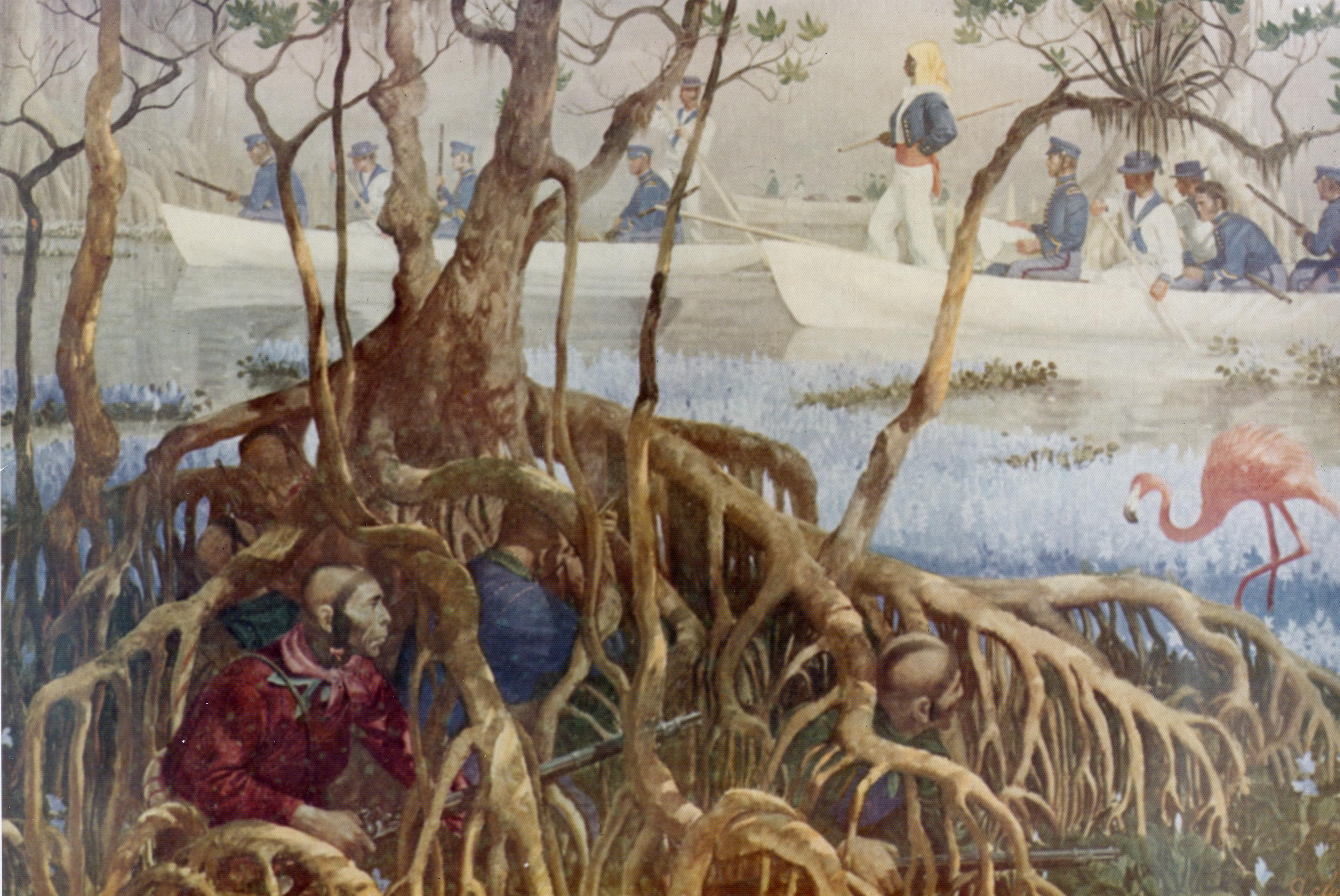
Marines battle Seminole Indians in the Florida War--1835-1842. Defense Dept. Photo (Marine Corps) 306073-A

Causes for American-Seminole violence may relate to older British tactics of using Seminoles against American settlers.  In the war of 1812 the Seminoles had supported Britain.  Harbouring runaway slaves was one offence that later caused the Americans to seek punitive justice against the tribe.  Beckett suggests the First Seminole War (1816-18) was largely motivated by the need to fight back against Seminole raiding partiesElsewhere, the murder of several Georgia families by chief Neamathla has been suggested as the event that sparked the conflict. General Andrew Jackson invaded Spanish Florida with around 3,000 soldiers and pushed the Seminoles further south.  Jackson dispersed villagers, burnt towns and seized Pensacola and St. Marks.  The Seminoles, in turn, conducted hit and run attacks on towns and plantations.  American ambitions for control of the peninsula were another casus belli, and in 1819, Florida was ceded by Spain to the United States

In 1823 a large reservation was established for the Seminoles, but this four million acre tract was not to remain a sanctioned home for long. In 1830, with Jackson as president, the Indian Removal Act become law. The United States governments attempts to remove all Indians west of the Mississippi into "Indian Territory" was accepted by some leaders who signed the Treaty of Payne's Landing in 1832.  Others refused to leave and moved deeper into the Everglades.

Oseola (As-se-he-ho-lor, Black Drink),
 a Seminole; bust-length, 1837. 
 
The treaty of 1832 allowed for three years for the Seminoles to move west, and in 1835 the stage was set for conflict with the hold-outs.  In December 1835, a 108 man detachment of Major Francis Dade’s forces was ambushed in the Wahoo swamp of the Withlacoochie River. A contemporary heritage website notes that, "As Major Francis Dade marched from Fort Brooke toward Fort King, 180 Seminole warriors led by Micanopy, Alligator and Jumper attacked. Only one man of that army detachment survived the ambush."  That the Seminole War was "the fiercest war waged by the U.S. government against American Indians", would presumably be contested by some historians.  Florida Heritage claims that more than  1500 American soldiers died in the conflict.
The action would begin the Second Seminole War (1835-42), which would see a series of frustrating actions for American generals.  The Seminoles crossed the Georgia border constantly and established safe havens in the Okefenokee Swamp.  Megan Kate Nelson quotes Ware County militia commander Thomas Hilliard who complained in 1836 that the Seminoles, "go concealed as much as possible, and are committing depredations continually, robbing our corn fields and killing our stock."  Seminoles destroyed numerous sugar plantations in Florida, crippling the industry and freeimg numerous slaves.  In February 1836, Major General Edmund Gaines' force of over 1,000 men was besieged and forced to retreat.  Subsequent generals fielding even more troops could not even find the enemy.  Campaigning in the summer months was difficult due to torrential rainfall and disease.

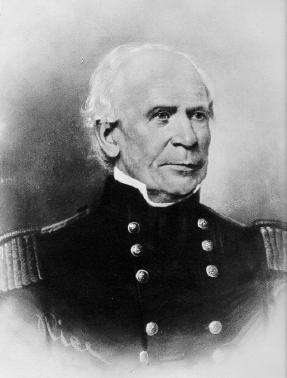
One noteworthy exception to American defeat is found in the campaign of future president Zachary Taylor, who benefited from the Seminoles abandonment of guerrilla tactics. At Lake Okeechobee in December of 1837, the Seminoles defended a fixed position in the everglades, and the Americans triumphed. The tribe did not make the mistake again, and Taylor’s counter-insurgency techniques divided the area and patrolled from outposts. It may have been racial conceptions of superiority which led American forces under General T.S. Jesup to ignore military custom and capture leader Osceola while under a flag of truce.  Osceola died in confinement several months later.  Meanwhile, Taylor destroyed crops and removed livestock, to little effect, and Taylor’s war continued until April 1840 when he asked to be removed from his command.  Jesup had some successes establishing forts and using mobile columns to sweep the country.

Thomas Sidney Jesup (1788–1860), 

As Beckett notes the war ended in 1842, not through any military success, but “largely by the army announcing it was over.” (p. 29) While 3800 Seminoles had been removed, there remained 500 guerrillas left in the swamps. The Third Seminole War (1855-58) reduced this number to mere 100 who continued to hide out in ever more remote areas of the everglades. Beckett suggests that the Americans little learned very little about counterinsurgency these early actions.

Wednesday, September 26, 2012

Military Mascots: Auchinleck, Rommel, and Monty in the Western Desert

Jonathan Fennell’s Combat and Morale in the North African Campaign (2010), traces the complex web of factors which influence military morale. One kernel in this cornucopia is the cult of personality surrounding the high commander. In the case of British and commonwealth troops in the Western Desert, it seems that a certain notorious German commander stole a march on the British.
 
General Erwin Rommel's charisma still effects the observers of military history, especially due to the popularization of his opposition to George Patton, as portrayed in the 1970 film Patton.  Problems arose in 1942, when British troops recognized the charismatic German general over their own commanders.  General Claude Auchinleck was an unknown entity to troops under his Middle East Command as long as a year after he took control.

Generalfeldmarshschall Erwin Rommel (1892 - 1944):
 Rommel at a staff conference in the Western Desert.
© IWM (B 6541)
Fennell records that Rommel approached “folk hero” status, among troops. One officer wrote during a slow period in the desert that, “there is no news of interest here at the moment except that I have often heard fellows say ‘I wish we had Rommel on our side.’” (Fennell, p. 212) Attempts to confront the Rommel legend by Middle East Command came from the “MEF Weekly Military Newsletter no. 74”. “Axis propaganda had gone to considerable pains to build up the legend of Rommel, one of the aims being to give us a feeling of inferiority in the face of this photogenic General who is supposed to be master of the Libyan desert”.

The Auk.Creator Eves, Reginald Grenville (RA)
© IWM (Art.IWM ART LD 729)
Auchinleck’s personal reaction betrays his own concerns about the power of his opposition's celebrity. Auchinleck wrote,

 “I wish to dispel by all possible means [the idea] that Rommel represents something more than an ordinary German general…The important thing now is that we do not always talk of Rommel when we mean the enemy in Libya. We must refer to “the Germans”, or the “Axis powers”, or “the enemy” and not always keep harping on Rommel…PS. I am not jealous of Rommel.”(Fennell, p. 214, cited from Nigel Hamilton, The Full Monty, p. 544)

It seems that Auchinleck’s best efforts at becoming a military idol were in vain. The situation was reversed with the coming of the flamboyant and press-savvy Montgomery, who “actively pursued publicity and the press limelight and purposely took on the Rommel legend.” (Fennell, p. 214)

As Montgomery wrote after the war:
The Eighth Army consisted in the main of civilians in uniform, not of professional soldiers. And they were, of course, to a man, civilians who read newspapers. It seemed to me that to command such men demanded not only a guiding mind but also a point of focus: or to put it another way, not only a master but a mascot. And I deliberately set about fulfilling this second requirement. It helped, I felt sure, for them to recognize as a person – as an individual – the man who was putting them into battle. To obey an impersonal figure was not enough. They must know who I was. (Fennell, p. 214)
Monty with "Hitler" (l) and "Rommel" (r) © IWM (B 6541)
That Montgomery bought in to the cult of Rommel can be gleaned by the questionable honour of naming his dog after the general.  The distinction is only heightened by noting the moniker of his other canine comrade: "Hitler".  Monty, as against Auchinleck's policies would long personalize the German forces he opposed as "Rommel", and emphasized that he knew the "Desert Fox" better than anyone else.  

Fennell does acknowledge  Montgomery's success in becoming part mascot, claiming that he was the first British celebrity general, with the possible exception of Kitchener. (Fennel, p.5) It appears at least one prominent military historian disagrees with awarding full celebrity status to any British general.  Writing in the 1970s in his pivotal work Face of Battle, John Keegan suggests that Robert E. Lee was "the only cult general in the English-speaking world". (Keegan, 1976, p. 54)  So much for Kitchener of Khartoum and Montgomery of Alamein!  It seems that at least honorable mention is due to the Duke of Wellington, or even Sir Garnet Wolseley, whose name was incorporated in the British soldiers' pantheon of slang as synonymous with doing all right.  In overcoming the cult of Rommel, however, it appears that things were not "all Sir Garnet" for the desert generals!

Saturday, June 9, 2012

The Canadian Methodist Missionary Interpretation of the First Sino-Japanese War, 1895

The Japanese victory over China in the 1895 Sino-Japanese war has been attributed to modernization under the Meiji restoration.  Westerners assumed that the Chinese navy's ironclads and presumably extensive army would handily crush the Japanese.  This was not the case, and the shift in power in the region from China to Japan, caused consternation among some in the Western world.
Battle of Weihaiwei.  Woodblock by Ogata Gekko. 1895?
The Canadian Methodist Missionary Society, had established missionaries to Japan in 1873, and were quick to attribute the victory to the very concept of civilization which they were promoting overseas.  By the 1890s, over twenty missions were established in Japan, with over two thousand members of the church tallied.   As the Society's 1895-96 general report noted,
Of late our foreign work has been subjected to disturbing forces of an unusual kind, which at first seemed to threaten the progress, if not the existence, of the cause; but the outcome has confirmed our faith and put to flight our fears.  Japan has emerged from the conflict victorious.  Destiny has decided in favor of the minority.  This is doubtless due to that higher plane of intelligence and efficiency up to which the people, as a whole, have been raised in the last few years.  Christianity is now being recognized by the most 'advanced minds' as the important factor in the up-lifting of the nation, and is likely to receive a greater and more sympathetic attention than heretofore. (CMMS 72nd annual report, p. xi)

How the 2137 members of the Canadian Methodist Church's missions could have any actual influence on the war remains to be seen.

The war was fought over control of Korea, whose independence was accepted at the 17 April 1895 Treaty of Shimonoseki.  China also gave up Port Arthur and Taiwan, the former being swiftly snatched up by Russia, backed by its Triple Intervention allies, France and Germany.  There were clearly several overlapping layers of active colonialism surrounding the conflict.

Thursday, May 17, 2012

Legendary Paratrooper : The Leadership of Marcel Bigeard, 1956

Syndey Morning Herald Obit 2010
Marcel Bigeard was one of the legendary paratrooper leaders of the Algerian conflict.  His training regime was as rough as they come, and his leadership style was a text-book example of leading from the front.

Bigeard's introduction to the Second World War shared the disapointment of many of his French compatriots, but he quickly rose to prominence.  Captured in 1940 in the Maginot Line, he managed to escaped the next year to Senegal joining a colonial infantry unit in De Gaulle's Free French Forces.  In 1944, he parachuted into France, and spent the postwar years in French Indo-China.
Bigeard in Indo-China. Independent.
On his third combat tour to Vietnam, it was Bigeard's misfortune to be dropped into Dien Bien Phu.  Again he showed his determination in commanding what Alistaire Horne called in his Savage War of Peace, "one of the most inspired counter-attacks."(1987, p.168)
Bigeard was subjected to three months of brainwashing, and this may have inspired his belief that the "subversive warfare" in Indo-China was the beginning of a world-wide attack of which Algeria was a part.

Rama CeCILL
Arriving in Algeria, Bigeard commanded the 3rd Regiment of Colonial Parachutists, which immediately was purged of the weakest members.  Others who did not wish to be in the unit were offered transfers.  Those that remained were subjected to a brutal training regime in the dry lands of Algeria.  They returned a new breed of Para, sporting a long-brimmed camouflage cap, causing the pied noirs (Algerians of european stock) to nick-name them, the "lizards".  Bigeard denied the use of torture during the conflict, but did admit to "muscular interrogations."


Alistair Horne doesn't pull his punches in describing the paras as, "on their way to becoming a crack force; one of the most effective in the Western world". (p. 168)  An early construction of the Bigeard legend was the book The Centurions (1960) by Jean Lartéguy, which featured a character modelled after the commander.
A film based on The Centurions.
Bigeard led from the front, conducted his own reconnaissance and jumped with the first wave.  Horne notes, "tall and powerful, with a beaked nose that imparted a look of a bird of prey, Bigeard had that particularly French quality of allure essential to an outstanding commander.  He seldom did anything without panache.  Instead of arriving by staff car, or even helicopter, his favourite manner of inspecting a unit was to drop by parachute, arm at the salute as he touched down."

Imitators of the Bigeard command-style should, however, be wary.  Horne notes that in later life, when Bigeard was approaching sixty, one such troop inspection went wrong.  In Madagascar, Bigeard was dropped into shark-infected waters, breaking an arm.  His unfortunate yet "faithful" staff, who parachuted into the water with him, managed to save the General from the waters.

Friday, April 13, 2012

Indiscriminate Killings during Insurgencies: Servan-Schrieber's "Lieutenant en Algerie"

Alistair Horne's A Savage War of Peace (1977) is a classic account of the 1954-1962 insurgency in Algeria.  The book was reportedly read by George W. Bush and numerous American military commanders after the 2003  invasion of Iraq.  Horne himself was consulted by the president, and wrote that, "In the Oval Office last year, I was questioned intently on how de Gaulle got out of Algeria; I had to reply, 'Mr President, very badly; he lost his shirt.' Though it was clearly a disappointing response, Mr Bush replied, with emphasis: 'Well, we're not going to get out of Iraq like that.' There are several ways in which the Americans lost their shirt in Iraq, and George W. Bush could be said to have personally lost his comfy pad on Pennsylvania Avenue.

Insurgencies are difficult to generalize.  Most are specific and chaotic, inseparable from their historical context, and refuse to be neatly compartmentalized into good guys and bad guys.  Algeria was a particularly brutal war, and Horne does not back away from the grisly details.  An account which he quotes from Jean-Jaques Servan-Schrieber's book Lieutenant en Algerie (1957), echos the frustrations of regular soldiers who cannot tell friend from foe.  An old campaigner here tells a fresh-faced captain about the realities of discriminating civilians from combatants:
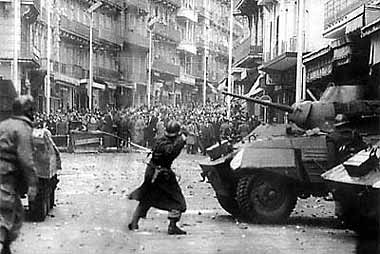
1960 Algerian Independence Demonstration
"Either you consider a priori that every Arab, in the country, in the street, in a a passing truck is innocent until he's proven the contrary; and permit me to tell you that if that is your attitude...you will immediately be posted, because the parents of reservists one has had killed don't like it, and will write to their deputies that you're a butcher...Or you will...consider that every Arab is a suspect, a possible fellagha...because that, my dear sir, is the truth...But once you're here, to pose yourself problems of conscience - and treat possible assassins as presumed innocents - that's a luxury that costs dear, and costs men, dear sir, young men themselves also innocent, and our own..."


Such sentiments are how insurgencies are won militarily and lost politically.  This brutal calculus of counterinsurgency exposes the attitude of distrust which creeps into the soldier's psyche when any passerby may be a potential killer.  This is one common thread to insurgencies: they are an extremely difficult psychological task for the soldiers that fight them.

Thursday, March 29, 2012

Iroquoian Military-Religious Torture

Torture was a common occurrence between the warring Algonkians and Iroquoians at the time of contact with Europeans.  Jim Miller's Skyscrapers Hide the Heavens notes that prisoners were subjected to excruciating treatment by fire and blade.  Captured soldiers were expected to remain calm while the captors subjected them to this degradation.  Miller notes, "it would be even better if he laughed at his torturers and told them that he was enjoying the treatment he was receiving." (p.12)
Canadian Military Heritage Gateway


The tortured were kept alive throughout the night, and revived if they passed out from the pain.  Iroquoians adapted a form of sun worship in which the prisoner was finally put out of his misery when the sun rose in the morning.  Cannibalism was not uncommon.  Those who were particularly stoic would have their heart cooked and distributed among the young men to eat.
Champlain and Huron Allies attacking an Iroquois Fort on the Richelieu in 1610.  CMHG


Miller notes that these practices were both sun worship and a masculine "cult of prestige". (p.13)  By eating a portion of a brave soldier's heart, the young men could gain some of their captive's bravery.  Interestingly, after contact,  Europeans also participated in the desecration of their Native opponent's bodies. Desmond Morton notes is his A Military History of Canada that while such mutilation was part of Iroquoian religious ceremony, the Europeans had no such cultural justification for their actions.

Sunday, February 12, 2012

The Adventures of Johnny Canuck: WWII Dime Comics

Canadian patriotism inspired by the Second World War led to the birth of the big three of Canadian nationalist super-heroes.  Nelvana of the Northern Lights, Johnny Canuck, and Canada Jack, would all battle the Nazis and their sympathizers at home and abroad.  War economies also played a role in the publication of home-grown Canadian comics. Concern about balancing the exchange of American dollars lead the the 1941 War Exchange Conservation Act, which banned the import of American "fiction periodicals" into Canada.  The need for Canadian heroes, and concern over a balance of foreign currency led to the dawning of the Golden Age of Canadian comic books.


Nelvana of the Northern Lights, Adrian Dingle,
front cover, Nelvana of the Northern Lights,
ca. 1945 © National Archives of Canada/Nelvana Ltd.

In August, 1941, the first super-hero with a distinctly Canadian identity was introduced.   Adrian Dingle's Nelvana of the Northern Lights, co-created with Franz Johnston of Group of Seven fame, was a super-symbol of the Canadian North. As Mary Louise Adams noted, in The Trouble with Normal: "based on a character from Inuit mythology, Nelvana was, nevertheless, portrayed as a white goddess, the personification of the North. She drew her supernatural powers from the Northern Lights and dressed in a short, fur-hemmed skirt, tall boots, and a cape. She had just about everything a superhero could want: she was immortal, she could fly, travel at the speed of light, melt metal, disrupt radio communications, make herself invisible, and alter her own shape and that of her brother (with whom she communicated telepathically). She put her powers to use fighting supernatural villains with nasty ties to the Nazis." (Adams, 143)  Nelvana stands out from her heroic Canadian cohorts in that she had bonafide super powers.  The following two nationalist super heroes were just plain tough.

The next national super hero to arise was the now legendary Johnny Canuck.  Johnny or Jack Canuck had been portrayed in Canadian political cartoons, beginning in the nineteenth-century.  Once portrayed as a French-Canadian habitant, the figure became increasingly western, donning high leather boots and a stetson.  
"Canada's Answer to Nazi Oppression", Leo Bachle, Dime Comics No. 2, p. 23, March 1942
© National Archives of Canada/Nelvana Ltd.
 Johnny Canuck's Second World War reboot has an interesting origins story of its own.  In 1942, the sixteen-year-old Leo Bachle was browsing some Dime Comics when that company's financial backer John Ezrin asked the young man what he thought of the comics.  Bachle candidly criticized the artwork, and when asked to produce a better depiction of two men fighting, he promptly did.  Ezrin told him to dream up a new comic book character, and that night Johnny Canuck was born.

Leo Bachle (script and art), Dime Comics No. 1, p. 23, February 1942  Super ITCH
Unlike Nelvana, Johnny Canuck had no super powers to speak of, but travelled to exotic climes, met with the resistance (and inevitably a beautiful woman), and usually escaped from his Nazi captors by highly improbable means. While Canuck fought evil overseas, a super-hero soon emerged to keep the home-front safe from Nazi sympathizers.

Canada Jack appeared in 1943, and was the first fictional addition to the Canadian Heroes comic books.  Canadian Heroes was the creation of Montreal's Educational Products, which had a wholesome educational mandate legitimized by letters of endorsement by Canadian cabinet ministers.  Canada Jack's exploits were largely restricted to foiling the dastardly plans of saboteurs on the Canadian home-front.

When the war ended, the ban of American comics in Canada also ceased, and the fledgling industry all but collapsed.  The transition to colour was another barrier to a home-grown comics industry.  Crime and mystery comics began to grow in popularity, and were the subject of considerable backlash from those who felt their message was unsavoury.  By 1947, the Golden Age of Canadian comics had all but come to an end.

Sources/Links
Adams, Mary Louise (Author). The Trouble with Normal: Postwar Youth and the Making of Heterosexuality.
Toronto, ON, CAN: University of Toronto Press, 1997. p 144.
http://site.ebrary.com/lib/calgarypublisher/Doc?id=10200841&ppg=171

Johnny Canuck's entire adventures summarized on an archived Library and Archives Canada page:
http://epe.lac-bac.gc.ca/100/200/301/lac-bac/guardians_north-ef/2009/www.collectionscanada.gc.ca/superheroes/t3-301-e.html

English Canadian Comic Books from the Canadian Encyclopedia:
http://www.thecanadianencyclopedia.com/articles/comic-books-in-english-canada

Saturday, February 11, 2012

Hunting Jackals as the Cure to the Scholar's Stoop: ELM Burns at Quetta, 1928-29

Emblem of the Quetta Staff College.
The hunched back of the scholar may be considered a trait contradictory to the ramrod soldierly disposition, but with the considerable schooling to be completed as the army officer climbs through the ranks, a peace-time staff-officer may be more likely to suffer from a papercut than a thrusting bayonet.  In the interwar years, there must have been numerous casualties of book smarts in the ranks of the fifty-odd Canadian officers sent overseas to British Staff College to learn lessons in the military art.  ELM Burns noted in his memoirs, General Mud, that his 1928-29 service in Quetta, India was typified by sporting events of upper-middle class respectability.  Burns claimed that such gentrified leisure could prevent the strains of scholarship from wearing a young officer down:

"These were very pleasant years, during which the military instruction was ingested in a fairly relaxed atmosphere, wherein the students, mostly of the rank of captain with twelve or more years service and war experience, were encouraged to maintain their physical fitness with tennis, golf, polo, riding to hounds (after the jackal) and other exercises suited to ward off myopia and the scholar's stoop."
Hunting Jackals at Quetta.  Date Unknown.  Swetenham Ancestors.

Tuesday, February 7, 2012

Dr. Seuss' Wartime Political Cartoons, 1941-43

Thedor Seuss Geisel (1904-1991), is best known for his delightfully illustrated children's books, but during the Second World War, Dr. Seuss' hand was used to prod Americans into action.  From 1941-43, Seuss penned political cartoons for the leftist New York paper PM.  An excellent website has made his drawings, held at the University of California, San Diego, available for perusal.

29 April 1941, PM. UCSD
Early drawings in 1941, show Seuss firmly chastising isolationist policy.  Picturing Americans with their heads in the sand and ignoring the war in Europe, Seuss suggests that the "Hitler headache" will necessitate stronger medicine.  Charles Lindbergh, an early proponent of American isolationism, was the target of Seuss' early agitation.  Note the purveyors of these fantastic ostrich hats was one "Lindy Ostrich Service Inc.".

Most shocking for those familiar with Seuss' childrens material is his racist portrayal of the Japanese.  As Richard H. Minear, author of Dr. Seuss Goes to War: The World War II Editorial Cartoons of Theodor Seuss Geisel, wrote,

 Perhaps it is no surprise that American cartoonists during the Pacific War painted Japan in overtly racist ways. However, it is a surprise that a person who denounces anti-black racism and anti-Semitism so eloquently can be oblivious of his own racist treatment of Japanese and Japanese Americans. And to find such cartoons - largely unreproached - in the pages of the leading left newspaper of New York City and to realize that the cartoonist is the same Dr. Seuss we celebrate today for his imagination and tolerance and breadth of vision: this is a sobering experience.

12 December 1941. JM UCSD

As Minear suggests, Seuss took a liberal stand towards the inclusion of African-Americans in the war effort.  In a 1942 cartoon, Uncle Sam chides "War Industry" that "if you want to get real harmony, use the black keys as well as the white."

30 June 1942, JM. UCSD
As Seuss' cartoons were targeted at the American home front there is no surprise that enemies are made of shirkers, wasters, and the corrupt.  The final cartoon in the collection uses the theme of familial recollection, also present in Great War propaganda posters, to chide those complaining about wartime shortages.  The cartoon shows an old timer telling his grandson of how his contribution to the "Battle of 1943" was composed of sitting around and complaining about fuel shortages.

5 January 1943,

Browse the rest of the University of Califonia San Diego's collection, complete with contextual introduction by Richard Minear, here:
http://libraries.ucsd.edu/speccoll/dswenttowar/#intro