Showing posts with label memorials. Show all posts

Tuesday, November 18, 2014

Monumental Sherman

Mewata Barracks,
 Calgary, Alberta
If you are a Canadian, whether you know it or not, you have likely had a run-in with a Sherman tank.  The Sherman tank was ubiquitous on the battlefields of the Second World War.  With over 50,000 tanks produced during the war, and a bad reputation for losses when going head-to-head with those big German cats (Tigers, and Panthers, and Nazis oh my!) the Sherman has been used as an example proving the Brute Force concept of Second World War historiography, associated with John Ellis' book of the same name.   This line of reasoning claims that while the Sherman was inferior to the later model panzerkampfwagens, the Allies eventually used their sheer numbers to overcome the Wehrmacht. A handful of historians challenge this popular version of the Sherman's failings and claim that in certain terrain, and commanded by skilled operators, the Sherman could best the hallowed panzers.  Like the armoured fighting vehicles that they defend, these revisionists are facing an uphill battle.


A Sherman Firefly at
 Trois-Rivieres, QC


Shermans are also ubiquitous in Canadian memorials across the country and overseas.  The vast majority of these memorials are not, however, the M4A4 model Sherman, which was widely used by British and commonwealth formations during the second world war, but M4A3E8s, used in the closing months of the war by Americans and in the post-war era by Canadians.  The so-called "Easy Eights" had a smoother suspension and larger gun than the early 6 pounder or 75mm variants.  Giveaways for later model identification, include muzzle-breaks on 76mm guns and the Horizontal Volute Spring Suspension (HVSS).

HVSS was used on later model Shermans, while
 Vertical Volute Spring Suspension was used on models
 used by Canadians in the Second World War.  Image
"Athena" Memorial in Ortona, Italy. 75mm gun
There is an interesting story behind one of the more well-known Canadian tank memorials found in Italy.  The "Athena" tank memorial is situated in the town of Ortona, where the Three Rivers Regiment's (TRR) troopers helped the infantry regiments of the 1st Canadian Divisions take the town in house-to-house fighting in December of 1943.  The tank, while being the correct model that the TRR fought with, is not a relic of the street-battle of Ortona.  A few years ago, members of the regiment shopped around looking for a suitable tank, and purchased "Athena", previously dubbed "Cookie" from the Dutch War and Resistance Museum in Overloon, Netherlands.  The tank had served with the 7th American Armoured Division until turning over in a ditch.  In 2006 the tank, freshly painted with Canadian insignia, was presented to the town of Ortona.  As preservedtanks.com reports, 
The installation of the tank in the Piazza was intended to be temporary, pending the creation of a suitable site. This was planned to be on a pedestal north of the Piazza, overlooking the beach. In the meantime the tank has been moved to a grassy area nearby.
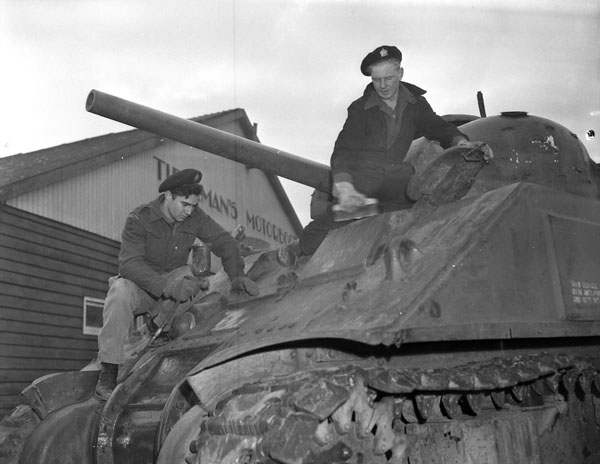
Most origins of memorials are likely lost to the public record, squirreled away in Legion Branch filing cabinets or fading with the memory of the "Greatest Generation". An interesting image in the Library and Archives Canada shows men preparing a Sherman as a memorial in "Fort Garry Park, Doetinchem, Netherlands" in late 1945.

Trooper J.L. Dumouchelle and Corporal W.L. Corn cleaning a Sherman tank of The Fort Garry Horse used as a monument in Fort Garry Park, Doetinchem, Netherlands, 22 November 1945. Photo Credit: Capt. Ken Bell / Canada. Dept. of National Defence / Library and Archives Canada / PA-131691
The tank still remains in what is now known as "Canada Park" in the town.  The name change is interesting, in that what once was a tribute to a specific action by a specific regiment has now been nationalized using a name that the average Dutch citizen is much more likely to identify with.  It is hard to say how the troopers polishing the tank back in 1945 would react to the removal of the regimental name.  Did they invest great importance in the notion that the tank would stand as a memorial to their specific regimental family?  Who knows, they may have just been tasked with polishing up the tank due to some minor disciplinary infraction and were looking forward to attending a dance with local Dutch women.


M4A3E8 in Kelowna, BC. 76mm gun
That Sherman tanks are popular as memorials speaks both to their widespread availability after the war, and their iconic appeal as one of the quintessential Allied weapons of the Second World War.  It certainly is not hard to find them across Canada.  The use of these machines as memorials, however, seems to draw away from their purpose.  These memorials are to the soldiers who fought and died for their various regiments, yet there is little to remind one about the human experience of war in the display of a vehicle.  True, dedication plaques often mention those that served in the vehicles, but to often form their crews appear in the histories as silent ghosts in the machine.  Like Cartesian body and mind, it is difficult to determine where and how the two interact. 


Charlottetown, PEI. 76mm gun
M4A4 in Normandy. 75mm gun
[A previous version of this post was originally published on 22 August 2010]


Tuesday, November 11, 2014

Two Siksika Soldiers and the Second World War

Of the around 3000 First Nations that fought for Canada in the Second World War, a number hailed from the Siksika (Blackfoot) First Nation, east of Calgary.  Their stories reflect the tragedy, loneliness and heartbreak of war.

A list of men enlisted from the district in the Gleichen Call during the war notes the names of Mark Wolfleg, C. Olds (Veterans Guard), Charlie Royal, Gordon Yellowfly, and Ed. Manybears as hailing from the Blackfoot Reserve.  To add to this list, the Aitsiniki Siksika newspaper lists Clarence McHugh, LF McHugh, Joseph Snake-Person, F. Turning-Robe, and A. White Pup as soldiering in the Second World War.

We know of the personal effect of war on one of these men, Mark (Ninnonista) Wolfleg, as he gave an 1983 interview to the University of Regina.  Wolfleg spoke of the happenstance behind his signing up in Calgary. 
At the time I was working at the mines, at the east end of the reserve, and I had gone up to Calgary for shopping and the next day I was still there, and I was walking up 8th Ave. heading west and I looked across the street and I saw a sign that, a recruitment sign.  So out of curiosity, I went across, went upstairs in a three story building on the top floor and I came in and there was sergeant there and he was really glad to see me and really friendly so he asked me if I wanted to sign up so just on impulse I said, "Yeah, I came to sign up." I came just by chance.  It wasn't a conscious decision.

The personal effects of war and army life on Wolfleg were  profoundly negative.  He spoke of how he was changed by the experience: 
When I first joined the army, when I first joined, enlisted, I did not really know what it was all about, the war and everything, but slowly I began to change.  I noticed a charge in my thinking, the life was very different from what I knew and back home in the Indian way of life, my outlook was a lot different then and it changed radically, especially when I went overseas.  My outlook on life became more harsh, a harder outlook.  There was anger in my life that wasn't there before and through all of the experiences I experience over there, when I came back, I had become a much angry person, a person that got angry a lot faster whereas before I never had the experience of experiencing anger...through the years I got over this.  Especially when I got into the spiritual life more and more.  I became more kindly to the elders and the youngsters because these were the ones that I saw suffer the most in the war, the older people and the children.

Mark Wolfleg Sr, visits the grave
 of Gordon Yellow Fly in 1983.
Photo: Handout/Mark Wolfleg Sr.
Reflecting on the experience of war, he claimed that, "Seeing war does not bring out any outstanding experiences.  It is all lonesome and that is what war is, it is lonesome, so I cannot really see what was very outstanding and none of the experiences stand out as being outstanding, it was all lonesome, loneliness."

When Wolfleg returned from the war, his Indian Agent told Ottawa that the First Nations veterans were being taken care of, and so he was denied benefits.  Wolfleg passed away in January 2009 at the age of 89, his obituary notes that the "old cowboy" fought with the Loyal Edmonton Regiment in Italy and that "his most treasured adventure" was a trip to Ortona, Italy, when he visited the grave of "his dear old friend" Gordon Yellow Fly.

Signature from Yellowfly's Will on his Service File
Gordon Yellowfly was known in the 1930s and 1940s as an excellent athlete.  He won third place in the Calgary Herald Road Race the year before he shipped overseas, and was active in hockey and boxing.  He had played hockey with Mark Wolfleg in the 1930s and 40s.

 His transition to army life, and army discipline was not smooth.  His service file, digitized with many others in the Killed in Action database at Library and Archives Canada, shows numerous crimes for drunkenness and being away without leave after he was taken on strength in June of 1942.  By the end of the year he was headed overseas.

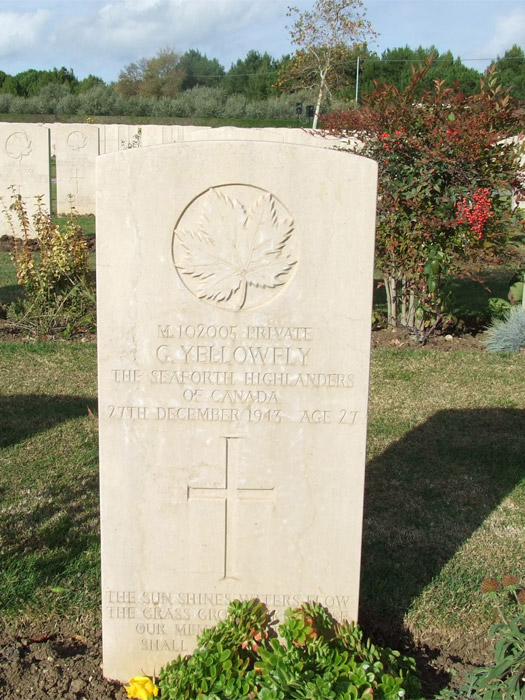
Gordon wrote home on the 31st of July from Sicily claiming that it was great that he was "in the big show", but that he had to flee from German bombs.  On the 27th of December 1943, Yellowfly was killed by a sniper's bullet at the age of 27.  He was carrying two new testaments, a prayer book, his Seaforth Highlanders Glengarry, a whistle, and a few other effects.  His father was to write the Department of National Defence in July 1945: "Will you be kind enough to find out for me what became of the personal effects of my son.  Gordon. who was killed in action at Ortona Italy Dec 27 1943.  Heretofore I could not gather enough courage to enquire, but now for sentimental reasons I would certainly be glad to get his personal effects."

Adding to the sad tragedy of Yellowfly's story, he was undergoing divorce proceedings with his wife, which had not yet been finalized when he was killed.  His service file lists Winston, George and Donald Yellow Fly as his children.  Donald's name was scribbled in in March 1943, suggesting that this was a child that he never met.  The bitterness of Gordon's father Teddy is suggested in the following excerpt from a letter to the Canadian Legion in March 1944:


Like many Canadians that fell in the Moro River and Ortona conflicts, Yellowfly is buried in the Moro River Canadian War Cemetery.  His epitaph is particularly interesting, yet obscured in the photograph at wikisicily.com [link].  It reads in part, as the treaty promises of old started, "The Sun Shines, the Waters Flow, the Grass Grows.." There was clearly a feeling, both from Mark Wolfleg and TeddyYellowfly's testimony, that the promises of the Canadian state had not been honored in the Second World War, which echoes contemporary criticisms of treaty promises.


http://www.siksikanation.com/siksikafair2005.html
Gordon Yellowfly is memorialized by the Gordon Yellowfly Piiksa-pi Memorial Arbour on the Siksika reserve.  The dedication from Donald and Alphina Yellowfly reads, "We submit that my father gave the ultimate sacrifice not only for his king and country of his time, but more importantly for his people of Siksika, and since the time of his death this Nation has never given him the proper acknowledgement.[...]
My father's Blackfoot name was PIIKSA-PI; and using original Blackfoot translation his name was "Sacred Visionary""

These two Siksika men's service experience, are well worth considering for their personal insight into the lived experience of warfare.  War for these men was not that of heroism or glory.  It was the stuff of tragedy and loneliness.  Wolfleg took years to get over the anger that war brought him.  War shattered Yellowfly's life and left his children without a father.

Monday, November 4, 2013

Alexander Young Jackson, the Group of Seven, and the First World War

Many historians have claimed that the First World War was a transformative period, ushering in a new modern era of bureaucracy and state control. For Canadian historians, the dominant narrative surrounding the war, has been that of colony to nation. In art history, this nationalist tone rings true as well, for it was during the Great War that key nationalist artists who would later become known as the Group of Seven developed their skills and were broadly publicized through patriotic efforts linked to the conflict.
Group of Seven, 1920. From left to right: Frederick Varley, A. Y. Jackson, Lawren Harris, Fairley, Frank Johnston, Arthur Lismer, and J. E. H. MacDonald. It was taken at The Arts and Letters Club of Toronto. Photo: Arthur Goss.

Four future Group of Seven artists were officially commissioned by the Canadian War Memorials Fund to depict the war. On the homefront, Arthur Lismer and Frank Johnston depicted Canadian efforts, and overseas, AY Jackson and Frederick Varley captured the battlefields of Europe. Unofficially, a fifth member, JEH MacDonald, lent his hand to the war effort by producing illustrations for honour rolls, posters, and other patriotic impressions.

The Group of Seven are the quintessential Canadian visual artists, known for depicting a stark Canadian wilderness which some argue bears the mark of military experience. As Colleen Sharpe, (curator of a previous exhibition at Calgary's Military Museums on the emergent Group of Seven and war), wrote in 2009, "The iconic features of the Group of Seven's art - disturbed ground, prominent rocks, muddy colours and skeletal tree trunks - have not been widely acknowledged as originating in the landscape of the First World War, yet it seems no accident of chronology that these men painted many of their seminal art works directly following the war."(Colleen Sharpe, "Artists and Soldiers", in Art in the Service of War: The Emergent Group of Seven (2009), p. 3) Maria Tippett also saw a direct military connection in the formation of the Group's style, writing that "The low-keyed colours of no man's land and the trenches - muddy brown, yellow ochre, and cool grey - came to permeate the post-war canvases of Varley, Jackson, and others who had lived and painted at the front." (Maria Tippett, Art at the Service of War: Canada, Art, and the Great War (Toronto, 1984), p. 108)  She also notes that exposure to British modernists during their time in England, was a wartime connection that would bring change to Canadian art.

The Canadian War Memorials Fund was the organization which did the most to support Canadian war art during the First World War. Headed by Lord Beaverbrook, the Fund commissioned artists to create a permanent artistic record of the conflict. It prioritized the documentary aspects of art, giving artists the opportunity to explore the battlefields and sketch what they observed. The Fund supported British artists as well, but historians have argued that its major contribution was the support of artists, and the organization of critics and gallery executives, "which enabled a national school of art to fluorish." (Maria Tippett, Art at the Service of War: Canada, Art, and the Great War (Toronto, 1984), p.6.) From November 1916, the CWMF gave artists full-time officer's rank and wages to memorialize the war.


The Great War occurred at a time when artistic taste was changing. As Jackson himself wrote, the war would let Canadian art "emerge from all its tribulations. Its worst foe materialism is being walloped, and will never be quite so formidable again. And all the academic bunch are dying off, gradually very gradually ... the future will take care of us."(Tippett, p. 7) For Jackson, more traditional means of portraying battle no longer rang true. As he put it, depictions of clashes of arms, with crisp lines, and vibrant colours had, "gone underground. There was little to see. The old heroics, the death and glory stuff, were obsolete." (Tippett, p. 13)

House of Ypres
Painted by Alexander Young Jackson
Beaverbrook Collection of War Art
CWM 19710261-0189

Private A.Y. Jackson c.1915
60th Battalion, enlisted June 1915
McMichael Canadian Art Collection Archives
AY Jackon created one of the largest bodies of work of any battlefield war artist, and had served in the 60th Battalion before being committed full time as an artist. He would write that "Lawren Harris wanted me to apply for a commission and offered to defray all expenses in connection with it, but I knew nothing about soldiering and decided to start at the bottom as a private in the infantry." (Art in the Service of War, p. 4) During his time in the line, Jackson put his artistic skills to military use, by drawing diagrams and details from military maps. (Tippett, p.12) Jackson was wounded at Maple Copse near Ypres, which fortunately kept him out of the fighting in Passchendaele. The artist was no stranger to France, having spent some time studying there a decade previous to the war.


Jackson spent time convalescing in France before being sent back to England. He was taken on strength of a reserve battalion and in Shoreham Camp when he heard about the CWMF and decided to approach Lord Beaverbrook. The environment in the battalion contributed to this decision. Jackson noted there was "not enough food and too many military police" with disgruntled soldiers being "drilled and disciplined by men who had not been in France". (Tippett, p. 14) Shortly after he left the battalion a mutiny broke out in the unit.


It was the battlefield itself that inspired; the alien mudscapes, and shattered woods.  Maria Tippett wrote that, "Nothing came to symbolize the war for the artist and the combatant as much as the land upon which it was fought....Pock-marked with gaping water-filled craters, strewn with bones, metal, and all the refuse of modern warfare, the topography of the front line offered few familiar associations....The machine had superseded God's handiwork; his landscape was being reshaped by man's instruments." (Tippett, p. 58) Tippett notes that it was this violent new meaning and manifestation of the landscape that made Romantic-Realist conventions seemingly out of place. Jackson felt that his style needed to be adjusted as well: "the impressionist technique I had adopted in painting was now ineffective, visual impressions were not enough." (Tippett, p.59)

A Copse, Evening
Painted by Alexander Young Jackson
Beaverbrook Collection of War Art

These landscapes and the new techniques used to portray them were directly influential in the development of a national school of art for Canadians after the war. As Tippett writes, "After the war Jackson and his fellow artists deliberately sought to paint 'swampy, rocky, wolf-ridden, burnt and scuttled country with rivers and lakes scattered all through it.' The Group of Seven's concern to demonstrate...the 'spirit' of painting in Canada, was thus associated with a sense that this could best be done by employing methods and techniques they and their colleagues had either seen used or themselves employed to paint the war-torn landscape of the Old World." (Tippett, p. 109)

The Glenbow museum of Calgary is currently exhibiting the work of AY Jackson and Otto Dix, drawing comparisons around the idea of nation and the influence of the Great War on their art.

Wednesday, January 11, 2012

Riel the Statuesque Strange Attractor

Riel 1870. UofManitoba Libraries
What is it that attracts Canadians to Louis Riel? The impetuous wag might quip, Riel's rebellion was a brief but bloody outbreak in Canada's otherwise pallid past.  Jennifer Reid has opted for a more cerebral explanation in Louis Riel and the Creation of Modern Canada : Mythic Discourse and the Postcolonial State (2008).  Reid suggests that for Canadians, Riel functions like the "strange attractors" used in chaos theory which make patterns discernible within complex systems.  The struggle for a Canadian national identity must work across the complex variations in region, language and ethnicity, and Riel may offer a way to understand these nuances.


As Reid writes, "Straddling the dichotomies of the Canadian social body, the man and the myths that have attached themselves to him (as well as to the resistance of 1869-70 and the Rebellion of 1885) might also present themselves to us a 'repeating' elements, signalling a different kind of order to be discerned within a history of disjunction.  From this vantage point, it is Riel as the emblem of 'in-between-ness' who expresses a most basic fact of the Canadian experience: that of cultural hybridity or...metissage." (Reid, 81)


Mackenzie Art Gallery
Riel has served as a bedrock of controversy in his numerous incarnations in Canadian culture, and no less so when his most intimate features are chiselled in stone.  The first of the Riel statue controversies occurred shortly after the 1968 unveiling of John Nugent's sculpture at the Saskatchewan legislature.  As Reid writes, "the virtually naked representation of Riel, right arm raised, genitals clearly visible, and neck angled upward as in prayer was presented to a public that was relatively unanimous in its displeasure for the piece." (Reid, 3)  It took until 1991 to have the statue removed and donated to Regina's Mackenzie Art Gallery.


Another statue, created by Marcien Lemay and Etienne Gaboury, and displayed to the public in 1971 at the Manitoba legislature, was also "naked and tormented", and drew the ire of politicians and the Manitoba Metis Federation, whose former president dubbed it an "undignified...incongruous monstrosity." (Reid, 4) In 1994, the statue was removed from the grounds to the College universitaire de Saint-Boniface.


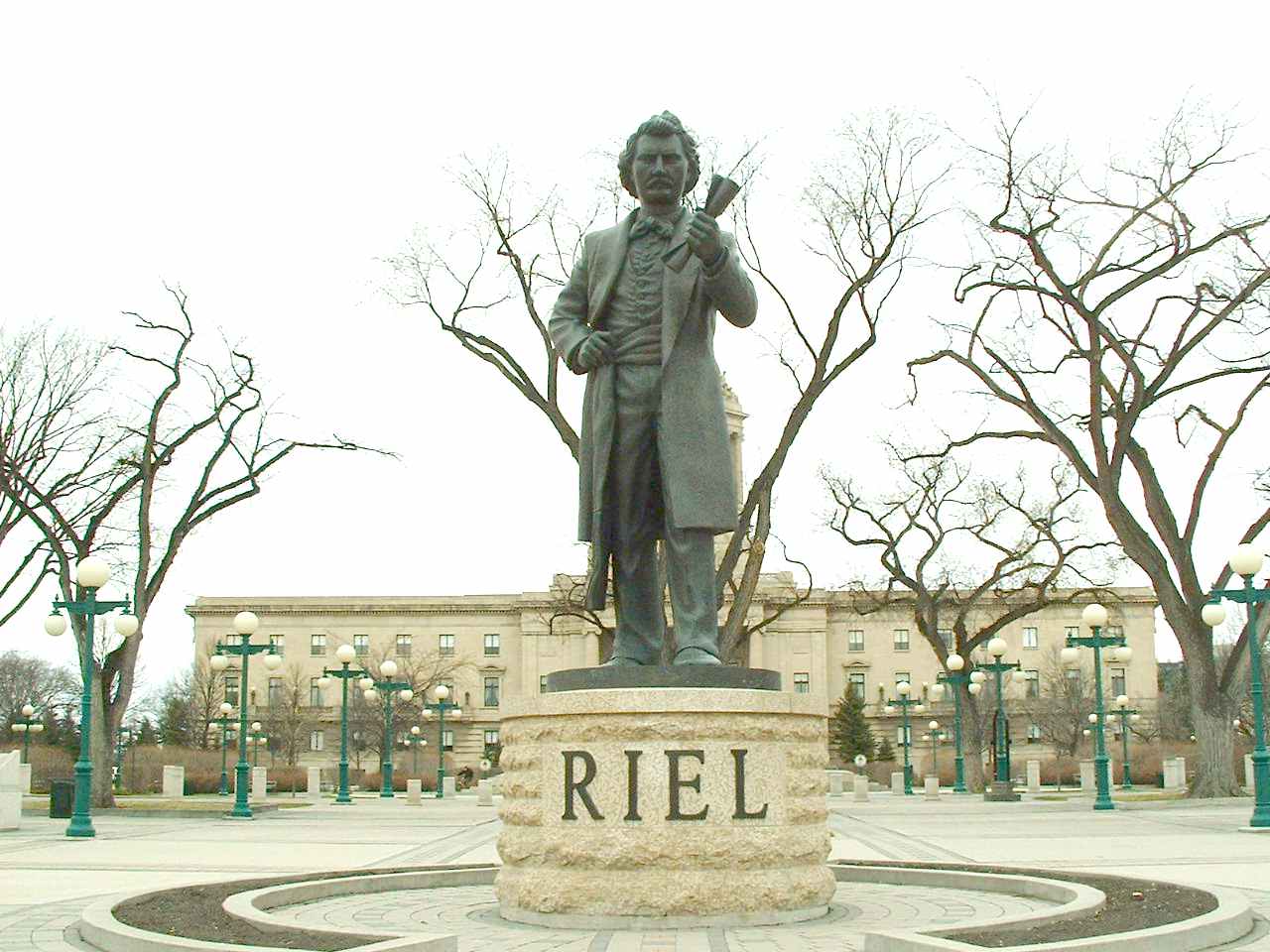
Finally, an acceptable statue created by Miguel Joyal was unveiled at the Manitoba legislature in 1996, which, after a full generation of controversy on the grounds was met with general approval of the public.  Unanimity is impossible to achieve, however, in historical interpretation as well as aesthetic taste.   Reid notes that one pundit claimed Joyal's work was, "just as boring and constipated as the other statues that dot the grounds." (Reid, 4)

Further Reading

Shannon Bower, "Practical Results": The Riel Statue Controversy at the Manitoba Legislature Building", Manitoba History
Sean Kheraj, "Representing and Remembering Louis Riel" Blogpost