Showing posts with label american history. Show all posts

Wednesday, October 14, 2015

Watch the Bee Go Get The Hun - Patriotic Sheet Music

Sheet music is a fascinating avenue into historical culture, and the patriotic jingles of the First World War are no exception.  Songs such as "Pack up your troubles in your old kit bag", or "A Long Way Tipperary", immediately bring that conflict to mind.  The Sheridan Libraries Special Collections at Johns Hopkins University features a vast collection of digitized sheet music for research and enjoyment in  "The Lester S. Levy Sheet Music Collection".  Clicking the World War I subject category yields 574 items, including popular soldiers' tunes such as "Hinky Dinky Parlay Voo?", patriotic odes to President Wilson and General Pershing, and a number of titles featuring belligerent threats aimed at the German enemy.

One of these belligerent numbers is the oddly titled, "Watch the Bee Go Get the Hun" whose cover features the familiar mustachioed caricature of Kaiser Wilhelm, subject to on onslaught of American soldier-bees, guided by the lamp of lady liberty!  The song was penned by Walter Hawley, and published in New York in 1918.


The lyrics of the song are as follows:

There's a beehive in America they call the U.S.A., And is far from 'over there'.
There's a hundred million busy bees a buzzing night and day, And they will soon be over there.
Uncle Sam is spending money so the bees can get the honey.
It's up to you to see them through the thickest of the fray.

Just watch the bee go get the Hun,
And bye and bye you'll see them run,
We're sending swarms and swarms of bees,
far across the deep blue seas,
To buzz around that big long distant gun.

So help the bee to get the Hun, Stamp U.S.A. on every one.,
And the Germans will be wiser when our Bees have stung the Kaiser,

Watch the bees go get the Hun.
Just Watch the Hun.

There are busy bees at Washington as busy as can be,
Preparing plans for 'over there'
And every bee throughout the land is watching anxiously
The bees who've landed over there.

The grand old Bell is ringing,
And our bees have started singing.
Their sting will win, good-bye Berlin,
it's all off Germany.

Just watch the bee go get the Hun,
And bye and bye you'll see them run,
We're sending swarms and swarms of bees far across the deep blue seas,
To buzz around that big long distant gun.

Our busy bees will get the Hun
With Kaiser Bill we'll have some fun,
To our bee-hive we will bring him so our little bees can sting him,

Watch the bees go get the hun.
Just Watch the hun.

It seems the bees here are variously ammunition, soldiers and civil servants.  It's a very busy metaphor! Why one would want to bring the Kaiser to the American bee-hive for a stinging when millions of bees are flying overseas is also a mystery.  Fortunately, Phonofile's youtube channel features a phonograph cylinder recording of "Watch the bee go get the Hun", so you can sing along at home.  All together now!


Thursday, October 18, 2012

Che the Failed Guerrilla

"Che" by Flick User JFabra. License
AttributionNoncommercialShare Alike Some rights reserved by JFabra
Che Guevara has become the ultimate symbol of counter-culture resistence and revolution. Ian Beckett in Modern Insurgencies and Counterinsurgencies, (2001), however, has little praise for the actual success of Che as revolutionary.  Beckett's critique is founded on the failure of Che to spread global revolution.  Others have expressed ethical reservations about Che's pop-hero status.  Writing for Slate magazine in 2004 upon the release of the acclaimed biographical film "The Motorcycle Diaries", Paul Berman moves beyond effectiveness in his critique of "The Cult of Che", calling his fame, "an episode in the moral callousness of our time."  To Berman, "Che was a totalitarian.  He achieved nothing but disaster."  Berman suggests that Che was central to the "hardline pro-Soviet faction" in the Cuban revolution, and was neither tolerant nor discriminant when it came to violence.
Che presided over the Cuban Revolution's first firing squads.  He founded Cuba's 'labor camp' system - the system that was eventually employed to incarcerate gays, dissidents, and AIDS victims.  To get himself killed, and to get a lot of other people killed, was central to Che's imagination.
Ernesto Guevara did not have a particularly revolutionary youth, beginning training in 1947 as a medical doctor at the age of nineteen, and spending summers working as a male nurse on merchant ships. Oddly, in 1950, he failed in an attempt to market an insecticide.  In his youth he travelled across South and Central America and observed the poverty there first hand.  Such experiences hardened his belief in Marxist revolution.
The 1954 American involvement in the overthrow of the Guzman government in Guatemala was a formative experience for Guevara. It was then that he received his nickname “Che”, which was Spanish for “buddy”, due to his frequent use of the term in his speech. In 1955, Che joined Castro in his revolutionary efforts, and led a guerrilla column into the Havana. With Castro's success over Batista in 1959, Che would become president of the National Bank of Cuba and minister of industry, working for the Castro government for a number of years.

Bookworld.
One of Beckett’s main arguments is that insurgency is a product of its time and place, and theory developed to counter insurgents is also a product of its historical setting. He sees Guevara’s revolutionary theory, heavily influenced by the French Marxist philosopher Debray, as failing to note that corruption, inefficiency, military ineffectiveness, and unpopularity were the real causes in the end of the Batista regime  (p. 171) Beckett cites a number of attempts at rebellionin the 1960s which failed to replicate the Cuban revolution in countries such as: Argentina, Brazil, Bolivia, Colombia, the Dominican Republic, Ecuador, Guatemala, Paraguay, Peru, and Venezuela.  Che would leave Cuba in 1965, due to friction there with certain leaders.  He hoped to foment global revolution, but attempts at training guerrilla forces in the Congo failed.


Beckett reserves the title of “the greatest failure of all” for that of Guevara’s attempts in Bolivia. (p. 173) In 1966 Guevara arrived there in hopes to organize resistance, but the 1950s had seen land reform and nationalization of the mining industry which denied Guevara the necessary bedrock of discontent. That Bolivia president Rene Barrientos, was of peasant origin did not help Che’s cause. Even the Bolivia communist party leaders objected to Che’s insistence on military control of the revolution, and abstained from support. Difficulties in the rugged terrain resulted in problems of manoeuvre, and as Beckett puts it, Guevara's force, "spent much of its time lost in the jungle.” (p. 174)
Guevara’s ultimate demise was a product of this lack of support, and the operations of a American Special Forces Mobile Training Team, under Major Robert “Pappy Shelton”. The Green Berets trained a ranger battalion for the Bolivian army which was deployed in fall of 1967. By 8 October 1967, Che’s remaining eighteen guerillas were surrounded at La Higuera. The wounded Che was captured and executed, and his body exhibited in Vallegrande.  Declassified American documents relate the final hours of his life.  A Lieutenant Perez was given the order to kill Guevara, but apparently did not have the heart to do so.   Perez asked Guevera what his last wishes were.
Guevara replied that he only wished to 'die with a full stomach'.  Perez then asked him if he was a 'materialist', by having requested only food.  Guevara returned to his previous tranquil manner and answered only 'perhaps'.  Perez then called him a 'poor shit' and left the room.  By this time, Sgt Terran had fortified his courage with several beers and returned to the room where Guevara was being held prisoner. [...]  'Willy', the prisoner taken with Guevara, was being held in a small house a few meters away.  While Terran was waiting outside to get his nerve back, Sgt Huacka entered and shot 'Willy'.  'Willy' was a Cuban and according to the sources had been an instigator of the riots among the miners in Bolivia.  Guevara heard the burst of fire in his room and for the first time appeared to be frightened.  Sgt Terran returned to the room where Guevara was being held.  When he entered, Guevera stood and faced him.  Sgt Terran told Guevara to be seated but he refused to sit down and stated, 'I will remain standing for this.'  The Sgt began to get angry and told  [...] him.  'Know this now, you are killing a man.'  Terran then fired a burst from his M2 Carbine, knocking Guevara back into the wall of the small house.  "Debriefing of Officers of Company B, 2nd Ranger Battalion"(www.gwu.edu)

The order to kill Guevara was made by General Ovando, the Chief of the Bolivian Armed Forces.  Walt Rostow wrote President Johnson of the execution, "I regard this as stupid, but it is understandable from a Bolivian standpoint.On the 13th of October, Rostow wired the president that Che was confirmed as dead.  It was long thought the body was discarded into the jungles via helicopter, but in 1997 Guevara’s remains were found under an airstrip in Vallegrande and re-interned in Cuba.
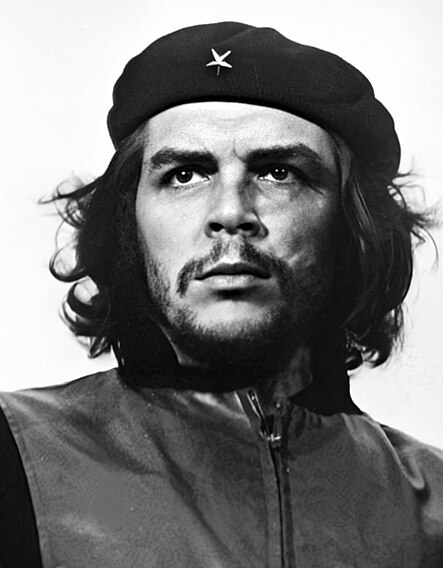
Date     Photo taken on 5 March 1960;
Source     Museo Che Guevara, Havana Cuba
Author     Alberto Korda Copyright

Che's beret-clad and bearded head has been said to be the most repoduced image in the world.  It seems that given his success as revolutionary, that Che as symbol, the Che of the rock t-shirts, and flags adorning teenage bedrooms across the world, is a fairly unlikely figure.  Indeed, one might say that he has inspired many more revolutionaries merely through the religious passion that his idol has evoked, more than any actual savvy regarding guerilla war.  In speaking of the Che's portrayal in "The Motorcycle Diaries", Berman notes "the entire movie, in its concept and tone, exudes a Chistological cult of martyrdom, a cult of adoration for the spiritually superior person who is veering toward death - precisely the kind of adoration that Latin America's Catholic Church promoted for several centuries, with miserable consequences."  The romantic ideal of Che as martyred revolutionary will probably never be excommunicated from the public mind.
"Che Guevara Monument and Mausoleum_Cuba 224" By James Emery.  License
Attribution Some rights reserved by hoyasmeg

Tuesday, October 16, 2012

Swamp Insurgency: Fighting Seminole Guerrillas in Nineteenth Century

The Seminole Wars show the problems that a conventional army can encounter when their enemies adopt guerilla tactics. Ian Beckett, in his survey work Modern Insurgencies and Counter-insurgencies(Routledge, 2001) describes the Seminoles as “particularly skillfulopponents” of the United States Army. (p.29)  Throughout the first half of the eighteenth-century, skirmishes, ambushes, and raids typified a conflict, where American's had as much trouble finding their enemies as defeating them on the battlefield.

The Seminoles were largely Lower Creek people which had been driveninto Spanish Florida, with other members from the Oconee, Yuchi, Alabama, Choctaw and Shawnee tribes. By the mid eighteenth century, familial links had also been made to runaway slaves which had found refuge in Floridian villages.  Their name has been variously suggested to derive from the Creek word simano-li, meaning "separatist" or "runaway", or the Spanish terms cimarron, for "wild" or cimarrones for "rebel" or "outlaw".  When Spain re-acquired Florida from Britain after the American Revolution, Spanish colonists, and American settlers alike aimed to settle in the area, coaxed in part by Spanish land grants.  Seminoles were allowed to take up land grants as well, as Spain hoped they would form a divide between the Spaniards and Americans.
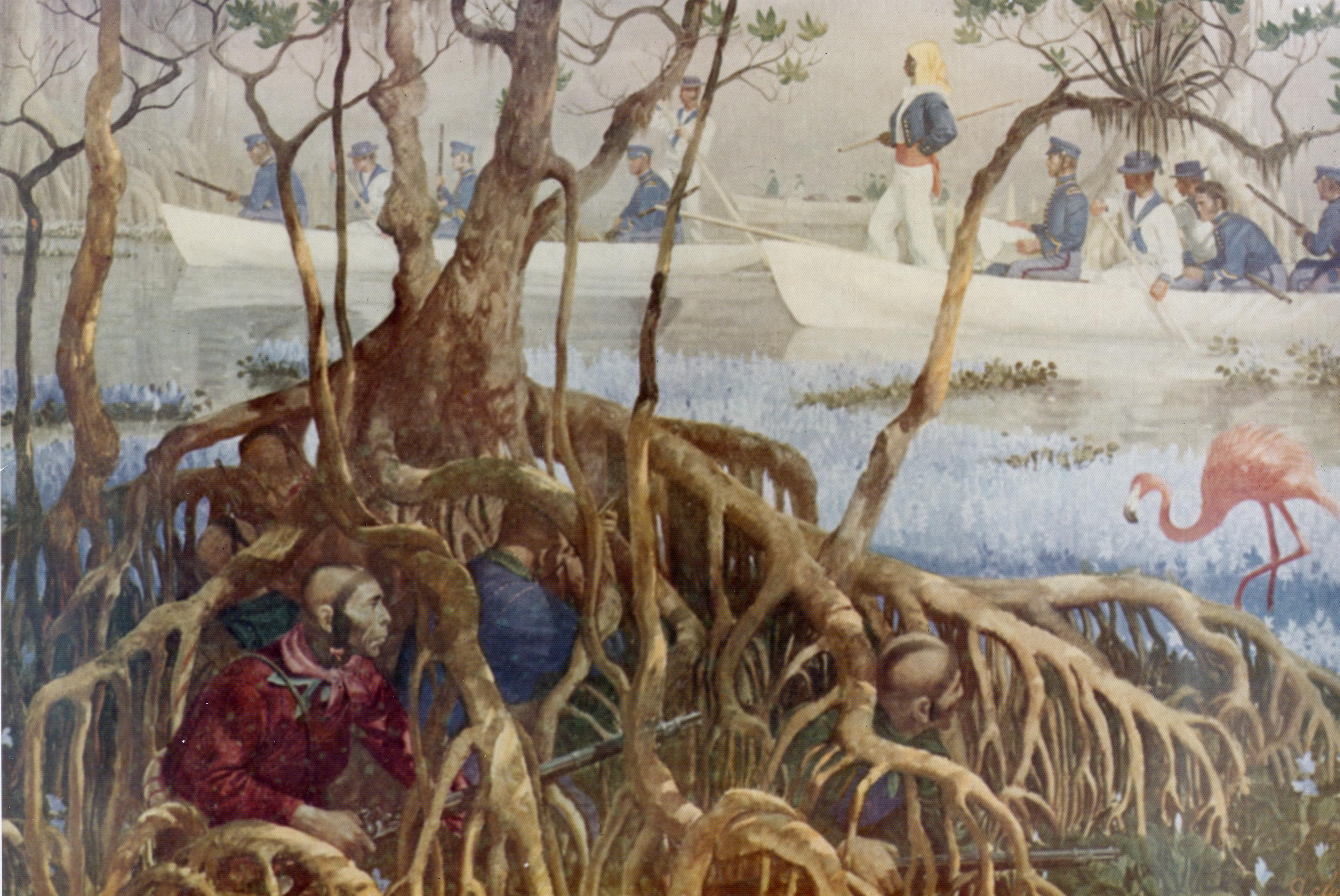
Marines battle Seminole Indians in the Florida War--1835-1842. Defense Dept. Photo (Marine Corps) 306073-A

Causes for American-Seminole violence may relate to older British tactics of using Seminoles against American settlers.  In the war of 1812 the Seminoles had supported Britain.  Harbouring runaway slaves was one offence that later caused the Americans to seek punitive justice against the tribe.  Beckett suggests the First Seminole War (1816-18) was largely motivated by the need to fight back against Seminole raiding partiesElsewhere, the murder of several Georgia families by chief Neamathla has been suggested as the event that sparked the conflict. General Andrew Jackson invaded Spanish Florida with around 3,000 soldiers and pushed the Seminoles further south.  Jackson dispersed villagers, burnt towns and seized Pensacola and St. Marks.  The Seminoles, in turn, conducted hit and run attacks on towns and plantations.  American ambitions for control of the peninsula were another casus belli, and in 1819, Florida was ceded by Spain to the United States

In 1823 a large reservation was established for the Seminoles, but this four million acre tract was not to remain a sanctioned home for long. In 1830, with Jackson as president, the Indian Removal Act become law. The United States governments attempts to remove all Indians west of the Mississippi into "Indian Territory" was accepted by some leaders who signed the Treaty of Payne's Landing in 1832.  Others refused to leave and moved deeper into the Everglades.

Oseola (As-se-he-ho-lor, Black Drink),
 a Seminole; bust-length, 1837. 
 
The treaty of 1832 allowed for three years for the Seminoles to move west, and in 1835 the stage was set for conflict with the hold-outs.  In December 1835, a 108 man detachment of Major Francis Dade’s forces was ambushed in the Wahoo swamp of the Withlacoochie River. A contemporary heritage website notes that, "As Major Francis Dade marched from Fort Brooke toward Fort King, 180 Seminole warriors led by Micanopy, Alligator and Jumper attacked. Only one man of that army detachment survived the ambush."  That the Seminole War was "the fiercest war waged by the U.S. government against American Indians", would presumably be contested by some historians.  Florida Heritage claims that more than  1500 American soldiers died in the conflict.
The action would begin the Second Seminole War (1835-42), which would see a series of frustrating actions for American generals.  The Seminoles crossed the Georgia border constantly and established safe havens in the Okefenokee Swamp.  Megan Kate Nelson quotes Ware County militia commander Thomas Hilliard who complained in 1836 that the Seminoles, "go concealed as much as possible, and are committing depredations continually, robbing our corn fields and killing our stock."  Seminoles destroyed numerous sugar plantations in Florida, crippling the industry and freeimg numerous slaves.  In February 1836, Major General Edmund Gaines' force of over 1,000 men was besieged and forced to retreat.  Subsequent generals fielding even more troops could not even find the enemy.  Campaigning in the summer months was difficult due to torrential rainfall and disease.

One noteworthy exception to American defeat is found in the campaign of future president Zachary Taylor, who benefited from the Seminoles abandonment of guerrilla tactics. At Lake Okeechobee in December of 1837, the Seminoles defended a fixed position in the everglades, and the Americans triumphed. The tribe did not make the mistake again, and Taylor’s counter-insurgency techniques divided the area and patrolled from outposts. It may have been racial conceptions of superiority which led American forces under General T.S. Jesup to ignore military custom and capture leader Osceola while under a flag of truce.  Osceola died in confinement several months later.  Meanwhile, Taylor destroyed crops and removed livestock, to little effect, and Taylor’s war continued until April 1840 when he asked to be removed from his command.  Jesup had some successes establishing forts and using mobile columns to sweep the country.

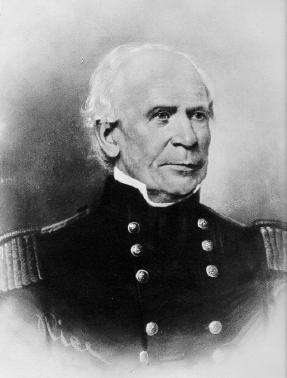
Thomas Sidney Jesup (1788–1860), 

As Beckett notes the war ended in 1842, not through any military success, but “largely by the army announcing it was over.” (p. 29) While 3800 Seminoles had been removed, there remained 500 guerrillas left in the swamps. The Third Seminole War (1855-58) reduced this number to mere 100 who continued to hide out in ever more remote areas of the everglades. Beckett suggests that the Americans little learned very little about counterinsurgency these early actions.

Wednesday, October 10, 2012

General James Dickon's Indian Liberating Army

"General" James Dickson, the so-called "Liberator of the Indian Nations", is a curious character, who goes down in Western Canadian history as a fleeting sojourner with more passion than sense.  Dickson's lineage is vague, but he has been claimed to be the "mixed-blood son of a British trader and Toto-win, sister of Sisseton Sioux Chief Red Thunder."
 [1](Thomas Ingersoll, To Intermix with Our White Brothers , p. 104) 
The governor of the Hudson's Bay Company, George Simpson described him as "covered with huge whiskers and mustachios and seamed with sabre wounds."  Elsewhere it has been noted that,
a bizarre character appeared in fashionable circles in New York and Washington in the winter of 1835-36, endeavoring, as he then said, to secure recruits to aid the Texans in their struggle for independence.  He called himself General James Dickson and told fascinating stories of his life in Mexico and of his service in the Texan army. His striking military dress and a very nice attention to the amenities of social life secured recognition for him but seem to have brought him few recruits.
(Nute, p.352)
Dickson's claim to fame was an attempt at gathering support for the establishment of a indigenous state stretching from Rupert's Land to Texas. 
Banner from Martin McLeod's "Attestation Papers", Nute

In 1836, Dickson recruited around thirty men from Montreal to join him in his quest.  All were apparently made officers in his army, and granted dress uniforms complete with "showy uniforms and glittering epaulettes."
(Lyman C Draper)
George Simpson would call these men, "wild thoughtless young men of good education and daring character, half-breed sons of gentlemen lately and now engaged in the fur trade."
  (Jennifer Brown, Strangers in Blood, p.190) 
Elizabeth Arthur, writing for the Dictionary of Canadian Biography, noted that he may not have told these recruits the full story of his plans to travel to Santa Fe, New Mexico, attack the fort and continue on to California, where he would establish a "utopian state in which Indians would hold all the property and where only a few white officials would be permitted."
McLeod County Minnesota.  Wikipedia.

One of Dickson's party was Martin McLeod, whose diary has survived the years.  McLeod was born near Montreal, but would later become a member of several councils in the Minnesota territorial legislature.   His presidency of the fourth council may be the reason why McLeod County, Minnesota was named for him.  Once in Minnesota, he would long function as a booster for the area, writing Canadian newspapers in praise of Minnesota.
 (Grace Lee Nute ed., The Diary of Martin McLeod, Aug 1922)

As McLeod made his way from Montreal to meet Dickson, he traveled Lake Ontario to Toronto, where he spent the day.  From his diary entry of 20 July 1836, it may be said that he did not enjoy his stay:
Remained one day at Toronto, do not like the place.  Saw Al[exander] Robertson of Inverness (an acquaintance at Montreal).  People kind enough apparently, but I think some what pompous.  Why?  God only knows.  What have they to bost of.  Their town or city (as I believe it is call'd) is a muddy hole - but then it is the Capital of [Upper Canada] and they are up to their ears in politics (damn politics) and they have Sir [Francis Bond Head] (whom by the by I saw a cheval) who is very popular &c &c and all that, so you see they are a people of some consequence, and not to be sneezed at, - that is if the d-------d stench of their town would allow a person to take his finger from his nasal organ long enough for that pleasant exercise.
(McLeod, p.355)
It was in Black Rock several days later that McLeod would meet General Dickson.  McLeod seemed slightly skeptical of the "General's" abilities noting that Dickson,
privately, informed me of his plans &c relative to the intended expedition to the north via  the great lakes and onwards God only knows where; and where and when it may end.  D[ickson] appears quite sanguine of success. As yet I know little of the man, but if I may judge from so short an acquaintance, he is some what visionary in his views - n'importe I wish to go north & westward and will embrace teh opportunity, but must "look before I leap."
(McLeod, p.359)

As Dickson had learned of Cuthbert Grant and the militant abilities of the Métis, he intended to gain recruits for his army in Red River.  He set out from Buffalo with only sixty of the 200 men that were initially proposed for the force.  As they had no money or supplies to speak of, they resorted to stealing and slaughtering some cattle near Detroit.  Unfortunately a sheriff's posse caught up with them, and they were made to pay a fine after some tricky negotiating.

The traveling was hard, and made particularly difficult by Dickson's questionable command decisions.
 (Anne Hyde, Empires, Nations, and Families, p.132)
Dickson could not help the damage done by a storm to their schooner on the Great Lakes which almost swamped them, but his decision to press ahead of his party in northern Minnesota without adequate supplies was highly questionable.

On the 27th November 1836, McLeod noted the difficulties crossing Cass Lake after the winds had polished the ice.  The party travelled 30 miles that day.  The next day McLeod noted, "Obliged to rest as a number of the party are unable to proceed from the fatigue of yesterday's march and the bruises which they received from frequent falls upon the ice. Indeed all our men were so "done up " that they did not arrise yesterday till near dark."
(McLeod, p. 388)

It was when the party's Sioux guides left them on the 9th of December, that Dickson's leadership began to crumble.  They had left Thief River that day and were still around a week's walk to the Red River settlement, yet were not at all familiar with the open prairie.  As McLeod wrote in his diary:
Saturday 10th Decr At day break we were summoned together,and informed by Gen1 D[ickson] that as our guides had desserted and as we had but five days provisions, and had yet to travel near three hundred miles in a strange country of which we had not an accurate map, he left us all to act, each man for himself, to either follow him, as it was his determination to trust to fortune and push forward, or return to Red lake and there wait untill they could procure a guide. I had previously made up my mind to continue my route at every risk, and all the rest with the exception of two preferring to follow Gen1 D., we made immediate preparations to start.
It was several days later that Dickson left the main group without blanket, food, nor means to light a fire. Dickson arrived in Red River, starving and frost-bitten.  As Lyman Draper noted, "the cold weather set in before their arrival at Red river [sic], and Dickson had his toes frozen off, which crippled him as well as the whole enterprise."
  (Draper) 


Sir George Simpson, Governor of the
 Hudson's Bay Company, 1857.
Credit: Library and Archives Canada, Acc. No.
1978-14-3 Source: Manuscript Division,
 W.W. Campbell Collection (MG30 D 8)
Governor Simpson was none too amused with the party, refused his bank drafts and quickly employed the men who had been recruited.  Several of Dickson's recruits were in fact the mixed-blood sons of HBC officials.  Their sense of adventure was probably supplanted by their common sense, after the hard travelling in the company of Dickson.  In the spring of 1837, the Indian Liberator left Red River, incredibly, worse off for resources than when he arrived.
 (Pannekoek, Snug Little Flock, 90).
  As Grace Lee Nute put it in 1922, "America has been the land of roseate dreams; but, among all its visions of wealth and power, where is the equal for novelty and adventure of this mad product of Dickson's disordered mind?"
 (Nute, 352)

Monday, June 18, 2012

Theodore Roosevelt's Muckrakers, 1906

Theodore Roosevelt's soft hand towards the business trusts, those great demons of turn-of-the-century America, make questionable the president's commitment to reforming American capitalism.  This being said, Historian Richard Hofstadter, no progressive sympathizer, noted that TR's commitment against corruption, civic indifference, and materialism, qualify him in some respects as a progressive.  He certainly is a closer cut to the archetypal reformer than other presidents of his age.
  • Title: [Theodore Roosevelt photomontage]
  • Creator(s): Underwood & Underwood, photographer
  • Date Created/Published: c1908 Jan. 28.LC-USZ62-131821
Roosevelt was wary of the literature of criticism that was emerging in the first decade of the twentieth-century, hoping that a revolutionary sentiment was not overtaking the nation.  In a speech of 1906, Roosevelt coined the term for the growing clamour of expose journalism, exemplified by Upton Sinclair's The Jungle. (Hofstadter, Richard, ed. The Progressive Movement, 1900-1915. New Jersey: Prentice Hall, 1963, p. 11, 18)

In Bunyan's 'Pilgrim's Progress' you may recall the description of the Man with the Muck-rake, the man who could look no way but downward, with the muck-rake in his hand; who was offered a celestial crown for his muck-rake, but who would neither look up nor regard the crown he was offered, but continued to rake to himself the filth of the floor.
         In 'Pilgrim's Progress' the Man with the Muck-rake is set forth as the example of him whose vision is fixed on carnal instead of on spiritual things.  Yet he also typifies the man who in this life consistently refuses to see aught that is lofty, and fixes his eyes with solemn intents only on that which is vile and debasing. [...] the man who never does anything else, who never thinks or speaks or writes, save of his feats with the muck-rake, speedily become, not a help to society, not an incitement to good, but one of the most potent forces for evil."
(Roosevelt, 14 April 1906)

Friday, May 25, 2012

Wall Street: The Embodiment of Evil in the 1880s

The portrayal of Wall Street as the embodiment of an evil capitalist is as familiar to the reader of 2012, as to an American of the mid-west in the late nineteenth-century.  Russel B. Nye's Midwestern Progressive Politics (1959), notes that it did not take long for the alienated Midwest to strike back against the colonial pressures of "the triple alliance of railroads, banks and tariff-protected industry." (Nye, 12)  Nye noted that

 'Wall Street' became very real to the Midwest as a general term including the entire body of Eastern influence - the moneylender, the high-tariff manufacturer, the market speculator, the railroad king, the trust holder, the mortgage owner.  It might mean Minneapolis, Chicago, Kansas city, St. Louis, or Boston as well as New York, but "Wall Street" was a living entity, a major influence in Midwestern thinking after 1865.


The evil Rockefeller depicted in"What a Funny Little Government" Horace Taylor 1899 Haley Ghiringhelli's Blog

One Granger writer wrote of the Midwestern concept of a meeting of the directors of one of these nefarious corporations.  The sinister meeting agenda would read thus:

"Order of Business:
bankrupt farmers,
form new monopoly,
rig market,
fix prices;

Resolutions Passed:
raise interest rates,
lower farm prices,
instruct business through interlocking directorates to raise prices on all goods sold to farmers,
order newspapers to support regular party candidates,
allot money to 'educate' legislatures,
declare dividend,
adjourn."


Nye notes that Midwestern Americans of the late nineteenth-century expressed, "the feeling that the average Midwesterner had entertained for some time, that something (he was not certain what) was riding him hard.  He called it variously the Money Power, the Rich, Invisible Government, Plutocracy, Wall Street, the Trusts, the Interests, or the Gold Bugs." (Nye, 106)

Wednesday, May 9, 2012

CP Stacey on the tardy American entry into the First World War

C.P. Stacey is a giant among Canadian military historians, and rightfully so.  Having penned the official histories of the Canadian Army in the Second World War, and innumerable works on the Canadian armed forces, his impressive oeuvre speaks for itself.  One would not expect Stacey to share the common knee-jerk anti-Americanism that is so wrapped up in Canadian identity.  In Canada and the Age of Conflict. Stacey's sober analysis notes that in 1903, the Alaska boundary dispute sowed seeds of distrust for Americans which may have played a role in Canadian rejection of the Liberal's 1911 reciprocity plank.  Stacey notes that the First World War did little to warm Canadian-American relations, and uses a autobiographical anecdote to prove his point:


Toronto Normal School. 1911? 
William Jame Fonds 1244, Item 1702
City of Toronto Archives
"In the school year 1918-19 the writer was in the top form of the Normal Model School in Toronto.  One of our academic exercises was known as 'oral composition'.  A classmate of mine took as his topic 'The United States in the War'.  My recollection is that it was a pretty scarifying presentation, and that it was universally acclaimed.  I remember specifically one point, the story with which the boy ended.  It concerned General Pershing in Paris.


General John J. Pershing. General Headquarters

 Chaumont, France., 10/19/1918. NARA.

The general, it seems, called a taxi, and it did not arrive quite on time.  When it did arrive, Pershing protested to the driver, who was a female: 'My good woman, you're three minutes late.' And the lady replied, 'My good man, you're three years late.' We twelve-year-olds thought that a sparkling piece of repartee; and I am sure that in this we were fairly representative Canadians of that day." (Stacey, 1977, p.234)

Stacey seems little effected in the long run by his peer's anti-American rhetoric.  The scholar earned his PhD in Princeton, and lectured there from 1933-1940.

Tuesday, May 8, 2012

Upton Sinclair's THE JUNGLE: Slaughterhouse Expose, 1906

The muckraking journalists of the progressive era set their sights on the worst facets of industrialization and urbanization.  They sought to expose the exploitation of the workers and the working and living conditions of the urban poor.  A classic example, and one that led to reforms in the food industry was Upton Sinclair's The Jungle (1906) which sought to show the world the  conditions in the Chicago slaughterhouses.
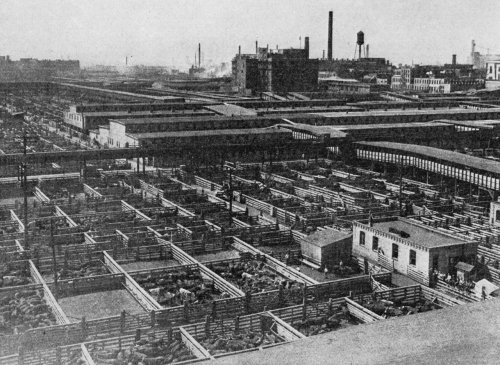
Union Stockyards, Chicago 1920 Pax Canadiensis

One particularly revolting facet of the industry was the use of beef which had developed cysts due to the use of cheap fodder.  Upton wrote

"It seemed that they must have agencies all over the country, to hunt out old and crippled and diseased cattle to be canned.  There were cattle which had been fed on "whisky-malt," the refuse of the breweries, and had become what the men called "steerly" - which means covered with boils.  It was a nasty job killing these, for when you plunged your knife into them they would burst and splash foul-smelling stuff into your face; and wean a man's sleeves were blood, and his hands steeped in it, how was he ever to wipe his face, or to clear his eyes so that he could see? It was stuff such as this that made the 'embalmed beef' that had killed several times as many United States soldiers as all the bullets of the Spaniards, only the army army beef, besides, was not fresh canned, it was old stuff that had been lying for years in the cellars."  As quoted in (Hofstadter, Richard, ed. The Progressive Movement, 1900-1915. New Jersey: Prentice Hall, 1963.)