Showing posts with label propaganda. Show all posts

Wednesday, October 14, 2015

Watch the Bee Go Get The Hun - Patriotic Sheet Music

Sheet music is a fascinating avenue into historical culture, and the patriotic jingles of the First World War are no exception.  Songs such as "Pack up your troubles in your old kit bag", or "A Long Way Tipperary", immediately bring that conflict to mind.  The Sheridan Libraries Special Collections at Johns Hopkins University features a vast collection of digitized sheet music for research and enjoyment in  "The Lester S. Levy Sheet Music Collection".  Clicking the World War I subject category yields 574 items, including popular soldiers' tunes such as "Hinky Dinky Parlay Voo?", patriotic odes to President Wilson and General Pershing, and a number of titles featuring belligerent threats aimed at the German enemy.

One of these belligerent numbers is the oddly titled, "Watch the Bee Go Get the Hun" whose cover features the familiar mustachioed caricature of Kaiser Wilhelm, subject to on onslaught of American soldier-bees, guided by the lamp of lady liberty!  The song was penned by Walter Hawley, and published in New York in 1918.


The lyrics of the song are as follows:

There's a beehive in America they call the U.S.A., And is far from 'over there'.
There's a hundred million busy bees a buzzing night and day, And they will soon be over there.
Uncle Sam is spending money so the bees can get the honey.
It's up to you to see them through the thickest of the fray.

Just watch the bee go get the Hun,
And bye and bye you'll see them run,
We're sending swarms and swarms of bees,
far across the deep blue seas,
To buzz around that big long distant gun.

So help the bee to get the Hun, Stamp U.S.A. on every one.,
And the Germans will be wiser when our Bees have stung the Kaiser,

Watch the bees go get the Hun.
Just Watch the Hun.

There are busy bees at Washington as busy as can be,
Preparing plans for 'over there'
And every bee throughout the land is watching anxiously
The bees who've landed over there.

The grand old Bell is ringing,
And our bees have started singing.
Their sting will win, good-bye Berlin,
it's all off Germany.

Just watch the bee go get the Hun,
And bye and bye you'll see them run,
We're sending swarms and swarms of bees far across the deep blue seas,
To buzz around that big long distant gun.

Our busy bees will get the Hun
With Kaiser Bill we'll have some fun,
To our bee-hive we will bring him so our little bees can sting him,

Watch the bees go get the hun.
Just Watch the hun.

It seems the bees here are variously ammunition, soldiers and civil servants.  It's a very busy metaphor! Why one would want to bring the Kaiser to the American bee-hive for a stinging when millions of bees are flying overseas is also a mystery.  Fortunately, Phonofile's youtube channel features a phonograph cylinder recording of "Watch the bee go get the Hun", so you can sing along at home.  All together now!


Saturday, March 10, 2012

German-American Hordes, 1914

One of the sordid aspects of Canadian social reform in the early years of the twentieth-century was the nativist sentiment which resisted non-white-anglo-saxon-protestant attempts to share in the prosperity of the era.  The Chinese head-tax, and the repulsion of a boat-load of Indians from the Pacific coast are two of the more notorious instances of racism during the period.  Racism was not confined to the "non-White races", however, and Europeans were also discriminated against.  With the advent of the First World War, Germans and Austrians would receive their share of racist ire, having their shops vandalized, being socially ostracized, and in some cases being interned in "enemy alien" camps.
Large Image
File number: NA-838-8
Title: Fireman attacking effigies of German soldiers, Calgary, Alberta.
Date: [ca. 1914-1918]
 Across the desk of JD Hazen,minister for Marine, Fisheries and Naval Affairs, came one particularly inventive account of the alleged conspiracies of German-Americans.  As Ramsay Cook and Robert Craig Brown noted in A Nation Transformed (1972, p.224), anti-German rhetoric could become quite fanciful:

"The Germans all over the United States are holding meetings, their intentions are to invade Canada on the lines of the Fenian Raid...Their headquarters is Milwaukee.  They are getting all the automobiles they can possibly get without causing suspicion; they intend to muster 150,000 men along the border and invade in three or four places, destroy the canals, the railroads and grain elevators; their plans are for inland invasion; they have plenty of money behind this."

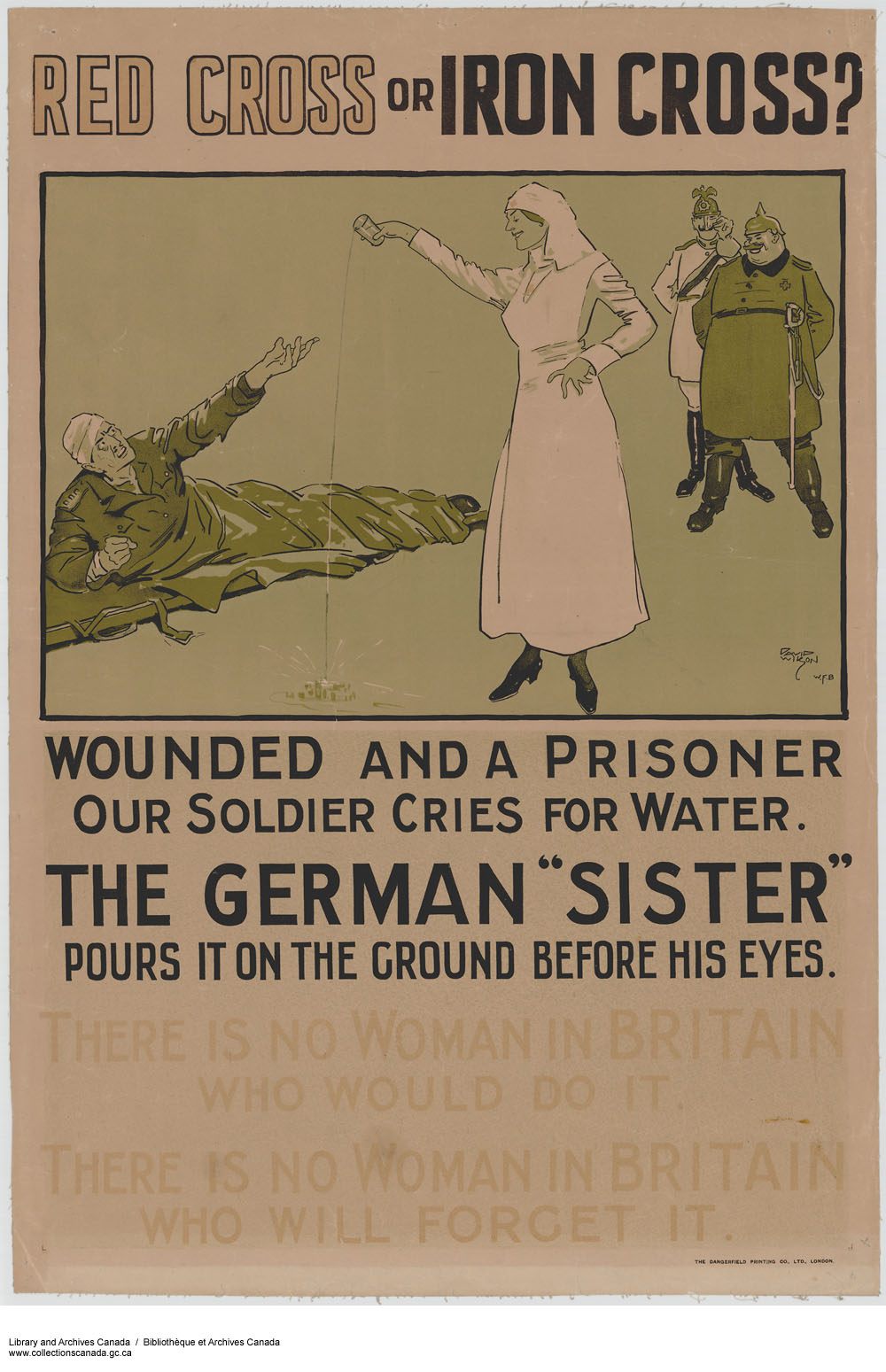
British Propaganda Poster. Credit: Library and Archives Canada, Acc. No. 1983-28-38

Sunday, January 1, 2012

Military Propaganda and New Year's Expectations

All soft-caps and no steel-helmets
 in this British Recruitment Poster, 1915.
Credit: Library and Archives Canada,
Acc. No. 1983-28-1325
New Year's is a time for considering the past and projecting high hopes for the coming year.  In times of war, military powers have hoped to channel these sentiments of personal improvement to rally citizens to their militant duties.  A British Great War poster features an army of soldiers marching to victory in 1915.  Historical hindsight offers a grim reality-check to these optimistic hopes for the glowing rays of victory in the first year of the Great War.

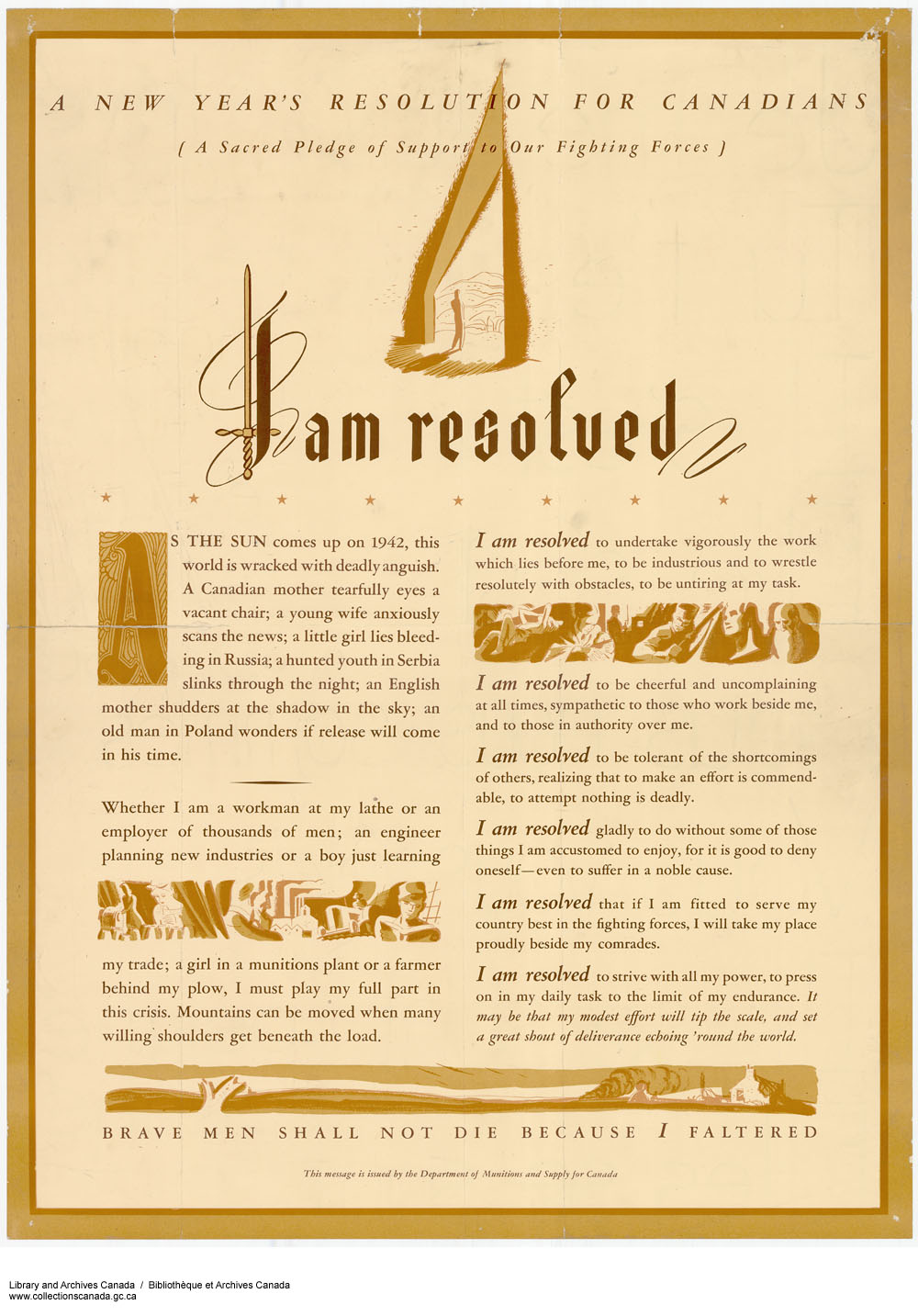
With the coming of 1942, Canada's Department of Munitions and Supply opted for a more emotional appeal in hopes to channel New Year's resolutions.  Canada's broad mobilization for war in the previous year and a half is evident, as a limited liability strategy turned into a full-scale war effort.  The text-heavy poster is clearly aimed at increasing efforts on the home front to back the attack, yet includes a phrase imploring those best fit for military service to serve in the armed forces.

"I will resolve that if I am fitted to serve my country in the armed forces. I will take my place proudly beside my comrades."

Credit: Library and Archives Canada, Acc. No. R1300-262
German propagandists were not immune to tapping the celebratory expectations of the bombastic New Year's eve party.  Directed at American soldiers in Italy, one leaflet depicts decadent New York capitalists partying in luxury.  Targeting soldiers in the frigid conditions of January 1945, the leaflet attempts to raise memories of better times and evoke suspicions of war profiteering, while lowering morale on the front.  The broad expectations of New Year's parties and resolutions, it seems, have proven to be common themes in attempts to influence the public's militant resolve.

Hoping to drive a wedge between the homefront and the battlefield, the German pamphlet depicted a raucous orgy of heartless capitalism "THEY know what you are fighting for when they pocket their huge profits and big paychecks." Tapping in to the seasonal urge to ponder the future, the ultimate  anxieties of the soldier were exploited.

"What has the new year in store for you?
Will you die on the battlefield?
Will you be maimed or blinded?
Who knows?"    


New year's celebrations date back to the Romans.  Perhaps they too used military propagandaTheir large arena displays were one way they could use display to seek allegiance from the masses.  It seems, however, the expansion of print media made attempts to spread the a militant message easier. Glossy posters and the ability to bombard the enemy with paper messages spread material quickly throughout the target population.  The effectiveness of propaganda in any era is a contentious topic, but the concentrated resources forwarded to the efforts of those such as Joseph Goebbels, or on a smaller scale, John Grierson, of Canada's Department of Wartime Information, point to the Second World War as the high watermark of global propaganda.  Arguably, the introduction of the film reel changed the nature of propaganda, as the experiential effect of movies and newsreels drew participants to the medium's message.

Thursday, April 21, 2011

Conscripting Youth: Children and the Posters of the Great War

Advertisers know that children can sell just about anything.  A grinning cherub armed with an endearing catch-phrase is often used to melt our hearts and open our pocketbooks.  It is no surprise, then, that during the Great War, images of children were conscripted to promote the war effort in many Allied countries.  It was not just the cute appeal of the innocent child, however, that was used to drum up money for war bonds or recruit men to the regiments. In many cases, the strong social bonds of family expectations were used to put pressure on citizens as family members.

As this British poster of the melancholy man shows, fathers were targeted by posters which hoped to recruit men to to the ranks.  Here it is the social pressure of participating in the major event of the generation that is used to coerce fathers into enlistment.  The girl on his knee points to a history book and inquires what her father's role was in this epic adventure.  One can only imagine the shame that the son may have endured in learning his father had stayed at home, missing out on the derring-do of the living-room floor campaigns of his heroic toy soldiers.

Compassion for children as family members was often used to attempt to convince citizens to contribute to war bonds.  A poster sponsored by Curtiss Airplanes has a child praying for a brother overseas.  The consoling mother in this domestic scene helps the youth send hopeful prayers for their soldier's safe return.  The strong coloured vertical lines from the American flag's bars are contrasted with the soft oval portrait.  In a case of patriotic product placement, in lieu of the flag's stars, the Curtis company has inserted its own biplanes.  If only the reader contributes to war savings stamps, the idyllic family will be reunited.
Children were also used symbolically as the youth of a nation. The national siblings of Australia and England are here portrayed as innocent friends with hands clasped.  The clean-handed childhood chums, clad in angelic white over the vibrant yellow seem to suggest that by contributing to the war effort, one would be on the side of purity and right.  Again it is the family member away at war that is used to implore contributions from the public.  Here the message is more explicitly aggressive.  Instead of focussing on bringing the family together again, in this case War loan bonds will help "daddy" win the war.


Children as targets themselves were used by the Red Cross to encourage contributions to their humanitarian efforts.  Here a stoic yet compassionate nurse looms over the destitute French orphans.  The drab outfits of the French citizens and the deep orange of the fire-wracked city are offset by the vulnerability of the infant's pink attire. Again the concept of family is used in the emphasis of motherless and fatherless suffering.


Library and Archives Canada has a vast online archive of war posters, from which all the above images came.

Friday, March 18, 2011

Italian Campaign War Diary Snippets

*********************************************************

R.T. Currelly, "Report on Operations of 12 CAR (TRR) for the period 1 Apr to 6 May 44...", 1 Canadian Field Historical Section, Directorate of History and Heritage, 31 July 1944, 4.

"Cassino was like a ghost town. It is completly demolished. The jagged remains of the house walls stand up stark and white like bleached bones in a desert and there is not a tree or a bush that is still alive. At night the enemy would emit weird bloodcurdling cries like the call of wild animals. The eerie silence which normally prevailed was periodically shattered by the scream and crash of an incoming salvo of shells. The whole atmosphere was most death-like, and was by no means improved by the pervading stench of rotting corpses in the rubble of the shattered buildings."

*********************************************************

6 British Armoured Division, 1 June 1944

From captured document of 1 German Parachute Division written by General Heidrich.

"(a) Elimination of the word "catastrophe". In accordance with the directive of the Ministry of Popular Enlightenment the word "catastrophe" is to be eradicated from general usage. The word "catastrophe" will be replaced by the phrase "circumstance of great peril" and the phrase "catastrophic action" by the phrase "air-raid action".

*********************************************************
4th British Division, 25 June 1944

"3. Manners Makyth Man
It has come to light that one of our patrols located a German position yesterday by a singular chance. The patrol was passing along a track when a rude and quite unmistakable sound was heard. On stealthy investigation, a German was found, and when he endeavoured to warn his comrades, was shot at point-blank range. Had he been able to restrain his bestial impulse, he might be living."

***********************************************************

Kensingtons Regimental News, May 1944
"A.T.S. girls are now warned to look before they Jeep and so avoid being Yanked into maternity."

***********************************************************

138th Field Regiment RA War Diary 20th May 1944

"A lull in the fighting. Three objects for the day: 1. To kill Boche; 2. to calibrate the guns in order to kill Boche in the future; 3. to kill more Boche."

***********************************************************

75th Heavy Field Regiment RA War Diary

2 May 1944
"At 0830 hrs O.P. on M. Trocchio reported Swastika Flag flying on top of Hangman's Hill (pt 435). After Airburst practice by 504 Bty at 1230 hrs an ambulance was observed proceeding to tgt area."

17 May 1944
"At 1020 a report was recieved that the enemy in the Monastery had put up the white flag but subsequently fired on the Polish Infantry. The Poles said they would take no more prisoners."

***********************************************************
17th Heavy Field Regiment RA War Diary
12 May 1944

2306hrs "Barrage reported to have shaken a bottle of beer off the table in 228 Bty Comand Post - broken."

***********************************************************
66th Medium Field Regiment RA War Diary
15th May 1944

- 1045hrs "B.O.P reports 'enemy recce cavalry in our area. Am prepared to use own armament if necessary' later reported to be 2 enemy on mules who gave themselves up."

****************************************************************
17th Medium Field Regiment RA War Diary
17th May 1944

1230hrs "Corps artillery fired on MONASTERY - still in German hands - enemy had shown white flag and then machine gunned, Polish infantry as they emerged form cover. Incidient reported of wounded paratrooper stabbing Polish medical orderly in an A.D.S as he tended another casualty."

*****************************************************************

259th Field Company Royal Engineers War Diary

1430hrs "O.C., Lt Price to recce bridge site. They swam the river and recced far approach without any trouble, which they were not in a position to combat anyway, having no clothes."
*****************************************************************
German Propaganda Leaflets
Roosevelt the Reaper