Norman Dixon's On the Psychology of Military Incompetence(London: 1984, 1976), serves as an apologetic for historical British military stupidity. Instead of a simple lack of intelligence, the blunders of the military past are shown to be the product of authoritarian personalities, torn between their conscience and a pathological need for aggression. Dixon doesn't have much good to say of the military profession, nor of military institutions. He notes that the armed services are a place where anti-intellectualism reigns supreme, and where aggression, order, and obedience attract authoritarians. Perhaps apologetic was the wrong word? Dixon suggests that strategic mistakes were made, not due to a lack of intelligence, but due to the military environment fostering unstable authoritarian personalities.
A Freudian analysis typifies much of the work, which at points emphasizes the anxieties surrounding sex, elimination, eating, and death. Perhaps his most quotable passage, comes in analysis of the soldierly profession as a "instinctive" one.
Broadly speaking, human activities may be regarded as falling into one of the other of two main groups: those which are directly instinctual and those which are not. Into the first, which involves what have been succinctly described as the 'three Fs' - feeding, fighting, and 'reproduction' - fall such robust pastimes as pugilism, professional pie-eating, prostitution, and soldiering. Into the second group fall all those other vocations which, though sometimes subserving the basic drives, do not have as their end-product the original consummatory response. (Dixon, p.169-170)
A recent edited volume of primary documents, Combat Stress in the 20th Century is an excellent addition to the literature on psychiatry at war. Editors Terry Copp and Mark Humphries have selected a broad range of articles from medical journals, archived reports, and accounts by medical officers and laymen alike which show the development (or some would say lack thereof) of military thought on mental breakdown and treatment in the commonwealth armies.
For those of more eccentric historical taste (you've come to the right place!), there are plenty of accounts of the more extreme sides of the subject, including electroshock therapy, barbituate sedation, or insulin shock therapy. On the scale of strange, however, it is hard to top the account of FM Richardson's competitive health preservation. It seems that to remove the risk of malaria and the sheer annoyance of the omnipresent fly, all Second World War British officers needed to do was start counting:
In a camp in Sudan where fly infestation was very bad and made life intolerable despite intensification of all the usual measures and the efforts of a strong daily fly-swatting patrol almost unbelievable results were achieved in little over a month by a fly-killing competition. The unit was divided by tents and other convenient groups into teams of ten to twelve men and a running total of the number of flies killed by each team was published weekly. A standard tin of which the fly content was known was kept by the G.M. Havildar to whom the teams brought their daily bag to be counted, recorded and burned. The results soon became apparent and it was not long before the 100,000 mark was passed. The I.H.C. sepoy would do a lot for a few rupees and a good curry bat, and enthusiasm soon rose so high that the best hunting grounds had to be allotted on an official programme like the blocks in a shooting jungle. Finally the few remaining flies were being stalked by the more resolute competitors and one could see none where recently they had been swarming.
Allied Advances in the East African Campaign. Image by historicair
This may all sound rather ridiculous but I was later discussing it with a man who had lived in Rumania, where, he said, flies had been innumerable. A similar competition on a village basis for big money prizes was organized by the Government, and the results, he assured me, were so remarkable that flies virtually disappeared from the country and the disposal of the rubbish which the flies would have eaten became quite a problem. I accept no responsibility for this statement which may have been merely a dramatic way of emphasizing the success of the scheme, but it is a stimulating thought for medical entomologists. (FM Richardson, "Competitive Health Preservation in the Army", text of a presentation at the USAREUR and Seventh Army Medical Surgical Conference at Garmisch, Germany, 18 May 1981.)
Richardson is best known for his work Fighting Spirit which is a socio-psychological look at men in combat. He suggested applying the health competition to battle exhaustion cases. This seems like a questionable cure for the malady. If soldiers took the competition seriously, and paid attention to the publicized battle exhaustion rates of various competing units and formations, they would condemn those with symptoms of breakdown. Hence, it is more likely that those suffering from combat stress would be under even more pressure from their peers, complicating their malady further. In consideration of how important acceptance by the group is to soldiers, letting their unit down further in the competition may have increased their shame, reducing the already low chances of rehabilitation and return to unit.
The old myth of the Boer War as one of the last gentlemanly wars, tied to romantic visions of honourable combatant knights, has long been revised and retired. The conflict had no lack of ferocity and destruction, and the line between combatants and non-combatants was very much blurred. The guerilla tactics of Boer commandos from 1900 posed a serious difficulty to the British Army. Attempts to curb the mobility of small groups of mounted riflemen included the use of blockhouses and barbed wire, with mobile columns attempting to press the Boers towards these defences. Ian Beckett notes in Modern Insurgencies and Counterinsurgencies(2001) that a more controversial method was the establishment of “concentration camps”, the destruction of houses and crops and the removal of livestock.
After the fall of Bloemfontein in the spring of 1900, Field Marshal Lord Roberts had ordered the protection of Boer property and allowed Boers considered loyal to return to their homes. After guerrillasbegan to emerge in the summer, however, Roberts ordered the destruction of houses close to vulnerable communications infrastructure. Other efforts to detract from guerrilla attacks were collective fines and the compulsion of Boer civilians to ride on trains.
Kitchener
Roberts policies may be deemed moderate. He rescinded less discriminate policies, and ordered the destruction of only those houses which were proven to be used by Boer fighters. From December of 1900, however, Roberts' successor Lord Kitchener extended the internment system to includeboth military prisoners and civilian refugees. Kitchener attempted to remove the entire Boer population from the veld. As he wrote in March 1901, "The refugee camps for women and surrenderedboers [sic] are I am sure doing good work[;] it enables a man to surrender and not lose his stock and movable property . .. The women left in farms give complete intelligence to the boers of all our movements and feed the commandos in their neighbourhood".(Krebs, History Workshop, No. 33, p. 41)
Kitchener’s internment policy was aimed at women as well, who were thought to be key figures in motivating the Boers. Women were originally rounded up to prevent them from spying for the Boers. Yet as Paula Krebs suggests, this motivation was kept quiet, as it would admit that the women were incarcerated due to their military activities. (Krebs, p.42) Liberals and Irish M.P.s had been arguing that those in the camps were prisoners of war, not refugees. In March of 1901, an exchange in the House of Commons evoked the gendered nature of imperialism. Irish M.P. John Dillon asked, "What civilised government ever deported women? Had it come to this, that this Empire was afraid of women."(Krebs, p.42)
Beckett suggests that some women were held hostage to provoke Boer surrenders. Many women and children were condemned to a nomadic existence when their homes were razed. Inside the camps, Boer children were subject to colonial indoctrination. Research by Paul Zietsman notes that education provided in concentration camps attempted to Anglicize Boer children, which shows parallels with colonial aboriginal policies of assimilation behind residential schools. These policies invoked further political controversy back in Britain, especially when poor management of the camps led to the deaths of nearly one quarter of the 116,000 civilians detained. When camp tents began to be populated by women and children, Britain, and especially British women, were alerted to a potential cause. After the uproar regarding the camps, Kitchener still claimed that their functional value outweighed the dissent. In 1901, Kitchener claimed, "I wish I couldget rid of these camps but it is the only way to settle the country andenable the men to leave their commandos and come in to their familieswithout being caught and tried for desertion." (Krebs, p.43)
Typical group of Boer farmers at "Compensation" claims tent after war.Rodolphe Lemieux / Library and Archives Canada 1902-1903.
The success of these efforts is still debated among military historians. It would not be the last time that the tactics of counterinsurgency led to political turmoil domestically. Curiously, the tactic of burning farms was not as controversial as the camps themselves. By May of 1902, somewhere in the range of 30,000 homes had been razed along with many acres of crops. Larry Addington noted that Kitchener's tactics were very "un-Victorian", and observes the "systematic sweeps through Boer country foreshadowed American 'Search and Destroy' tactics during the Vietnam War nearly seventy years later." (Addington, Patterns of War since the Eighteenth Century, p.124). Death rates are a matter of some debate, but figures of 25,000 Boer deaths, along with 12,000 black Africans. The conflicts' brutal policy against non-combatants and domestic outrage at the harder facets of suppresion, resonate with students of twentieth-century counterinsurgency.
The phenomenon of the Great War drag show is somewhat perplexing. Some argue that soldiers were not just laughing at the gender-bending performances but were actually aroused by the shows. A broad array of explanations are offered for the cross-dressing phenomenon, ranging from desires for the portrayal of normalized femininity, to sublimation of homosexuality.
'The Dumbells' Concert Party. Formed from 3rd Canadian Division in France. 'Marjorie' (R.D. Hamilton), and 'Marie' (A.G. Murray), the two girls of the Dumbells show, with the manager, Captain M.W. Plunkett, Credit: Canada. Dept. of National Defence/Library and Archives Canada/
JG Fuller'sTroop Morale(Oxford, 1990), notes the importance of music shows to the soldiers when they were at rest, and among these theatrical revues, drag shows were fairly common. Analyzing a broad range of soldiers' journals, Fuller writes that , "curiously these female impersonators seem to have generated considerable sexual excitement. He quotes one of the men in the ranks as claiming, "judging from the way [the men] sat and goggled at the drag on stage it was obvious that they were indulging in delightful fantasies that brought to them substantial memories of the girls they had left behind them in London, Manchester, Glasgow, wherever." (As cited in Fuller, p.105) Apparently, many impersonators did not make a caricature of their roles, but played their parts with candour. Fuller notes that many journals accounted for the realism of the concert party "girls". One soldier wrote that, "it all seems to show that English beauty is essentially masculine." Fuller is more critical of the illusion: "judging from the photographs, it shows the intensity of the desire to believe." (p. 106)
Big Beauty Chorus, Marie and the Boys. Dumbells troupe. Library and Archives Canada. PA-005741
Fuller wonders why this desire to believe in the gender-bending charade was so strong with the relative ease of access to women in the rear areas. It is true that after the spring of 1917, troops may have gone for weeks without seeing a woman in the farms, hospitals, shops and estaminets. Yet, Fuller suggests that the appeal of the entertainers was likely, "their emphasis put on glamour [not] the sheer fewness of females." He notes that "peasant girls, working hard at practical tasks with their menfolk away, were often the reverse of 'feminine' in the restricted sense of the age." A quote from an Australian journal lamented, "Women of shattered Picardy, Why are your boots so flat and vast?" Of this desire for fancy femininity, Fuller writes
The trappings of elegance and luxury were the negation of war and squalor and, as such, a potent fetish of peace. The female impersonators therefore took care over the fripperies, having lingerie sent out, or going on special leave to London or Paris to select the items themselves. On stage they sang the sentimental songs which represented the greatest frippery of all, asserting the idealized stereotype of soft and vulnerable romantic femininity. (Fuller, p.106)
Historian David A Boxwell, in his article "The Follies of War: Cross-Dressing and Popular Theatre on the British Front Lines, 1914-1918" Modernism/Modernity 9.1 (2002) 1-20, disagrees with the thesis that drag performance was strictly a desire for idealized heterosexual relations. He identifies two forms of female impersonation which had already developed on British stages by 1914. He notes that, "Mimicry was most visibly embodied in the pantomime "dame" tradition, a comedic effort to render the female form in its most hypercarnivalized manner: the grotesque, oversized, and voracious body of the raddled, "ugly" woman presented on stage out of a misogynistic animus" (Boxwell, p. 13). The other form of impersonation was mimesis, which historians have traced back to the 1860s. Mimesis represented "idealized femininity as closely as possible (Boxwell, p. 14).
'The Dumbells' Concert Party. 'Marie' (A.G. Murray)PA-005743
Boxwell argues, "the complex dynamics of men objectifying other men as women does not occur completely within a heterosexual matrix." (Boxwell, p. 16) Boxwell's argument is formed in analysis of the HC Owen quote that, "it all seems to show that English beauty is essentially masculine."
[Owen] may well have intended to define female beauty in masculine terms, to suggest that British women were at their most beautiful when they most looked like men. The slippage that inheres in the statement effectively eradicates women's existence: male beauty not only exists, but cannot be conceived of in anything other than "masculine" terms. Thus there was an ineradicable trace of homoeroticism at the heart of drag during the Great War.[...] A man watching another man in drag must, at some level, self-reassuringly avow that the "woman" has a penis. But this act of speculation threatens to put the male spectator beyond the boundaries of the heterosexual matrix. (Boxwell, p. 16)
For Boxwell, enjoying a drag show was a cathartic way of releasing homosexual anxieties in a homophobic society. As may be expected, other historians disagree.
Laurel Halladay, in "A Lovely War: Male to Female Cross-Dressing and Canadian Military Entertainment in World War II Journal of Homosexuality Volume 46, Issue 3-4, 2004 traces drag performances in the Canadian military, and identified in the Great War period, an attempt to reconstruct a heterosexual community. (Hallady, p. 21) For Hallady, drag performance was either comedic or dramatic, either mocking perceived female foibles or respecting femininity.On the issue of sexualization, Halladay writes that, "Perhaps contrary to more modern expectations, drag performerswere not the least bit threatening to the taken-for-granted heterosexual practices of their comrades and both contributed to and enjoyed the homosociability of the battlefield." (Halladay, p.23) For Halladay, it was only when women were recruited into the Canadian military in the Second World War, that female impersonation was broadly considered deviant.
The debate over the meanings of female impersonators in the First World War is by no means over. How could it be when analyzing the subjective reception of gendered performances by a broad variety of men? The work yet to be written on the complex nuances of drag performance is bound to be exciting historical work, addressing the overlap between social, sexual, and gender history.
From John to Jack, Susannah to Susie, Punch (1916).
Jonathan Fennell’s Combat and Morale in the North African Campaign (2010), traces the complex web of factors which influence military morale. One kernel in this cornucopia is the cult of personality surrounding the high commander. In the case of British and commonwealth troops in the Western Desert, it seems that a certain notorious German commander stole a march on the British.
General Erwin Rommel's charisma still effects the observers of military history, especially due to the popularization of his opposition to George Patton, as portrayed in the 1970 film Patton. Problems arose in 1942, when British troops recognized the charismatic German general over their own commanders. General Claude Auchinleck was an unknown entity to troops under his Middle East Command as long as a year after he took control.
Generalfeldmarshschall Erwin Rommel (1892 - 1944): Rommel at a staff conference in the Western Desert.
Fennell records that Rommel approached “folk hero” status, among troops. One officer wrote during a slow period in the desert that, “there is no news of interest here at the moment except that I have often heard fellows say ‘I wish we had Rommel on our side.’” (Fennell, p. 212) Attempts to confront the Rommel legend by Middle East Command came from the “MEF Weekly Military Newsletter no. 74”. “Axis propaganda had gone to considerable pains to build up the legend of Rommel, one of the aims being to give us a feeling of inferiority in the face of this photogenic General who is supposed to be master of the Libyan desert”.
Auchinleck’s personal reaction betrays his own concerns about the power of his opposition's celebrity. Auchinleck wrote,
“I wish to dispel by all possible means [the idea] that Rommel represents something more than an ordinary German general…The important thing now is that we do not always talk of Rommel when we mean the enemy in Libya. We must refer to “the Germans”, or the “Axis powers”, or “the enemy” and not always keep harping on Rommel…PS. I am not jealous of Rommel.”(Fennell, p. 214, cited from Nigel Hamilton, The Full Monty, p. 544)
It seems that Auchinleck’s best efforts at becoming a military idol were in vain. The situation was reversed with the coming of the flamboyant and press-savvy Montgomery, who “actively pursued publicity and the press limelight and purposely took on the Rommel legend.” (Fennell, p. 214)
As Montgomery wrote after the war:
The Eighth Army consisted in the main of civilians in uniform, not of professional soldiers. And they were, of course, to a man, civilians who read newspapers. It seemed to me that to command such men demanded not only a guiding mind but also a point of focus: or to put it another way, not only a master but a mascot. And I deliberately set about fulfilling this second requirement. It helped, I felt sure, for them to recognize as a person – as an individual – the man who was putting them into battle. To obey an impersonal figure was not enough. They must know who I was. (Fennell, p. 214)
That Montgomery bought in to the cult of Rommel can be gleaned by the questionable honour of naming his dog after the general. The distinction is only heightened by noting the moniker of his other canine comrade: "Hitler". Monty, as against Auchinleck's policies would long personalize the German forces he opposed as "Rommel", and emphasized that he knew the "Desert Fox" better than anyone else.
Fennell does acknowledge Montgomery's success in becoming part mascot, claiming that he was the first British celebrity general, with the possible exception of Kitchener. (Fennel, p.5) It appears at least one prominent military historian disagrees with awarding full celebrity status to any British general. Writing in the 1970s in his pivotal work Face of Battle, John Keegan suggests that Robert E. Lee was "the only cult general in the English-speaking world". (Keegan, 1976, p. 54) So much for Kitchener of Khartoum and Montgomery of Alamein! It seems that at least honorable mention is due to the Duke of Wellington, or even Sir Garnet Wolseley, whose name was incorporated in the British soldiers' pantheon of slang as synonymous with doing all right. In overcoming the cult of Rommel, however, it appears that things were not "all Sir Garnet" for the desert generals!
A soldier's morale is contingent upon numerous factors. He may just need a hot mug of tea to cheer him up, or perhaps some bacon and oatmeal to replace his bully beef breakfast. Most take support from their primary group, the men of their immediate working environment, whose esteem is critical to their emotional well-being. Some may seize a greater ideology to keep them satisfied with their place in the greater war machine. Nearly all soldiers keep some connection with their loved ones in distant communities. Mail from home could be the greatest morale booster for men in far-flung and isolated theatres.
Mail being unloaded from an Army Post Office lorry in the Western Desert, 16 July 1941.
Jonathan Fennell's Combat and Morale in the North African Campaign (2010) examines the many factors effecting the rise of the British Eighth Army's morale as the pivotal battle of El Alamein approached in the fall of 1942. Fennell writes, "it was not just the arrival of the mail that was important but also the contents of the written correspondence, with all that this entailed in regard to relationships and family affairs.
As it was pithily put by one officer, 'the two main factors affecting morale of the soldier overseas are the mail and the female.'" (Fennell, p. 165) Historians have noted that the long build-up of Canadian troops in England had a negative effect on the morale of Canadian citizens and soldiers alike. It appears, due to the Canadians' amorous assault on the island nation, that a reciprocal decline of morale was experienced by British troops in the Western Desert. One officer wrote in September 1941, of his soldiers' perceptions of the Canadians in England:
The boys are getting very scared of the Canadians upsetting their domestic life at home. We have three instances of it in this unit during the last month. It started when I got a letter addressed to the O.C. Would I be good enough to inform Pte. X that his wife was an expectant mother and had gone to live with another man...Poor chap...He couldn't speak for three days. Since then two more have had letters breaking off engagements. What with that and the delay in the mail, the whole crowd are worried to death. (Fennel, p.165, from "British Troops in Egypt no. 100 Field Censorship Report Week Ending 23 September 1941, p.4, AWM 54 883/2/97)
Fennell notes that by January 1942, censorship summaries recorded a "hysterical pandemic of worry and jealousy among the troops in the desert". That summer, one soldier wrote to his wife, "I tell you what our tent is called now, love, it is called the 'Jilted Lovers Tent,' because there are four chaps in this tent who were engaged, but now their girls have broken it off and in three cases the girls have married Canadians."
The stress over infidelity may have caused physiological distress as well. In April 1942, medical officers noted that disease could be brought on by psychological friction noting "marital infidelity" and "broken homes" as particularly effective in wearing a man down. This stress was linked directly to a decline in morale.
Bing Coughlin cartoon as published in "The Half Million". Allies in War.
One might assume there was nothing the War Office could do to combat such natural feelings arising from dislocation. Fennell notes, however, that the Directorate of Welfare effectively used the Soldiers, Sailors, Airmen and Families Association (SSAFA) as a liaison between soldiers and families, to initiate a reconciliation scheme. SSAFA would visit wives and attempt to ameliorate domestic issues in lieu of withdrawing family allowances, legal action, or divorce. (Fennell, p. 170) Free legal aid was offered in the Middle East for men filing for divorce. SSAFA dealt with sixty known cases and thirty suspected cases of infidelity daily! Fennell suggests that as only 53% of the divorce cases ended in marital dissolution, the efforts of the War Office to soothe anxieties were fruitful.
Mail normally dampened the agony and longing for connection with distant loved ones, but it is clear that when promises were broken, morale could plummet. Men would invest great hope in the life that they would return to after the war, and their partner was central to the sentiments which allowed them to endure the privations of campaigning. In a sense mail could be a double edged sword. While fostering an idealized and romanticized civilian past, mail could just as easily dash these dreams and leave soldiers with nothing but grim combat to look forward to.
There is no beverage as definitively English as tea. In the harsh environment of the Sahara Desert during the Second World War, the comfort of a warm cup of tea was supremely important to the soldiers of the British Eighth Army. Tea could make foul water drinkable, and monotonous life bearable. Jonathan Fennell noted in Combat and Morale in the North African Campaign (2010), that tea was one of the few pleasures in a theatre where, "the empty days of static warfare could melt into one indefinable consciousness." (Fennell, p.128)
Three shallow open graves containing uniformed bodies. Behind them the burial party are are looking on drinking tea.(Art.IWM ART LD 3035)Ardizzone, Edward Jeffrey Irving
The boring grind of soldiering in the desert was related in the memoir of Len Tutt. Fennell cites a conversation that Tutt had with a fellow member of the 104th Regiment (Essex Yeomonry) Royal Horse Artillery while garrisoned at Tobruk:
'Is it Monday or Tuesday today Dump?'
'I thought it was Thursday,' I answered, 'but I'll look in the log in the Command Post.'
When I returned I said, ' We're well out. It's Saturday'
'Yes. But Saturday of this week or last?' (Fennell, p. 128, as cited from L.E. Tutt "Gentleman Soldier" p. 168.)
While in some theatres of war, foraging or downright pillaging could provide a number of the supplies needed for an army, the desert provided nothing but sand. Demand for water was especially massive. In the days before Operation Crusader, Eighth Army was supplied with 600 tons of water daily from a 147 mile long army-built pipeline. Daily rations were two gallons a day, but there were times when these sunk to two pints per soldier. (Fennell, p. 131-32)
The quality of what little water was provided was poor, further emphasizing the need to flavour it with a "brew-up" of "char", or tea. Tutt noted that it was, "foul stuff to drink in its natural form [and it was] much more satisfying to have as a brew." (Tutt, p. 201, from Fennell, p. 134)Historian John Ellis noted that the use of gas and oil cans to carry the highly chlorinated water was a major factor in its awful taste. Even that water uncontaminated by gas could absorb the interior coating of the containers made of paraffin wax or bitumen and benzine. (Fennell, p. 134 as cited from Ellis, The Sharp End, p. 285.)
Gas was needed for brewing tea as well, and Fennell notes that a battalion could burn a hundred gallons of gas in a day for this purpose. The so-called "Benghazi cooker", was a ration box cut so that a mix of sand and gasoline could be burned in one end and a pot brought to boil on the other. As Fennell notes, "A match thrown from a safe distance was all that was necessary after that. It would burn for half-an-hour with no more attention than an occasional stir with the point of a bayonet. (Fennell, p.136)
Fennell claims that improved morale was critical to the fighting performance of the Eighth Army at the Battle of El Alamein, noting that tea was one of many factors which could play a role in forming personal bonds between the men. Ultimately Fennell argues that the primary group bond between soldiers has been overestimated in the literature and that numerous factors such as: confidence in weapons technology; supply of provisions such as water; the harsh desert environment itself; and better man-management practices in part associated with the coming of Bernard Montgomery, all contributed to Eighth Army's improved morale in the fall of 1942.
Tea itself was part of the industrial quantities of provisions required by British soldiers in all theatres. In 1942, the British government purchased the world's entire tea crop. Stock in Britain climbed to 30 million tons. This is enough tea for approximately 1.5 trillion cups of desert char! In the harsh environment of the desert, tea was a simple pleasure which could alleviate the strains of soldiering. It was more than caffeine addiction that caused one soldier to claim that, "tea had become a drug to us." (Fennell, p. 134, as cited from Tutt, p. 201.)
All soft-caps and no steel-helmets in this British Recruitment Poster, 1915. Credit: Library and Archives Canada, Acc. No. 1983-28-1325
New Year's is a time for considering the past and projecting high hopes for the coming year. In times of war, military powers have hoped to channel these sentiments of personal improvement to rally citizens to their militant duties. A British Great War poster features an army of soldiers marching to victory in 1915. Historical hindsight offers a grim reality-check to these optimistic hopes for the glowing rays of victory in the first year of the Great War.
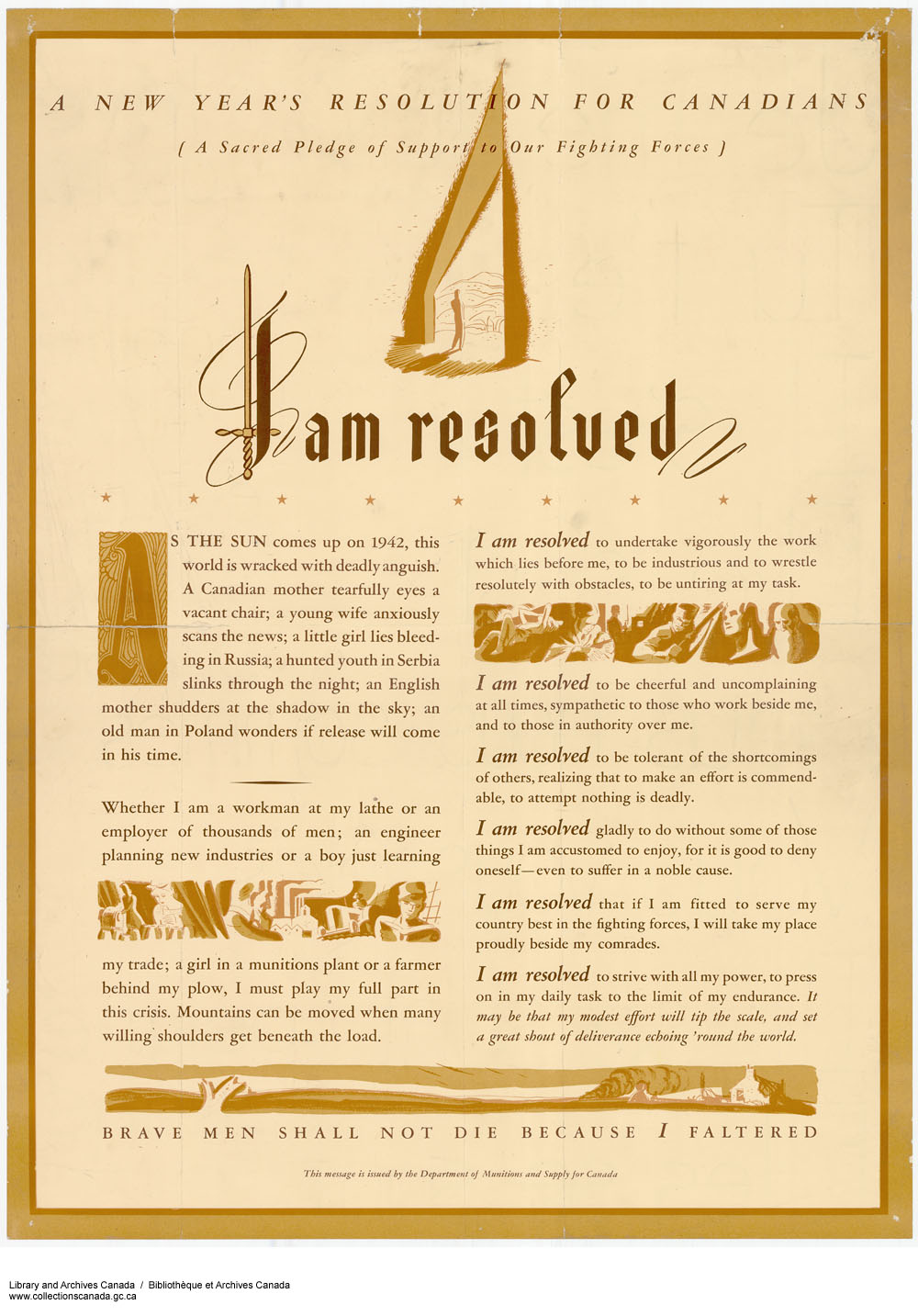
With the coming of 1942, Canada's Department of Munitions and Supply opted for a more emotional appeal in hopes to channel New Year's resolutions. Canada's broad mobilization for war in the previous year and a half is evident, as a limited liability strategy turned into a full-scale war effort. The text-heavy poster is clearly aimed at increasing efforts on the home front to back the attack, yet includes a phrase imploring those best fit for military service to serve in the armed forces.
"I will resolve that if I am fitted to serve my country in the armed forces. I will take my place proudly beside my comrades."
Credit: Library and Archives Canada, Acc. No. R1300-262
German propagandists were not immune to tapping the celebratory expectations of the bombastic New Year's eve party. Directed at American soldiers in Italy, one leaflet depicts decadent New York capitalists partying in luxury. Targeting soldiers in the frigid conditions of January 1945, the leaflet attempts to raise memories of better times and evoke suspicions of war profiteering, while lowering morale on the front. The broad expectations of New Year's parties and resolutions, it seems, have proven to be common themes in attempts to influence the public's militant resolve.
Hoping to drive a wedge between the homefront and the battlefield, the German pamphletdepicted a raucous orgy of heartless capitalism. "THEY know what you are fighting for when they pocket their huge profits and big paychecks."Tapping in tothe seasonal urge to ponderthe future, the ultimate anxieties of the soldier were exploited.
"What has the new year in store for you? Will you die on the battlefield? Will you be maimed or blinded? Who knows?"
New year's celebrations date back to the Romans. Perhaps they too used military propaganda. Their large arena displays were one way they could use display toseek allegiance from the masses. It seems, however, the expansion of print media made attempts to spread the a militant message easier. Glossy posters and the ability to bombard the enemy with paper messagesspread material quickly throughout the target population. The effectiveness of propaganda in any era is a contentious topic, but the concentrated resources forwarded to the efforts of those such as Joseph Goebbels, or on a smaller scale, John Grierson, of Canada's Department of Wartime Information, point to the Second World War as the high watermark of global propaganda. Arguably, the introduction of the film reel changed the nature of propaganda, as the experiential effect of movies and newsreels drew participants to the medium's message.
Library and Archives Canada, Acc. No. 1985-35-8 Copyright: Government of Canada
Venereal disease does not rank very high on the list of valorous ways to become a casualty of war. Nonetheless, VD, a now outdated medical term referring to sexually transmitted infections, left many Second World War soldiers incapacitated and left out of battle. The problem was acute enough in the Sicilian campaign for the officer commanding 2 Canadian Infantry Brigade, Brigadier-General Chris Vokes, to take matters into his own hands. His orders to a young British officer on his staff were to set up an army-run brothel. The women were to be inspected by medical officers and insured as "clean". Soldiers were to be issued with what Vokes referred to in his memoirs as a "French letter", or condom. Unfortunately for Vokes (and lusty Canadian soldiers), the Eighth Army Headquarters caught wind of the scheme, and an order with a very explicit message was distributed:
"THERE WILL BE NO BROTHELS. NO BROTHELS PERIOD. NO BROTHELS OF ANY KIND, OPENED ANYWHERE IN THE EIGHTH ARMY AREA" (Vokes, My Story, 127)
Chris Vokes. Department of National Defence
Reportedly the young British officer, who had the decidedly unmacho nickname of "Taffy", had the house of ill repute completely organized by the time the Eighth Army message arrived. He burst into Vokes' headquarters elated at his achievements.
"Brigadier, we are all set to open tomorrow at ten o'clock. I have never seen so many enthusiastic girls in my life... the madame, and the pimp and the girls...! GEE! And we want you to come down and cut the tape. Everything is organized. Everything is going to be first class!"
Vokes broke the bad news. There was to be no brothel. Taffy was much dejected.
"My God, sir," he said. "Those whores will cut my throat!"
Vokes replied, "Well, perhaps so, Taffy. Before that happens try paying them off."
Reportedly the women, (imported from Catania for the purposes), accepted the offer of 100 Lire each (the madame got 500 and the pimp 300). Poor "Taffy" survived the great brothel incident of 1943 with his neck intact.
The First Anglo-Afghan war proves that regime change can be a bloody affair needing public support to succeed. The struggle with Russia for power in central Asia, known to history as the Great Game, led to the desire for British control over Afghanistan, as a buffer for their power base in India. In 1839, Britain wished to replace Emir Dost Mohammad with a more friendly ruler. In doing so they precipitated revolt. Kabul was taken easily enough in 1840, but with the situation deteriorating, on 6 January 1842 the 4500 soldiers and 12000 camp followers began their retreat to Jalalabad under the command of Major General William Elphinstone. The effects of Afghan raiders on this column were devastating:
Last Stand of the 44th Regiment at Gundamuck, 1842. William Barnes Wollen
"The road was strewn with the mangled corpses of their comrades and the stench of death was in the air - All along the route they had been passing little groups of camp-followers, starving, frostbitten, and many of them in a state of gibbering idiocy. The Afghans, not troubling to kill these stragglers, had simply stripped them and left the cold to do its work and now the poor wretches were huddling together naked in the snow, striving hopelessly to keep warm by the heat of their own bodies. There were women and little children among them, who piteously stretched out their hands for succour ... Later the Afghans were to report with relish that the unhappy fugitives, in their blind instinct to preserve life a little longer, had been reduced to eating the corpses of their fellows. But they all died in the end." Patrick Macory, Signal Catastrophe, p.244.
Only a single man survived the march from Kabul, while several senior officers, including Elphinstone, had been taken prisoner. The words of a Captain Backhouse, a party in the relief force marching back to Kabul against the lines of retreat, portray a grisly scene: "the sight of the remains of the unfortunate Caubul force was fearfully heartrending. They lay in heaps of fifties and hundreds, our gun wheels passing over and crushing the skulls and other bones of our late comrades at almost every yard." (Dixon, Psychology of Military Incompetence, 78-79).
 Norman Dixon's On the Psychology of Military Incompetence (London: 1984, 1976), serves as an apologetic for historical British military stupidity. Instead of a simple lack of intelligence, the blunders of the military past are shown to be the product of authoritarian personalities, torn between their conscience and a pathological need for aggression. Dixon doesn't have much good to say of the military profession, nor of military institutions. He notes that the armed services are a place where anti-intellectualism reigns supreme, and where aggression, order, and obedience attract authoritarians. Perhaps apologetic was the wrong word? Dixon suggests that strategic mistakes were made, not due to a lack of intelligence, but due to the military environment fostering unstable authoritarian personalities.