Showing posts with label medicine. Show all posts

Thursday, February 5, 2015

1930s Insulin Shock Therapy - Snippet from the work of Edward Shorter

Ladislas Meduna,, 1955,
 UofIllinois Archives
Before the days of electroconvulsive therapy, experimentation was conducted in the interwar years inducing convulsions in schizophrenic patients.  In the late 1920s, Polish psychiatrist Manfred J. Sakel had experimented with insulin coma therapy for use on schizophrenics and others.  Camphor was one drug that was used, but it was found unreliable in its reactions, and patients reported great feelings of anxiety before the fits, not to mention the drug's tendency to induce vomiting. Metrazol, or Cardiazal was discovered by Ladislas von Meduna to be a superior drug to induce therapeutic seizure.

Before the 1930s, it was largely sedatives and hypnotics that were being used on psychiatric patients, with opiates and barbiturates coming to the fore in the nineteenth and twentieth centuries respectively.  If one counts laxatives as drugs, evidence exists for their use as psychiatric treatment as far back as the middle ages, and one could likely find similar uses in ancient times.  While we might like to think of Prozac as a revolutionary change in mental health treatment, it certainly had its forebears.  

Insulin shock therapy is given in
 Lapinlahti Hospital, Helsinki in 1950's
In the 1930s there were brief experiments with convulsive drug treatments, before these were swept away by the tide of electroconvulsive therapy.  Ladislas von Meduna was a Budapest psychiatrist who in 1934 was breaking ground in the use of insulin induced comas for the treatment of schizophrenia.  Seizures were an occasional side-effect of insulin comas, and some psychiatrists thought these were therapeutic, and induced them using cardiazol or camphor.  An account of one of Meduna's early patients gives an idea of the gap between the sanitized official record and the lived experience of the patient.  Meduna noted of his thirty-three-year-old patient that he had been committed to the Budapest State Hospital in 1930 on the basis of his delusions and hallucinations.  He had reportedly spent 1933 hidden under his bedcovers, and in January 1934, he had stopped eating.

Meduna administered camphor, and 45 minutes later the patient had his first seizure.  In the next couple of weeks, he would have five more injections.  Meduna reported:

 On the morning of February 10, the patient spontaneously arises from bed, is lively, speaks, and asks for something to eat.  He is interested in everything going on about him, asks about his illness and realizes that he has been sick.  He asks how long he has been in the hospital, and as we tell him that he has already been there four years he cannot believe it. (Shorter, 214-217)

Edward Shorter’s work A History of Psychiatry: From the Era of the Asylum to the Age of Prozac (New York: 1997) relays the after-effects of the treatment:


In reality, the patient felt so good that he escaped from the institution, went home, ‘and found out that the cousin living with his wife was not a relation at all but his wife’s lover.  He beat up the cousin and kicked him out of the house; proceeded to beat up his wife and told her that he … preferred to live in the state mental hospital where there is peace and honesty.’ (Shorter, 214-217)

Shorter's work argues against the disciples of Foucault who since the 1970s have damned psychiatry as a state tool to incarcerate the disruptive.  Shorter emphasizes that mental illness was real, and could be cured by various biology-based methods.  It is interesting to note, that Meduna's 1934 convulsive shock experiments reported that of 110 patients treated (presumable schizophrenics), half went into remission.  As the above account suggests, "cure" was not always synonymous with completely positive outcomes, and the dangers of inducing seizure and the low vital signs connected to insulin sleep therapy were always clear.

Southern Albertans interested in psychiatry and its history may wish to attend a couple upcoming talks.  Edward Shorter is in Calgary for a few days in early February 2015, and presenting two public talks at the University of Calgary.


The second talk is at 3:30pm. Monday February 9th at the Community Health Sciences department on the third floor of the Teaching Research and Wellness (TRW) building on the University of Calgary's Foothill's campus.  RSVP to Beth Cusitar bcusitar@ucalgary.ca.  The talks is as follows:


“DSM:  The History of a Train Wreck”


Diagnosis in psychiatry was once dominated by the German heavyweights.  After the Second World War, the United States becomes the world champion of psychiatry, and American diagnoses take over, first in the DSM-1 in 1952, then in the revolutionary DSM-3 in 1980, which was a dramatic break from psychoanalysis and offered hope for the diagnostic future.  But buffeted by institutional politics, the demands of patient organizations, pressures from niche marketers within the field, and the profit horizons of the pharmaceutical industry, the diagnostic promise of DSM-3 failed to be realized, and the entire diagnosis machine of DSM has started to run out of control.  We are now at DSM-5 (2013).  There probably will not be a "DSM-6."

Sunday, December 28, 2014

Mental States and Discipline in 3rd Canadian Infantry Division, 1942-43

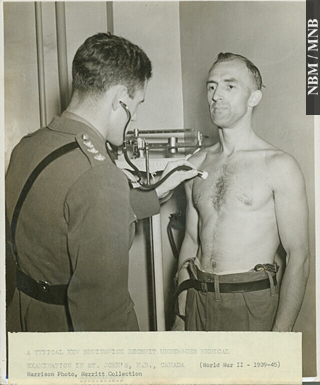
Second World War psychiatric evaluation in the Canadian Army exposes the institution as an modern disciplinary apparatus where the lines between medical evaluation and criminal sentencing are blurred.  A number of medical evaluations in the Army were directly linked to crimes, the most obvious being self-inflicted wounds.  Medical officers were always on the watch for malingering, balancing the age old tension of care for their soldier-patients and supplying the military machine with healthy manpower.  In the 3rd Canadian Infantry Division, a number of letters in February 1943 show how personnel testing and medical evaluation could greatly influence a soldiers' disciplinary outcomes.
3rd Canadian Infantry Division Shoulder Patch http://www.rcasc.com/world_war_ii_1939-1945/3rd_canadian_division_1939-1945

Recruit Undergoes Medical Examination,
 Saint John, New Brunswick - 1939-1945
New Brunswick Museum
Louis Merritt Harrison Collection (1989.83.1165)

Large numbers of men were allowed to enter the army that never should have been enlisted in the first place.  Before the 3rd Division left Nova Scotia, it was estimated that around 10% of personnel needed to be medically boarded and downgraded out of fighting units which demanded high grade personnel.  As the division set sail in July 1941, however, it is clear that this process was not complete.  The medical war diary wrote that "All soldiers not showing definite disability will be categorized A." (3rd Canadian Infantry Division, Assistant Director Medical Services, War Diary, Library and Archives Canada, RG24 Vol. 15,660)
  
More than a year later, men who were not fit for army life remained.  One soldier who had lost his kit and gone away without leave several times was judged in the psychiatric lingo of the day, a "low grade moron".  He was sentenced to serve 21 days detention, but due to the psychiatrist's report, medical officers recommended that he be struck off strength.  The officer commanding a Field Dressing Station wrote, "he seems totally unfit to look after himself."
Maj. TC Gibson, OC 5 Field Dressing station, RCAMC to [...] Cdn Detention Barracks, “F 88716, Pte. Maclean, G.A. – Disciplinary Action”, 3CID ADMS War Diary Appendix, 25 February 1943.

 Other soldiers had mental difficulties and neurological disorders with more grave and violent consequences.  It was not uncommon for epileptics to conceal their symptoms so that they could join the army.  One soldier who appeared to be having a manic episode or seizure had to be forcibly removed from his home.  His wife had called the authorities when the private had been knocking his head on the floor and kitchen sink and pulling handfuls of hair from his head. She had to trick him into believing they were going for a walk, so that provost and ambulance staff could seize him. 

The details of a another tragic case are few, but clearly indicate signs of mental collapse.  Jonathan Scotland has indicated (on the Active History blog) that soldier suicide is an important field hardly explored by historians.  The case of a suicide in the Regina Rifle Regiment in July 1942 shows strong connections between mental instability and suicide in the army.  The verdict of the coroner's report stated, "Death from [Gun Shot Wound] of head by own hand while of temporarily unsound mind."
Capt. RE Ralph, MO, Regina Rifle Regiment to Col. LH Leeson, ADMS 3CID, “REPORT ON FATALITY L28177 Rfn. Gilliland, A.”, 3CID ADMS War Diary, LAC RG24 Vol 15,660, 4 July 1942.

Tapscott, Globe and Mail,
17 December 1941, p. 5


One final case from February 1942 shows a unique example of what today would be called post-traumatic stress disorder.  The soldier in question was serving with the Royal Canadian Army Service Corps, but had come to that service through a tragic mishap at sea.  Private Robert G. Tapscott was originally from Bristol, and had served in the merchant marine until August 1940 when his ship was sunk through enemy action.  With six other survivors, he managed to find a life-boat which went adrift for two months in the South Atlantic.  When they were found by a native of the Bahamas, only Tapscott and another man were alive.  Tapscott subsequently was shipped to Halifax and found his way into one of the 3rd Canadian Infantry Division's petrol supply companies.

After arriving in England, Tapscott overstayed his leave to visit his family in Cardiff, and racked up a series of away without leave charges along with one for theft of an army truck.  His medical examination suggests that he had not recovered from his harrowing experience after the Atlantic sinking.  "He is a very nervous individual and states that he has been so since his experience at sea.  He states that he is afraid of the dark and, especially when he is left alone, this dates back from the time of the sea incident."  Tapscott had problems with his officer commanding, who insisted on putting him on night sentry duty, despite his lingering phobias. 

2001 edition of Two Survived
Interestingly enough, Tapscott's story was turned into a book by Guy Pearce Jones called Two Survived (Macmillan, 1941).  A review of the work in the Globe and Mail of August 23rd 1941 (p.10) wrote, "Tapscott, a stolid type, was plunged into melancholia after his rescue and took far longer to recover."  The book itself highlights other items regarding mental health.  The Globe columnist notes that in the life raft the "mentally deficient cook had gone insane and finally tumbled overboard. Twice Widdicombe and Tapscott had decided to end it all together, but in them the love of life was strong and each time they lowered themselves into the sea they felt so refreshed that they climbed back aboard to struggle further."  Another newspaper account suggested that two other men in the life raft were, "crazed by the heat and thirst, jumped overboard.  They were left with a companion who finally committed suicide by cutting his throat." (Globe and Mail, 14 January 1941, p. 9)

Mental health and discipline,then, were connected in important ways in Canadian Army administration during the Second World War.  While the army had ramped up its attempts to "weed out" formations of those that were considered too mentally unstable, or unintelligent to soldier, the 1942-43 records of the 3rd Canadian Infantry Division, and indeed the later reports of psychiatrists from active theatres of war, show that there were still a number of men in the Canadian Army who, for a variety of reasons, could not handle the strains of army life.  Many of these men would not receive a medical diagnosis, and would be simply recorded as disciplinary statistics, and sent to the detention barracks.  Others would be medically down-graded and sent to a pioneer company which sought to harness their labour away from the stresses of combat.

Wednesday, February 12, 2014

Mediterranean Musings: 5th Canadian Armoured Division Medical Humour

Amidst the quarterly medical returns and operational message logs in the 5th Canadian Armoured Division's medical services war diary, a comic account of the Italian campaign awaits those studying medical aspects of the Canadian Army during the Second World War.  Captain Brian Murphy's "Mediterranean Musings" is a witty reminiscence of his experiences with the No. 13 Canadian Field Dressing Station which acts as a tonic to the otherwise deathly serious account of daily medical operations.

The bulk of the war diary of 5th Canadian Armoured Division's Assistant Director Medical Services is what one would expect from a medical headquarters in the Italian Campaign.  The documents deal mainly with the operations of the field ambulances under its command, and the evacuation and treatment of casualties.  A number of interesting modifications to jeeps and carriers were made to accommodate stretchers to take the wounded from the battlefield, but in no quarter did battle casualties exceed sickness.  Major drains on manpower included infective hepatitis (jaundice), influenza, and venereal disease.  Captain Murphy's "Musings", however, were no treatise on epidemiology, nor a statistical rending of gonorrhea and syphilis rates in the Division.  Instead, Murphy opted for a humorous review of his campaign with the medicals.

Writing from the North-West Europe campaign, in the summer of 1945, Murphy started with a complaint to his editor which devolved into a description of a local Dutch elixir, which had the ability to raise the spirits of those awaiting repatriation.  The "Musings" begin,
Dear Ed;
You said I was becoming morose; you said let's have something gay for a change; and cut it down to a thousand words; you said gaiety is the spice of life and brevity is its container...Please don't ask me to be gay.  But then gaiety can be acquired artificially, so gather round and allow me to pour you a drink of Moose Milk...an old Dutch remedy for rheumatics contracted whilst awaiting transport to Canada.  Incidently the above-mentioned 'Lait de Moose' consists of gin, milk and eggs in proportions depending on whether you wish to stay in your billet and play 'Button, button, who'se got the button', or desire to sally forth and destroy single-handed a town, say of 20,000 inhabitants.  A list of such towns can be obtained by writing to the Moose Milk Dairies.  Only one town allotted per customer.
After this strange aside on the benefits of the local egg nog, Murphy cuts to the chase, but continues charting his alcoholic course, recalling the that the trip to the Italian theatre, code-named Operation TIMBERWOLF, was far from dry.
In September '43, we boarded the Cap Paradan a ship that was decidedly wet, outside and in.  I have never travelled with so many lawyers, everybody seemed to be called to the bar.  Cases weren't defended.  They were opened.  The juries were vicious, they kept yelling "Let's Kill It."
"Finito Signor???", Bing Coughlin, Herbie!, (Nelson: 1946).
After three weeks at sea, the troop transports arrived in Phillippville and the division then started the tedious train trip to Bizerta, which Murphy suggested was an excellent way to develop battle exhaustion symptoms.  The train travelled at 15 miles per hour, and Murphy noted sarcastically that this was, "fast I admit, but this is the modern age." A fire broke out on one of the train cars which set off small arms ammunition and in the insuing chaos locals began looting the train.  Murphy recalled, "a few natives had decided they were in dire need of blankets and boots, and more small arms ammo went off, only this time it was aimed in the general direction of the said culprits."

Once the 5th Division was in Italy, Murphy recalls several interesting tales about interactions between medical officers and Italian civilians.  When it became known that Canadian doctors diagnosed civilians, the line ups resembled those at London fish and chip stands.  Eggs were the usual payments for treatments, which usually involved assuring patients that they could not expect imminent death.  Murphy wrote, "At this realization, Guiseppe's or Maria's face would light up and with shrugging shoulders and clasped hands they would exclaim 'Grazie, grazie Dottore Canadesi buona' (translation: Gracious thanks, as a physician you are not bad.)" Murphy noted if patients were "very impressed by roadside manner", they might welcome the medical officer into their home for a spaghetti meal.   Returning to a familiar theme, he wrote, 
the spaghetti is not good food to get stiff on.  But with said filaments of flour and water, is served wine, of which the Canucks were very fond. Italy was no place for a chap with alcohic [sic] tendencies, water was just a place to wash clothes in.
"Think I'll Have M'Lunch.  Who's got a cork-screw?"
, Bing Coughlin, Herbie!, (Nelson: 1946).
Murphy's account continues to spin humorous yarns of housecalls to remove worms from Italian children, and intimacies in crowded rooms during air raids.  He even coins a term for a new affliction called "airmenorrhea", in which young Italian women mysteriously stop menstruating for months after spending an hour or two in close confines sheltered from bombers.

After a long campaign in Italy, suffering through two wet winters in the mud and snow, it comes as no suprise that Murphy was pleased to leave the theatre.  In closing his account, he wrote, "Christmas came late last year.  In fact it didn't happen until we sailed away from the land of the mud, mountains, mosquitoes and mines...and that was in February."


Captain Brian Murphy's account is found in the June 1945 War Diary of 5th Canadian Armoured Division's ADMS HQ, Library and Archives Canada, Record Group 24, Vol. 15,664.

Saturday, May 18, 2013

The Great Fly-Killing Competition: Sudan 1941

A recent edited volume of primary documents, Combat Stress in the 20th Century is an excellent addition to the literature on psychiatry at war.  Editors Terry Copp and Mark Humphries have selected a broad range of articles from medical journals, archived reports, and accounts by medical officers and laymen alike which show the development (or some would say lack thereof) of military thought on mental breakdown and treatment in the commonwealth armies.

For those of more eccentric historical taste (you've come to the right place!), there are plenty of accounts of the more extreme sides of the subject, including electroshock therapy, barbituate sedation, or insulin shock therapy.  On the scale of strange, however, it is hard to top the account of FM Richardson's competitive health preservation.  It seems that to remove the risk of malaria and the sheer annoyance of the omnipresent fly, all Second World War British officers needed to do was start counting:


In a camp in Sudan where fly infestation was very bad and made life intolerable despite intensification of all the usual measures and the efforts of a strong daily fly-swatting patrol almost unbelievable results were achieved in little over a month by a fly-killing competition.  The unit was divided by tents and other convenient groups into teams of ten to twelve men and a running total of the number of flies killed by each team was published weekly.  A standard tin of which the fly content was known was kept by the G.M. Havildar to whom the teams brought their daily bag to be counted, recorded and burned.  The results soon became apparent and it was not long before the 100,000 mark was passed.  The I.H.C. sepoy would do a lot for a few rupees and a good curry bat, and enthusiasm soon rose so high that the best hunting grounds had to be allotted on an official programme like the blocks in a shooting jungle.  Finally the few remaining flies were being stalked by the more resolute competitors and one could see none where recently they had been swarming.
Allied Advances in the East African Campaign. Image by historicair
 This may all sound rather ridiculous but I was later discussing it with a man who had lived in Rumania, where, he said, flies had been innumerable.  A similar competition on a village basis for big money prizes was organized by the Government, and the results, he assured me, were so remarkable that flies virtually disappeared from the country and the disposal of the rubbish which the flies would have eaten became quite a problem.  I accept no responsibility for this statement which may have been merely a dramatic way of emphasizing the success of the scheme, but it is a stimulating thought for medical entomologists.  (FM Richardson, "Competitive Health Preservation in the Army", text of a presentation at the USAREUR and Seventh Army Medical Surgical Conference at Garmisch, Germany, 18 May 1981.)
In civilian life, cold hard cash was necessary to promote fly-killing! 
 Mansfield Advertiser, Mansfield, Penn., June 24, 1914
via State Library of Pennsylvania via
 Questionable Advice and Advertisements
Richardson is best known for his work Fighting Spirit which is a socio-psychological look at men in combat.  He suggested applying the  health competition to battle exhaustion cases.  This seems like a questionable cure for the malady.  If soldiers took the competition seriously, and paid attention to the publicized battle exhaustion rates of various competing units and formations, they would condemn those with symptoms of breakdown.  Hence, it is more likely that those suffering from combat stress would be under even more pressure from their peers, complicating their malady further.  In consideration of how important acceptance by the group is to soldiers, letting their unit down further in the competition may have increased their shame, reducing the already low chances of rehabilitation and return to unit.

Wednesday, May 15, 2013

The poor to the madhouse, the rich to the spa: Neurasthenia in the 19th Century

The history of mental illness and psychiatry is a fascinating field that is always generating interest.  One would only need to glance at the program for the recent University of Calgary Conference "History of Medicine Days", to find new research on asylums, psychiatric pharmacology, or combat stress.  On this last topic, Terry Copp and Mark Humprhries' 2010 work Combat Stress In the 20th Century: The Commonwealth Perspective, compiles an impressive collection of primary sources from the archives and medical journals which outline the development of an understanding of mental breakdown on the battlefield.  Their introduction to the first chapter, "From Railway Spine to Traumatic Psychosis: Doctors Confront Trauma in the Modern Age, 1865-1918", shows how class and gender affected early thought on mental illness.

In the nineteenth century, public asylums could resemble medieval dungeons more than places of recuperation and rest.  Those committed to them were largely the impoverished, homeless cases deemed unstable and disruptive.  More affluent families with any compassion for a relation would certainly attempt to avoid incarcerating them here.  Instead of diagnosing these patients as insane, doctors would allow them to be classified as having "nerves".  As Copp and Humprhies write, "nerves allowed those with enough money to pay for treatment and a respectable diagnosis to wrap many of the more common mental illnesses in a linguistic cloak thus avoiding the stigmitization of the asylum". (p. 4)
Opening in 1247, London's St Bethlehem Hospital or "Bedlam"
 as it was known was the first dedicated strictly  to those with mental disorders.

Insanity was considered to be inherited, yet nervous disorders were thought to be acquired, and thus these were socially acceptable conditions.  Insanity reflected poor blood, while a nervous disorder may have just been reflective of being in the wrong place at the wrong time.  Psychiatrists, alienists, and neurologists were happy to be able to escape the practices of the asylum, and so by classifying the nervous disorders into neurasthenia, hysteria and traumatic neuroses, they looked forward to private practice with more well-heeled patients.
“Mistress and her maid,” by Jean Louis Forain.
University of Virginia Art Museum.
 http://www.hsl.virginia.edu/historical/reflections/fall2008/rest.html

Neurasthenia was thought to be a loss of nerve substances from the body.  Modernity, with its  railroads, electrification, and mechanization was thought to increase this dissipation of "nerve force".  While veterans of the American civil war were first to diagnosed, medical culture soon began to associate it with those who were on the cutting edge of the latest technologies.  Copp and Humpries record, "...a diagnosis of neurasthenia was often quite fashionable because it indicated that one was engaged with the modern world.  It grew in popularity so quickly that soon the link between veterans and the diagnosis was all but forgotten."  (p. 5)
Charcot demonstrates a case of 'hysteria' c. 1885 
http://www.richardwebster.net/freudandcharcot.html
 

Hysteria was a condition that was hard to distinguish from neurasthenia, and carried negative connotations with its diagnosis.  By the late nineteenth century it had become associated with undue sensitivity, moral weakness, and impulsiveness.  "Although it was similiar clinically to neurasthenia, hysteria resulted from the patient overexciting their own nerves through some specific idea or act.  Masturbation, obsession with romantic relationships, grief, and worry were all thought to unnecessarily tax the nervous system and sap the energies of the patient and, in extreme cases, produce a shock which resulted in the more pronounced hysterical symptoms like paralysis, blindness, and mutism." (p. 5)  With this contrast, it is clear which diagnosis was preferable for the patient!

The authors' note that it was the patient's class and sex that differentiated the two conditions to most doctors.  Patients from the upper class, of course, had "superior moral constitutions" and were less likely to succumb to the temptations which would bring on hysteria.  Women, however, thought to have less willpower and tendencies towards emotional outbursts, were also thought to be at risk.  It appears that wealthy women could turn a doctor's diagnosis in the favourable direction, as "...women of means were often able to find a doctor willing to label them neurasthenic." (p. 6)

Copp and Humprhies emphasize that after the Civil War, nervous disorders were increasingly accepted as a "more benign form of mental illness." They note that it was the pace of modernity that many blamed on the acute manifestation of these disorders:
At the heart of the diagnosis of neurasthenia was the notion that modernity itself was traumatic.  The mechanized, industrial slaughter of the Civil War and the hurdling pace of modern life were symptomatic of the trials and triumphs of the modern age and it was to be expected that man's feeble body would recoil in horror as it was further disconnected from an agrarian, rural past.  In the decades after the Civil War, doctors on both sides of the Atlantic were increasingly faced with victims who suffered from the after-effects of these head-on collisions with modernity. (p. 6)