Showing posts with label Liquor. Show all posts

Wednesday, February 12, 2014

Mediterranean Musings: 5th Canadian Armoured Division Medical Humour

Amidst the quarterly medical returns and operational message logs in the 5th Canadian Armoured Division's medical services war diary, a comic account of the Italian campaign awaits those studying medical aspects of the Canadian Army during the Second World War.  Captain Brian Murphy's "Mediterranean Musings" is a witty reminiscence of his experiences with the No. 13 Canadian Field Dressing Station which acts as a tonic to the otherwise deathly serious account of daily medical operations.

The bulk of the war diary of 5th Canadian Armoured Division's Assistant Director Medical Services is what one would expect from a medical headquarters in the Italian Campaign.  The documents deal mainly with the operations of the field ambulances under its command, and the evacuation and treatment of casualties.  A number of interesting modifications to jeeps and carriers were made to accommodate stretchers to take the wounded from the battlefield, but in no quarter did battle casualties exceed sickness.  Major drains on manpower included infective hepatitis (jaundice), influenza, and venereal disease.  Captain Murphy's "Musings", however, were no treatise on epidemiology, nor a statistical rending of gonorrhea and syphilis rates in the Division.  Instead, Murphy opted for a humorous review of his campaign with the medicals.

Writing from the North-West Europe campaign, in the summer of 1945, Murphy started with a complaint to his editor which devolved into a description of a local Dutch elixir, which had the ability to raise the spirits of those awaiting repatriation.  The "Musings" begin,
Dear Ed;
You said I was becoming morose; you said let's have something gay for a change; and cut it down to a thousand words; you said gaiety is the spice of life and brevity is its container...Please don't ask me to be gay.  But then gaiety can be acquired artificially, so gather round and allow me to pour you a drink of Moose Milk...an old Dutch remedy for rheumatics contracted whilst awaiting transport to Canada.  Incidently the above-mentioned 'Lait de Moose' consists of gin, milk and eggs in proportions depending on whether you wish to stay in your billet and play 'Button, button, who'se got the button', or desire to sally forth and destroy single-handed a town, say of 20,000 inhabitants.  A list of such towns can be obtained by writing to the Moose Milk Dairies.  Only one town allotted per customer.
After this strange aside on the benefits of the local egg nog, Murphy cuts to the chase, but continues charting his alcoholic course, recalling the that the trip to the Italian theatre, code-named Operation TIMBERWOLF, was far from dry.
In September '43, we boarded the Cap Paradan a ship that was decidedly wet, outside and in.  I have never travelled with so many lawyers, everybody seemed to be called to the bar.  Cases weren't defended.  They were opened.  The juries were vicious, they kept yelling "Let's Kill It."
"Finito Signor???", Bing Coughlin, Herbie!, (Nelson: 1946).
After three weeks at sea, the troop transports arrived in Phillippville and the division then started the tedious train trip to Bizerta, which Murphy suggested was an excellent way to develop battle exhaustion symptoms.  The train travelled at 15 miles per hour, and Murphy noted sarcastically that this was, "fast I admit, but this is the modern age." A fire broke out on one of the train cars which set off small arms ammunition and in the insuing chaos locals began looting the train.  Murphy recalled, "a few natives had decided they were in dire need of blankets and boots, and more small arms ammo went off, only this time it was aimed in the general direction of the said culprits."

Once the 5th Division was in Italy, Murphy recalls several interesting tales about interactions between medical officers and Italian civilians.  When it became known that Canadian doctors diagnosed civilians, the line ups resembled those at London fish and chip stands.  Eggs were the usual payments for treatments, which usually involved assuring patients that they could not expect imminent death.  Murphy wrote, "At this realization, Guiseppe's or Maria's face would light up and with shrugging shoulders and clasped hands they would exclaim 'Grazie, grazie Dottore Canadesi buona' (translation: Gracious thanks, as a physician you are not bad.)" Murphy noted if patients were "very impressed by roadside manner", they might welcome the medical officer into their home for a spaghetti meal.   Returning to a familiar theme, he wrote, 
the spaghetti is not good food to get stiff on.  But with said filaments of flour and water, is served wine, of which the Canucks were very fond. Italy was no place for a chap with alcohic [sic] tendencies, water was just a place to wash clothes in.
"Think I'll Have M'Lunch.  Who's got a cork-screw?"
, Bing Coughlin, Herbie!, (Nelson: 1946).
Murphy's account continues to spin humorous yarns of housecalls to remove worms from Italian children, and intimacies in crowded rooms during air raids.  He even coins a term for a new affliction called "airmenorrhea", in which young Italian women mysteriously stop menstruating for months after spending an hour or two in close confines sheltered from bombers.

After a long campaign in Italy, suffering through two wet winters in the mud and snow, it comes as no suprise that Murphy was pleased to leave the theatre.  In closing his account, he wrote, "Christmas came late last year.  In fact it didn't happen until we sailed away from the land of the mud, mountains, mosquitoes and mines...and that was in February."


Captain Brian Murphy's account is found in the June 1945 War Diary of 5th Canadian Armoured Division's ADMS HQ, Library and Archives Canada, Record Group 24, Vol. 15,664.

Monday, March 12, 2012

Medicinal Spirits: Prescribing Liquor during Prohibition, 1919

The patriotic fervour of the Great War was a great impetus to the passing of nation-wide prohibition.  Sir Robert Borden could rely on the notion that the use of grain for alcoholic purposes was a waste of precious war material when he passed the bill against the booze.  At the war's end, it was illegal to import, transport, or create liquor with more than 2.5% alcohol content.
File number: NA-4534-2
Title: Soldier in dispensary, during First World War.
Date: [ca. 1914-1918]
The consumption of liquor for medicinal purposes, however, was perfectly legal during these dry days in the Dominion.  Ramsay Cook and Robert Craig Brown note in A Nation Transformed (1972, p. 301),  the tendency to abuse the stipulation that alcohol could still be used for health purposes.  In 1919, one writer in Vancouver noted:


"Toward Christmas especially it looked as if an epidemic of colds and colics had struck the country like a plague.  In Vancouver queues a mile long could be seen waiting their turn to enter the liquor stores to get prescriptions filled. Hindus, Japanese and Chinese varied the lines of the afflicted of many races.  It was a kaleidoscopic procession waiting in the rain for a replenishment that would drive the chills away; and it was alleged that several doctors needed a little alcoholic liniment to soothe the writer's cramp caused by inditing their signature at two dollars per line."

Interior of Knowlton's Drug Store [15 Hastings Street East] - [ca. 1920] City of Vancouver Archives 99-1338


Friday, March 9, 2012

Modernity Quaffs a Brew, Selkirk Hotel Sign, 1913

The Laurier years in Canada featured the rise of modernity with all the bureacratic, urban,and industrial graft and grit that the word implies.  Ramsay Cook and Robert Craig Brown's classic survey, A Nation Transformed (1972), follows the growth of Canadian institutions in their attempts to catch up with a rapidly transforming society.  By 1921, Canada was as much urban as it was rural, and the bright light of modernity was illuminating innumerable vices in the burgeoning cities.

One rustic young "homesteader's son" was flabbergasted by the tall buildings and electric lights found in Edmonton upon his first visit in 1913.  (Cook and Brown, 100)  As the young hayseed noted:

"The buildings tower over the street two or three storeys high and even brick and stone buildings of six storeys.  Whoever imagined so many buildings, or such variety?  And the signs advertising their owners' business, painted in large letters, some illuminated and all overhanging the street in bewildering confusion, why, they make your head swim!...it was only after dark that the king of the signs stood out in all its glory over the Selkirk Hotel.  This one, done in many lightbulbs, showed by successive combinations a man pouring a glass of beer, lifting it to his lips, and then quaffing the liquor.  If I had seen nothing else in all the city, this would have been enough."

The incredible sign is seen in the top right of this photo from the Glenbow Archives. File number: NC-6-4776Title: Corner of 101st Street and Jasper Avenue showing Selkirk Hotel, Edmonton, Alberta.
Date: 1919

Tuesday, December 21, 2010

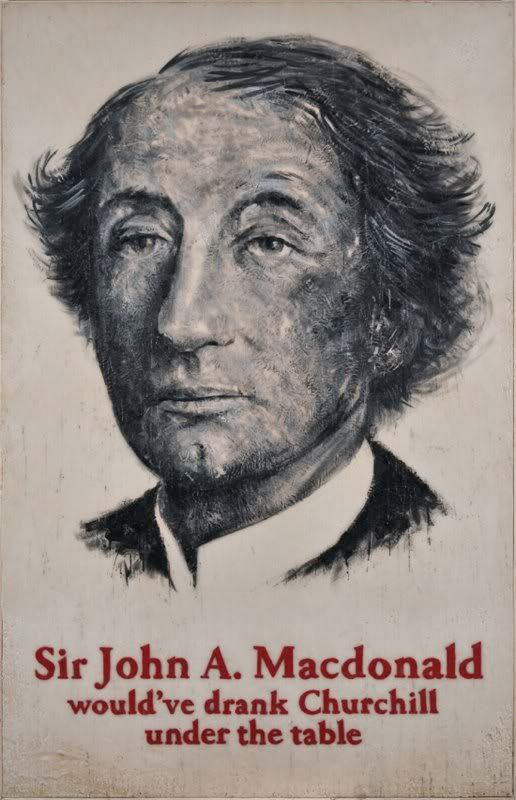
Sir John A. of Ebrius: No Stomach for the Opposition

Another legend of John A. Macdonald's drunken capers has come to my attention through Christoper Moore's 1867: How the Fathers Made a Deal.  It really is a shame that JAM is remembered for his drunkenness, but here I am contributing to such immaturity.

Andrew Hutchinson.
Magpie and WhiskyJack


Moore writes, "Weeks into a progressive drunk, Macdonald once horrified an election crowd by vomiting on the stage when he got up to answer his opponent - and then won them back by saying, 'I don't know how it is, but every time I hear Mr. Jones speak it turns my stomach.'"

Andrew Hutchinson places Macdonald's penchant for the bottle in the context of legendary big-drinkers. In the interesting medium of  encaustic, the colourization of beeswax, Hutchinson has completed a whole series of fun and flippant Canadian historical portraits.  The encaustic paintings are 1 meter wide and nearly 1.5 meters high.  Check out Hutchinson's work at his website.

Thursday, December 16, 2010

John A. Macdonald and the Dancing Bear

Most Canadians when asked to describe something about their first Prime Minister, Sir John A. Macdonald will report that he was a drunk.  It must be admitted that the man had a particular affinity for the bottle, and legendarily was caught clutching his desk for stability during the crisis of the Fenian raids.  It is reported that when delivering a particularly tricky oration in the parliament of the Province of the Canadas, that a number of his supporters, not knowing of each other's efforts, delivered a glass of gin to the speaker, cleverly disguised as a glass of water.  John A. Macdonald (not yet knighted for his service to Britain as architect of confederation) was inspired by the juniper juice and treated his listeners to a rousing speech.  For all these myths of debauchery, however, it seems slightly sad that a man whose later life was so dedicated to the national dream should be primarily remembered for falling off the waggon.

This being said, a recent read of the first volume of Donald Creighton's classic 1956 biography of the PM, The Young Politician provoked a contribution to the legend of JAM's party life.  Apparently Macdonald befriended a young Scotsman by the name of John Rose, living in Montreal in the early 1840s or late 1850s.  The following is Creighton's amazing description of a badly behaving man in his thirties:

http://jswagblog.wordpress.com/
"They were lighthearted and still fairly irresponsible young men who enjoyed life to the full without taking it very seriously; and once, when Macdonald at least was old enough to know better, they went off on an absurd adventure in the United States, and wandered around as travelling showmen, with Rose capering around as a dancing bear, and Macdonald playing some 'rude instrument' in accompaniment."  (Creighton, 243).