Showing posts with label Politicians. Show all posts

Wednesday, January 25, 2012

The Conservatives attack the Siftonian cult, 1905

Clifford Sifton
Nothing compares to the blood lust of a parliamentarian when sensing an opponent's weakness.  In 1905, when Clifford Sifton resigned from the Laurier cabinet, it was thought that the time had come for the Conservative wolves to move in for the kill.  D.J. Hall's biography of Sifton, notes that his position at the helm of the Liberal machine, his penchant for cutting debate, and a questionable record of profits and patronage, meant that Sifton was natural prey for the circling pack.  Without his protection in the cabinet as Minister of the Interior and sensing some loosened bonds to the Liberal party, it was prime time to lunge at the wounded Grit.


In a debate over Sifton's clandestine immigration bureau, the North Atlantic Trading Company (NAT) (an agency which gave bonuses to immigration agents who sent settlers to Canada), the Conservative George E. Foster laid into Sifton's profits and patronage:

"The] Siftonian cult...is a kind of modern Pilgrim's Progress - not to a spiritual but to a material Paradise.  Your novice enters it a pauper - he comes out a millionaire.  He goes in a poor pilgrim, leaning on his staff and with modest garments, he comes out a pampered prince, clad in fine raiment, riding in liveried chariots.  Whiskey permits, Treadgold concessions, claim lifting in the north; land looting, timber, coal scrip, wire fence graft in the middle areas.  Immigration frauds everywhere - crowned by a million dollar contract with a headless, houseless, homeless monstrosity [the NAT Co.], a sort of fugitive maw into which the Siftonians pour Canada's hard earned taxes." (Hall, Clifford Sifton, V.2, p 184)

Ukrainian Language poster from Sifton's North Atlantic Trading Company which advertises 160 free acres of land in Canada.
Despite the best efforts of the Conservatives, Sifton would remain active in politics until 1917.  While his wealth was obvious to his contemporaries, the extent to which he profited off his political position still remains a mystery.

Wednesday, January 5, 2011

19th Century Canadian Political Violence

The world of nineteenth-century Canadian politics could be surprisingly violent at times.  Election riots in  Newfoundland in the late century killed a number of voters due to the harsh sectarian divisions there.  The open-ballot, where one declared one's vote publicly, was considered the manly way to exercise one's right as a propertied citizen.  Due to this process, the tendency for political thugs to coerce voters with the threat of violence meant that voting could be a risky business unless you had your own mob to defend you.
Election Violence in the 1840s.


An incident recalled in J.M.S. Careless' biography of George Brown, fiery Reform party leader and editor of Toronto's Globe shows that the campaign trail could degenerate to all out brawling.  Brown was looking for re-election in Toronto in 1861, and had delivered a successful speech to a crowd of supporting liberals at St. Lawrence Hall on the 17th of June.  Two days later, however, he returned to the hall with a different environment, sharing the podium with his Conservative opponent John Crawford. No sooner had the meeting began, than it degenerated to heckling.  As the fervour of the crowd grew, the Reformers were pushed off of the stage.  Careless describes the melee that ensued as total pandemonium:
George Brown fending off a would-be assassin in 1880.  Infection from the bullet wound would later kill him.

"Highland blood up, torn coat flapping fiercely, Brown led a Liberal charge that almost reconquered the platform.  But out stepped Constable Jones of the Grand Trunk, and with a huge push tumbled them all back to the floor.  For good measure his friend Murphy swung at Brown's head with a cudgel, but Brown had rammed his hat on in the first attack and the blow smashed a good Victorian  top-hat - a useful safety helmet for the politics of the day."
More than just an elegant chapeau.

Tuesday, December 21, 2010

Sir John A. of Ebrius: No Stomach for the Opposition

Another legend of John A. Macdonald's drunken capers has come to my attention through Christoper Moore's 1867: How the Fathers Made a Deal.  It really is a shame that JAM is remembered for his drunkenness, but here I am contributing to such immaturity.

Andrew Hutchinson.
Magpie and WhiskyJack


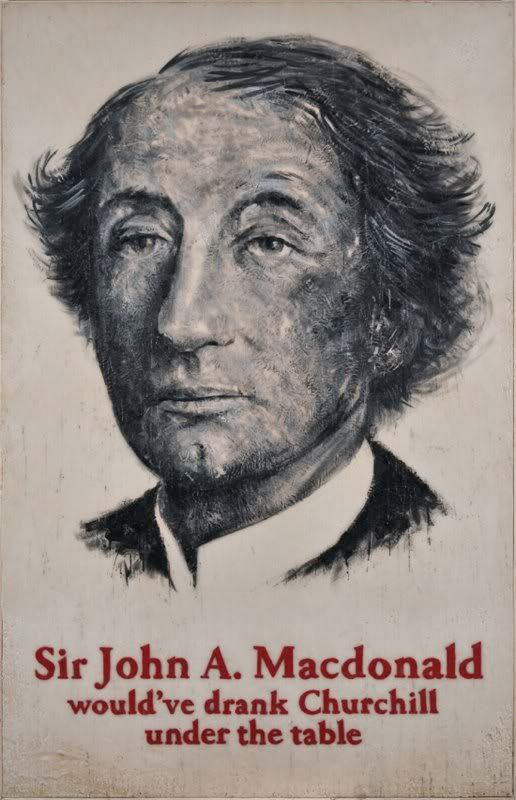
Moore writes, "Weeks into a progressive drunk, Macdonald once horrified an election crowd by vomiting on the stage when he got up to answer his opponent - and then won them back by saying, 'I don't know how it is, but every time I hear Mr. Jones speak it turns my stomach.'"

Andrew Hutchinson places Macdonald's penchant for the bottle in the context of legendary big-drinkers. In the interesting medium of  encaustic, the colourization of beeswax, Hutchinson has completed a whole series of fun and flippant Canadian historical portraits.  The encaustic paintings are 1 meter wide and nearly 1.5 meters high.  Check out Hutchinson's work at his website.

Sir John the Scrapper

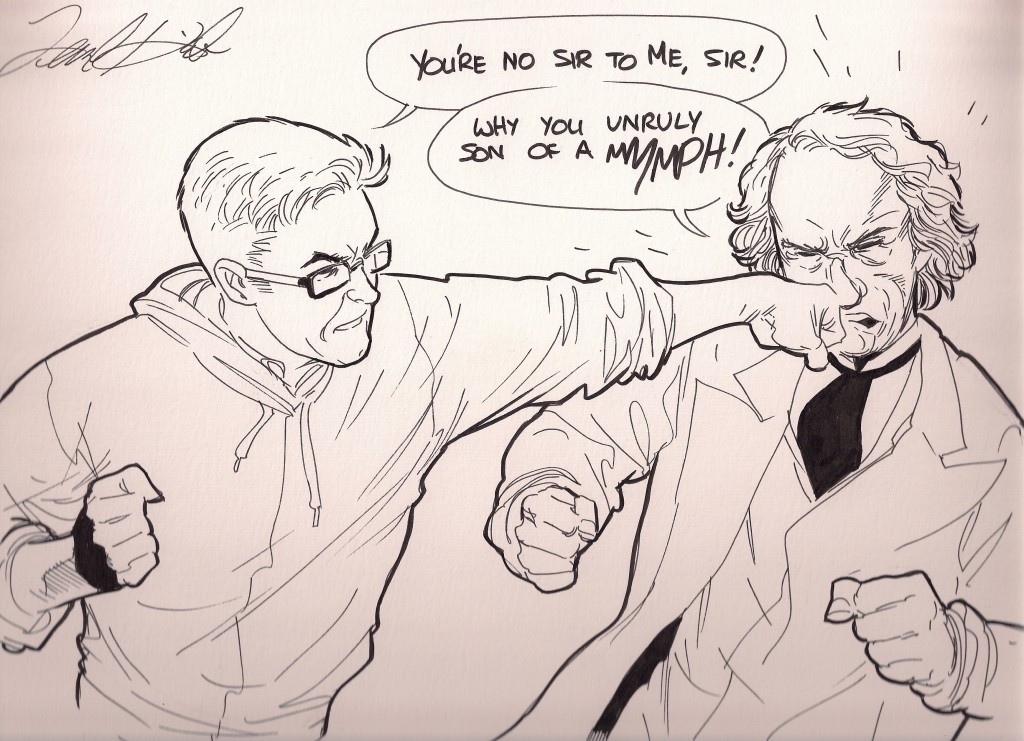
One may not think of John A. Macdonald as the type of man to resort to blows, but there were times when the red Scottish temper would boil over and get the better of him.  In a session of the parliament of the Province of Canada in 1861, Macdonald's future rival and former legal pupil, Oliver Mowat, was the target of a violent outburst from the future Prime Minister Sir John.


Oliver Mowat  H104-09
Macdonald had taken his seat after a speech which argued for a powerful central government.  The breakout of the American Civil War, with the cannons firing at Fort Sumter only a week before lent a credence to his suggestion for the federal government to hold robust overarching powers. In Macdonald's speech he had chastised Mowat for supporting representation by population, but Mowat took offence to being misrepresented.  Donald Creighton describes the ensuing furor in The Young Politician (1956):

"There must have been some provocation in his remarks - some charge that Macdonald had wilfully falsified his views.  Macdonald gasped.  These impertinences were actually coming from the fat boy who had been his inky junior at school and his respectful apprentice at law!  Suddenly, as the plump bespectacled, rather self-important little man finished his statement, Macdonald's brittle temper was shattered into splinters as at a blow.  In a minute - as soon as the Speaker had left the chair - he walked quickly across the gangway.  Blind rage in his heart, he confronted Mowat.

'You damned pup,' he roared, 'I'll slap your chops!' 
Pete DeCourcy gives Sir John a hard left.  Drawn by Leonard Kirk.  ComicBookDaily

Thursday, December 16, 2010

John A. Macdonald and the Dancing Bear

Most Canadians when asked to describe something about their first Prime Minister, Sir John A. Macdonald will report that he was a drunk.  It must be admitted that the man had a particular affinity for the bottle, and legendarily was caught clutching his desk for stability during the crisis of the Fenian raids.  It is reported that when delivering a particularly tricky oration in the parliament of the Province of the Canadas, that a number of his supporters, not knowing of each other's efforts, delivered a glass of gin to the speaker, cleverly disguised as a glass of water.  John A. Macdonald (not yet knighted for his service to Britain as architect of confederation) was inspired by the juniper juice and treated his listeners to a rousing speech.  For all these myths of debauchery, however, it seems slightly sad that a man whose later life was so dedicated to the national dream should be primarily remembered for falling off the waggon.

This being said, a recent read of the first volume of Donald Creighton's classic 1956 biography of the PM, The Young Politician provoked a contribution to the legend of JAM's party life.  Apparently Macdonald befriended a young Scotsman by the name of John Rose, living in Montreal in the early 1840s or late 1850s.  The following is Creighton's amazing description of a badly behaving man in his thirties:

http://jswagblog.wordpress.com/
"They were lighthearted and still fairly irresponsible young men who enjoyed life to the full without taking it very seriously; and once, when Macdonald at least was old enough to know better, they went off on an absurd adventure in the United States, and wandered around as travelling showmen, with Rose capering around as a dancing bear, and Macdonald playing some 'rude instrument' in accompaniment."  (Creighton, 243).