Showing posts with label Alcohol. Show all posts

Tuesday, July 3, 2012

Patriotic Rye: A Parody of Canada First

Thomas Phillips Thompson LAC C-38581
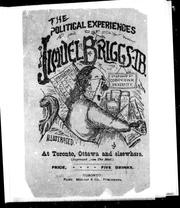
Thomas Phillips Thompson, was a Canadian satirist and social reformer.  In the 1870s, Thompson wrote for Toronto's Telegraph as well as the Mail, where his lampooning of George Brown, the Grits and the Globe would become well known to the readers of the conservative press.  His pseudonym, Jimuel Briggs was used to publish a fictitious autobiography incorporating some of his satirical journalism under the title, The Political Experiences of Jimuel Briggs, D.S., Graduate of Coboconk University. (1873)


His embellishment of Thomas Moss's 1873 attempt at election under a Canada First platform shows that patriotism could extend to the type of alcohol one preferred.  Thompson satirizes the zeal of the Canada First movement, which in 1874 formed the Canadian National Association, a political party which went nowhere.   The scene portrays the founding fathers of the party searching for a Canadian nationalist identity in the bottom of bottle:
There were fully twenty of us involved with the idea of Canadian nationality.  Previous to our proceeding to business, one of those moved that we should wet the New Party, a proposition that was wildly encored.  'I move,' continued he, 'that we order a dozen bottles of Bass, or perhaps the party would prefer some hot Irish whiskey?'
     I rose with concentrated indignation in my glance, and proceeded to excoriate the cuss. 'Do I hear aright? Have we already a traitor in our midst? Is it possible that any one of those here assembled to vindicate the glorious cause of Canadian nationalism is so lost to manhood, so degraded and servile a being as to advocate the use of such derogatory foreign beverages as Bass and Irish whiskey?'
     'Never! Never! shall I be so false to our glorious motto "Canada First" so as to endorse such a proposition.  Let us have Canadian old rye, hot and sweetened with the extract of the maple - the noblest tree of the forest to whose trunk the emblematic Moss clings as tightly as our candidate does to the principles of Canadian nationality - and some lemon in it - beg pardon, gentlemen, I retract the lemon, I forgot that was a foreign ingredient.' [...]
    That night, under such auspicious circumstances, the Canadian party  was formed, the germ of its existence being stimulated into growth by Canada's national beverage. [...]
     We again moistened the roots of the Maple and adjourned.As cited in Ramsay Cook  The Regenerators (p.155-56):
After a sojourn to the United States, Thompson returned to Canada in 1879, when his wit was turned against the emerging industrial order.  Thompson was increasingly concerned with labour issues, was associated with the Knights of Labor, and continued to lobby for socialist causes decades into the twentieth-century.

Monday, March 12, 2012

Medicinal Spirits: Prescribing Liquor during Prohibition, 1919

The patriotic fervour of the Great War was a great impetus to the passing of nation-wide prohibition.  Sir Robert Borden could rely on the notion that the use of grain for alcoholic purposes was a waste of precious war material when he passed the bill against the booze.  At the war's end, it was illegal to import, transport, or create liquor with more than 2.5% alcohol content.
File number: NA-4534-2
Title: Soldier in dispensary, during First World War.
Date: [ca. 1914-1918]
The consumption of liquor for medicinal purposes, however, was perfectly legal during these dry days in the Dominion.  Ramsay Cook and Robert Craig Brown note in A Nation Transformed (1972, p. 301),  the tendency to abuse the stipulation that alcohol could still be used for health purposes.  In 1919, one writer in Vancouver noted:


"Toward Christmas especially it looked as if an epidemic of colds and colics had struck the country like a plague.  In Vancouver queues a mile long could be seen waiting their turn to enter the liquor stores to get prescriptions filled. Hindus, Japanese and Chinese varied the lines of the afflicted of many races.  It was a kaleidoscopic procession waiting in the rain for a replenishment that would drive the chills away; and it was alleged that several doctors needed a little alcoholic liniment to soothe the writer's cramp caused by inditing their signature at two dollars per line."

Interior of Knowlton's Drug Store [15 Hastings Street East] - [ca. 1920] City of Vancouver Archives 99-1338


Friday, February 17, 2012

A Whiskey Shaking Patron visits Goldwin Smith, 1890s

Alcohol consumption is embalmed in a host of societal mores.  For the upper crust, it is only socially acceptable to drink certain types of alcohols at certain times, paired with the correct plates, and never to overindulgence.  A visitor to Goldwyn Smith's Toronto home in the late nineteenth-century, shows that different drinking customs could appear strange to the uninitiated, but it was not always high-class customs that perplexed.


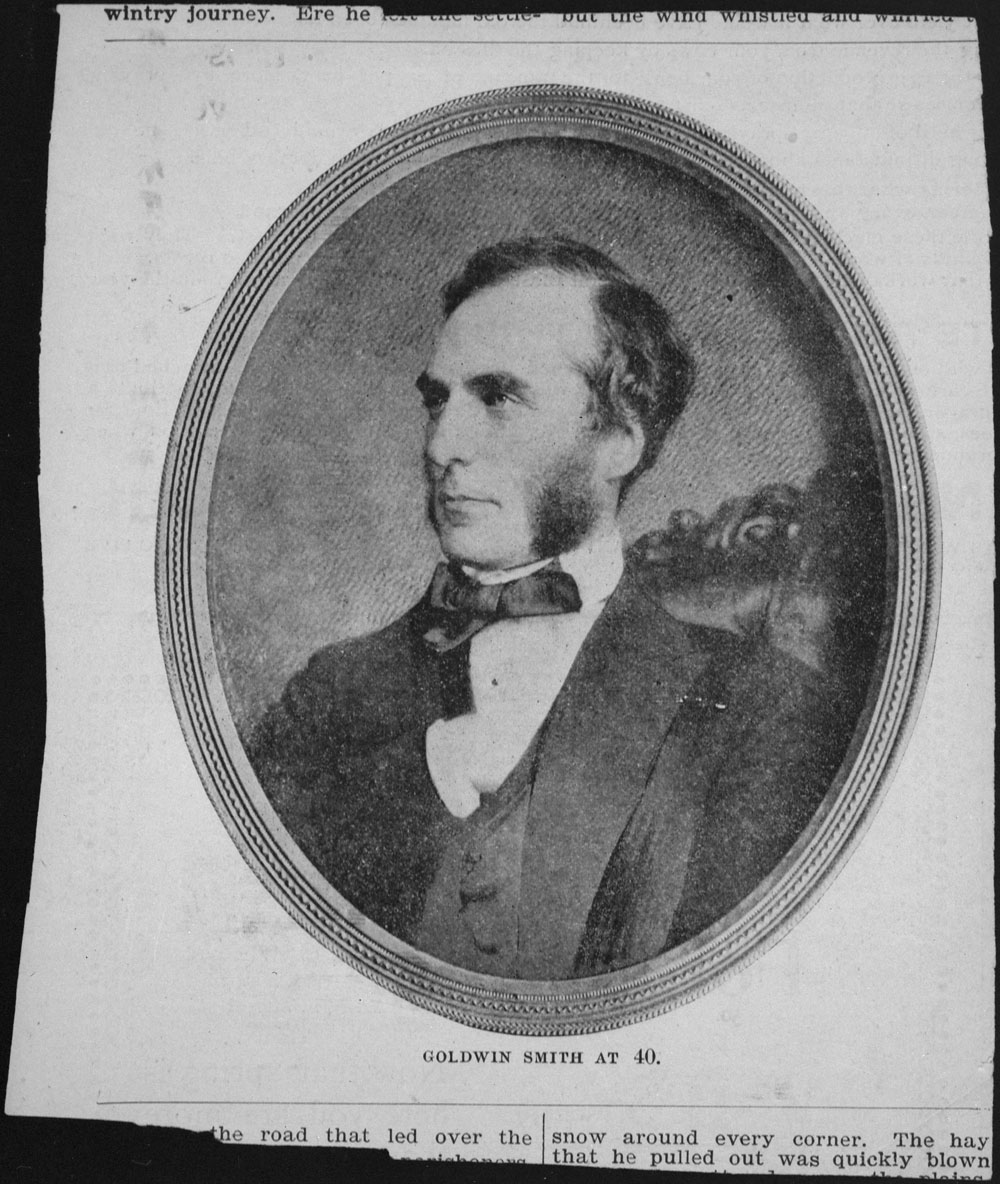
"Goldwin Smith at 40" by G.E. Perine. NAC
Goldwin Smith moved to Toronto in 1871, and began a long career in Canadian public life, which in the words of Ramsay Cook, was "designed to make Canada over in the image of his mid-Victorian liberal mind." (Cook, The Regenerators, 27)  Cook lists the causes that Smith embraced as: "Canada First, contintentalism, voluntary relief of poverty, Sunday streetcars, and, above all, an improved intellectual life."  It was to promote these causes in 1896, that Smith had acquired The Canada Farmers' Sun, a newspaper controlled by the farmer's political party, the Patrons of Industry.


Joe Haycock is described by Cook as an "ineffectual" leader of the Patrons of Industry in the late 1890s.  He had failed to reconcile the agrarian and labour elements in the Ontario party, and what power they had in the legislature would soon come to an end.  When Smith invited Haycock to his Toronto home, it became apparent that, "his guests were not always familiar with the standards of the Oxford common room." 
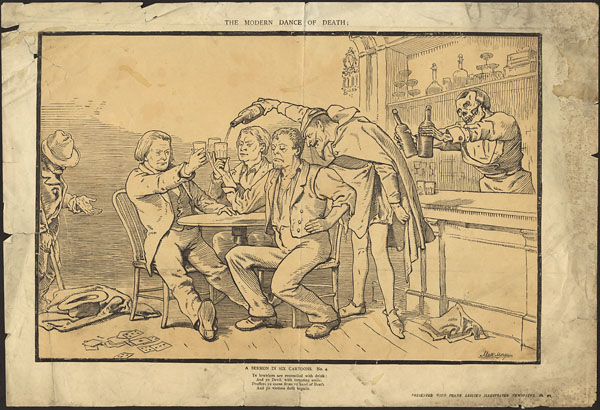
Death serves a stiff one in an early temperance cartoon.   Credit: Library and Archives Canada, Acc. No. 1989-406-45 Source: Molson Portrait Collection, Molson Archives, Montreal, Quebec


A bottle of whiskey was procured and when set upon the table the curious customs of the farm leader were observed.  Edward Farrer, who had introduced the two men from different walks of life, had to explain to Smith the farm leader's customs.  A witness of the event reported:


"Joe took the bottle and shook it vigorously before pouring out the whiskey into his glass.  Afterward the Professor [Smith] asked Farrer how it was that Haycock shook the bottle so.  Farrer told him that in the country hotels the whiskey was often adulterated and that the water rose to the top and it was customary for farmers, when getting a drink at the bar, to shake the bottle before pouring out the whiskey into their glass and that Joe had acquired the habit..." (Cook, 27-28)


It may be assumed that Smith was serving unadulterated whiskey, but it seems when it comes to drinking, old habits die hard despite the demands of respectability.

Sunday, March 6, 2011

Brews not Bullets: Labatt 50 in Korea

A recent spat between Molson and Labatt's brewerys over the right to be the official beer of the NHL is now going to the courts.  It seems that Labatt's longer relationship with the Canadian Forces remains intact.  Product placement is a common enough practice in contemporary media, but during the Korean War, Labatt's brewery went to great lengths to promote their new brand of beer commemorating the 50th anniversary of the company.  John Labatt personally delivered 3,440 cases of  Labatt 50 to troops in Korea.  This favour was apparently appreciated, as the 57th Field Squadron of Royal Canadian Engineers dubbed a bridge they built the "The John Labatt 50th Anniversary Bridge."

RCR Soldier enjoys a beer in Korea. NAC.

Labatt continues this tradition of sending beer to Canada's soldiers, sending thousands of cans of Keiths, Blue, and Kokanee to the Canadian Forces in Afghanistan.


Heron, Craig. Booze : A Distilled History. Toronto Ont.: Between the Lines, 2003. 
http://www.framingbusiness.net/archives/811
http://forums.army.ca/forums/index.php?topic=63627.0
http://www.army.gc.ca/IAOL/143000440000588/143000440000590/HTMLFiles/WSentinel_30apr.pdf

Wednesday, March 2, 2011

Hidden Hooch: Alcohol Smuggling

Dominion Brewery Invoice, Toronto, 1896.  Vitualmuseum.ca

Dominion's Club Ale, ca. 1900.  Virtualmuseum.ca
As Craig Heron's engaging history Booze (2003) explains, drink has a long history in British North America. While the story of alchohol prohibition in Canada is mainly focused on the 1920s, temperance crusaders have been active since the early nineteenth century.  By the 1870s, control over alcohol cut a major federal-provincial divide.  The Scott Act of 1878 allowed for municipalities to hold a plebiscite over the issue, and some localities became dry.  This did not stop the Dominion Brewery of Toronto, however, who sewed 4-5 dozen bottles into flour sacks for sale in "dry" districts.(Heron, 97)

Between 1919 and 1929, the sale of alcohol was prohibited by retailers and bars alike in Canada. The making of alcohol, however, could still provide a source of income.  One Alberta farmer was reputed to claim as the police were charging him, "Yes, I voted for prohibition, and I'd vote for it again.  I went broke farming."  (Heron, 240-242).  While making alcohol was still legal in Canada, the completely dry United States provided another potential market for rum-running (or perhaps rye-running) Canadians.

Pig Carcasses Stuffed with Whiskey. Glenbow Archives.
Methods of delivery were ingenious and varied.  Royal commissioners had learned of a whole host of methods which had sought to break the prohibition of liquor to the Northwest Territories in the late nineteenth century: "It was brought in secreted in packages of merchandise; in tins specially prepared and labelled "bibles"; as canned fruits, a single peach, perhaps, floating in alcohol valued at $5; in casks of sugar and rice; in packages of bottles, supposed to contain nothing but temperance drinks; in carloads of hogs or lumber, or as eggs."

Later in the 1920s, all conceivable products were again used to hide a shipment of booze.  Liquor was disguised with lumber, laths, and even packaged as Christmas trees.  Coffins were even used to try to hide liquid assets bound for the United States.  Talk about importing a stiff drink!


Heron, Craig. Booze : a distilled history. Toronto Ont.: Between the Lines, 2003. 

Tuesday, December 21, 2010

Sir John A. of Ebrius: No Stomach for the Opposition

Another legend of John A. Macdonald's drunken capers has come to my attention through Christoper Moore's 1867: How the Fathers Made a Deal.  It really is a shame that JAM is remembered for his drunkenness, but here I am contributing to such immaturity.

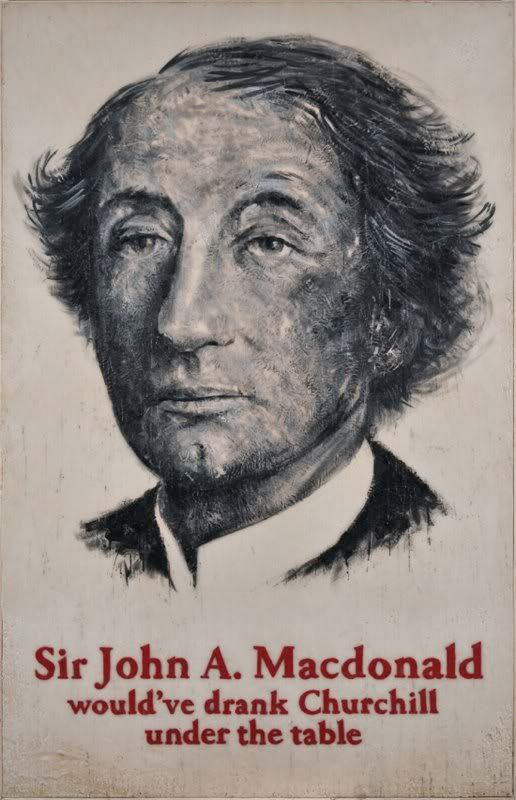
Andrew Hutchinson.
Magpie and WhiskyJack


Moore writes, "Weeks into a progressive drunk, Macdonald once horrified an election crowd by vomiting on the stage when he got up to answer his opponent - and then won them back by saying, 'I don't know how it is, but every time I hear Mr. Jones speak it turns my stomach.'"

Andrew Hutchinson places Macdonald's penchant for the bottle in the context of legendary big-drinkers. In the interesting medium of  encaustic, the colourization of beeswax, Hutchinson has completed a whole series of fun and flippant Canadian historical portraits.  The encaustic paintings are 1 meter wide and nearly 1.5 meters high.  Check out Hutchinson's work at his website.

Thursday, December 16, 2010

John A. Macdonald and the Dancing Bear

Most Canadians when asked to describe something about their first Prime Minister, Sir John A. Macdonald will report that he was a drunk.  It must be admitted that the man had a particular affinity for the bottle, and legendarily was caught clutching his desk for stability during the crisis of the Fenian raids.  It is reported that when delivering a particularly tricky oration in the parliament of the Province of the Canadas, that a number of his supporters, not knowing of each other's efforts, delivered a glass of gin to the speaker, cleverly disguised as a glass of water.  John A. Macdonald (not yet knighted for his service to Britain as architect of confederation) was inspired by the juniper juice and treated his listeners to a rousing speech.  For all these myths of debauchery, however, it seems slightly sad that a man whose later life was so dedicated to the national dream should be primarily remembered for falling off the waggon.

This being said, a recent read of the first volume of Donald Creighton's classic 1956 biography of the PM, The Young Politician provoked a contribution to the legend of JAM's party life.  Apparently Macdonald befriended a young Scotsman by the name of John Rose, living in Montreal in the early 1840s or late 1850s.  The following is Creighton's amazing description of a badly behaving man in his thirties:

http://jswagblog.wordpress.com/
"They were lighthearted and still fairly irresponsible young men who enjoyed life to the full without taking it very seriously; and once, when Macdonald at least was old enough to know better, they went off on an absurd adventure in the United States, and wandered around as travelling showmen, with Rose capering around as a dancing bear, and Macdonald playing some 'rude instrument' in accompaniment."  (Creighton, 243).