Showing posts with label violence. Show all posts

Wednesday, October 17, 2012

White Feathered Zeal: Accosting Shirkers in the Great War

In 1915, problems meeting the manpower commitments of the Borden government were quickly discovered by the Canadian army.  Jack Granatstein and JM Hitsman noted in Broken Promises(Oxford: 1977), their fundamental account of conscription in Canada, that standards were quickly lowered when men failed to flock to the recruiting stations.  Medical standards were reduced, the height restriction dropped an inch down to 5'2", minimum chest measurements were decreased, and married men no longer needed permission from their wives to enlist. (p.35)

Chief Justice TG Mathers noted that the strongest motivation to serve was the social pressures put on Western men who were still strolling  civvy-street.  Mathers, a Manitoban pro-conscriptionist, noted that
It is absurd to speak of enlistment at the present day as voluntary.  In the cities of the West the man who is not in uniform is made to feel that he is a sort of social outcast.  No man who joins the ranks today does so voluntarily.  He does so because he can no longer resist the pressure of public opinion.  (Granatstein, p. 38)
 Pierre Van Paassen NYPL th-60174
Patriotic souls took it upon themselves to organize pressure against those not yet serving.  Some women would search for workers and offer to take their place on the job if they would join the army.  As Granatstein noted, "often these patriotic ladies could get carried away."  The memoirs of Pierre van Paasen, a dutchman living in Toronto, testify to the fervour with which shirkers were sought out:
One afternoon I was accosted on the rear platform of a streetcar by a woman, who was dressed in mourning.  She told me that three of her sons had been killed at the front.  She showed me their photographs.  Suddenly she began to talk very loudly.  'Why aren't you in khaki?' She demanded.  'Why do you dare to stand there laughing at my miser? Why don't you go over and fight? Fight, avenge my boys!' she screamed.  'Madam,' I tried to calm her, 'I am not a Canadian.'  That remark set her yelling at the top of her voice.  She screamed that she, the mother of three heroes who had died for their king and country, had been insulted by a foreigner, a slacker, a German spy, a Red, and I don't know what else.
City of Toronto Archives      Fonds 1231, Item 508a
    Close up of 508, T.S.R. Car No. 6
   November 22, 1916
I pulled the cord to bring the street car to a halt.  I alighted. But the woman followed me off and she kept up her screaming about spies and Germans.  A crowd gathered....Somebody stopped me just at the moment when I thought of taking to my heels as the best way out of the predicament.  I was immediately surrounded by a mob.  A group of business men, who had managed to stay five thousand miles away from where the poppies grow, and who were at that moment emerging from the hotel, gallantly rushed to the woman's aid and forced me to submit, as she pinned a white feather through my coat into my flesh: the badge of white-livered cowardice. The last I saw of her was through a pair of badly battered eyes as she laughingly picked up some of the feathers which had dropped from her bag in the scuffle.
...The following day I enlisted.  (Cited in Granatstein, p. 39)
City of Toronto Archives Fonds 1244, Item 687
Title Mother of military personnel, World War I
Date(s) of creation of record(s)        [ca. 1916]
When in 1917, the Borden government finally acknowledged that the robust commitments of Canadian troops would necessitate conscription if the war were to continue grinding on, the position of Canadian women was far from clear-cut.  The attitude of women whose sons were still in Canada would, of course, be much different from that of the mourner Paasen encountered.  In February 1917, the journal Everywoman's World had organized a "woman's parliament", which stated that a 6:1 ratio of members were against compulsory service (Granatstein, p. 80).  The national women's organizations were broadly in support of Union government and conscription, but one should not assume this meant that half the nation's population to have a unanimous opinion on the matter.  The women's groups of feminist legend may not have had the influence on public opinion that historians at times ascribe to them.  It does seem clear, however, that women whose sons were lost in the war were given a status which was leveraged to promote conscription and shame "shirkers".

Friday, September 7, 2012

Strychnine and Axe-attacks North of Cochrane Alberta, 1890

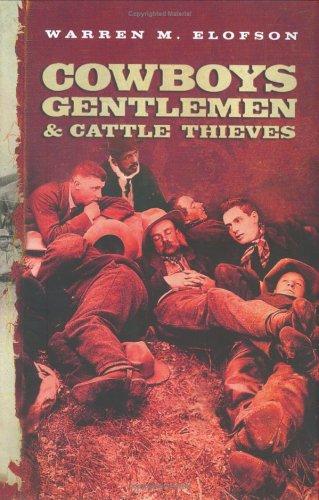
The old myth of the Canadian west as well-behaved and orderly, kept calm by respectable Mounties, and in no way related to the wild and woolly frontier south of the forty-ninth parallel, has not stood the test of time. Warren Elofson's Cowboys Gentlemen and Cattle Thieves (2002), is one work which argues that the image of the tame Canadian west dominated by metropolitan influences from Eastern Canada and Britain is in need of adjustment.  Elofson argues that Canadians could behave, "in astonishingly undisciplined and intemperate ways." He writes,
 
It is time to stop insisting on the absence of factors such as the frontier environment and lawlessness in western heritage. The frontier not only determined to a considerable extent the day to day practices utilized by the ranchers to run, protect and nurture their livestock, but did much to fashion their entire way of life, or culture in the broadest sense. A tendency towards extra-legal and even illegal modes and measures was part of that culture." (Elofson, xvi)

An 1890 North-West Mounted Police patrol report of the Cochrane, Bottrel, and Morley area seems to confirm Elofson's suggestions that the Canadian west could get downright unruly.  Corporal R. Macdonald was the leader of the patrol which set out west from Calgary at 8:30 a.m. on 6 June 1890.  What today takes no more than an hour's drive took the patrol all day, as they arrived in Cochrane at 5pm.  The next day they headed north on what was for some time called the Dog Pound, or Bottrel Road, but is now the Highway 22, (or, if you will, "The Cowboy Trail").  They stayed that evening at the Jenkins Brothers house.  The patrol learned that one of the Jenkins had been party to some spiteful violence which quickly escalated.

Corporal Macdonald's patrol report does not delve into the origins of the animosity between Jenkins and one James McDonough, but presumably a feud had been brewing for some time.  It may be the case that an errant canine was the source of the hostility.  As Macdonald wrote,
 A short time ago Jenkins + Nelson had determined to poison a dog belonging to James McDonough on account of its being in the habit of chasing their cattle.  Information to that effect was carried to him by Botterell - the consequence was a violent quarrel ending in the most abusive language by McDonough + a blow by Jenkins[. The] former then attempted to strike the latter with an axe. (RG18, Vol. 42, File 495)
It seems that McDonough was suspected of some foul play regarding poisonings in the area after the incident.  A horse some distance from Dog Pound Creek was found poisoned and it was discovered that McDonough had been to Calgary to buy fifty cents worth of strychnine.  Macdonald reported:
The bowels of the dead horse were examined by Dr. Heydon[?] of Mitford and strychnine was found in them.  In a conversation that I had with McDonough on the subject he said, "Its lucky that I live so far from him or he would suspect me of having killed them" he then went on to say "Its my opinion that they must have picked up some poisonous herb" and, on my telling him of the Doctors report, he said "Oh" several times in succession.
RG18, Vol 42, File 495. "Patrolling, Calgary District, Reports re."


The verdict on the McDonough poisoning case awaits further research, but the patrol report does provide some evidence supporting Elofson's thesis that the Canadian west could be violent.  The report gives great details on the region north of Cochrane, where in 1890 only twenty-four settler names could be procured in a area of approximately 500 square kilometers.  Corporal Macdonald reported healthy crops and fat sheep and cattle grazing on the open range.


Calgary Condominiums
Today the area is well-fenced, and cattle and a few sheep still placidly wander the grasslands, albeit with the occasional oil pump-jack in the way.  The Bottrel store sells grains and other agricultural goods, but children and adults alike from the nearby provincial campground seem to prefer the ice-cream.  Should one be interested in owning a piece of early western history, the store is up for sale!


Thursday, April 5, 2012

Eurocentric Interpretations of Native-American Torture

A. Walker. LAC, Acc. No. R9266-2362
In the seventeenth and eighteenth centuries, grisly tales of torture performed by the so-called "savages" of the New World, were read with delight by a European audience whose arrogance and pride were reinforced by torrid tales of "barbaric" action.


One such account was aghast at the role of women in torture ritual, yet clearly delighted in the details: "You should have seen these furious women, howling, yelling, applying fire to the most sensitive and private parts of the body, pricking them with awls, biting them with savage glee, laying open their flesh with knives; in short doing everything that madness can suggest to a woman.  They threw fire upon them, burning coals, hot sand; and when the sufferers cried out, all the others cried still louder, in order that the groans should not be heard, and that no one might be touched with pity." (Miller, p.60)


Jim Miller's Skyscrapers Hide the Heavens notes that this "ethnocentricaly inspired misunderstanding" discounted that most captives of war were adopted by the families of the victors to replace kin killed in battle, or enslaved for work or barter with the French. (p.60)  Miller writes that when torture was used it was as a part of sun-worship, and was used to break the enemy's will.  The Natives treated women captors much better than the Europeans.  For the white newcomers, Miller claims the spoils of war included "brutal rape and collective violence." (p.61)
"Indians Returning From War" P. Rindisbacher, 1825. LAC Acc. No. 1981-55-72
Europeans were particularly shocked at the cannibalism involved in Native torture ceremonies.  As CJ Jaenen suggests, Christians were particularly short-sighted in not understanding the spiritual side of cannibalism, what with the beliefs in "transubstantiation and literally eating their Lord in their communion service." (Cited in Miller, p.61)  Miller notes the taking of scalps for trophies should have been more comprehensible, given that Europeans "guillotined, hanged, drew, and quartered those guilty of any hundreds of offences, and who put heads on pikes as warning to others." (p.61)

Tuesday, December 21, 2010

Sir John the Scrapper

One may not think of John A. Macdonald as the type of man to resort to blows, but there were times when the red Scottish temper would boil over and get the better of him.  In a session of the parliament of the Province of Canada in 1861, Macdonald's future rival and former legal pupil, Oliver Mowat, was the target of a violent outburst from the future Prime Minister Sir John.


Oliver Mowat  H104-09
Macdonald had taken his seat after a speech which argued for a powerful central government.  The breakout of the American Civil War, with the cannons firing at Fort Sumter only a week before lent a credence to his suggestion for the federal government to hold robust overarching powers. In Macdonald's speech he had chastised Mowat for supporting representation by population, but Mowat took offence to being misrepresented.  Donald Creighton describes the ensuing furor in The Young Politician (1956):

"There must have been some provocation in his remarks - some charge that Macdonald had wilfully falsified his views.  Macdonald gasped.  These impertinences were actually coming from the fat boy who had been his inky junior at school and his respectful apprentice at law!  Suddenly, as the plump bespectacled, rather self-important little man finished his statement, Macdonald's brittle temper was shattered into splinters as at a blow.  In a minute - as soon as the Speaker had left the chair - he walked quickly across the gangway.  Blind rage in his heart, he confronted Mowat.

'You damned pup,' he roared, 'I'll slap your chops!' 
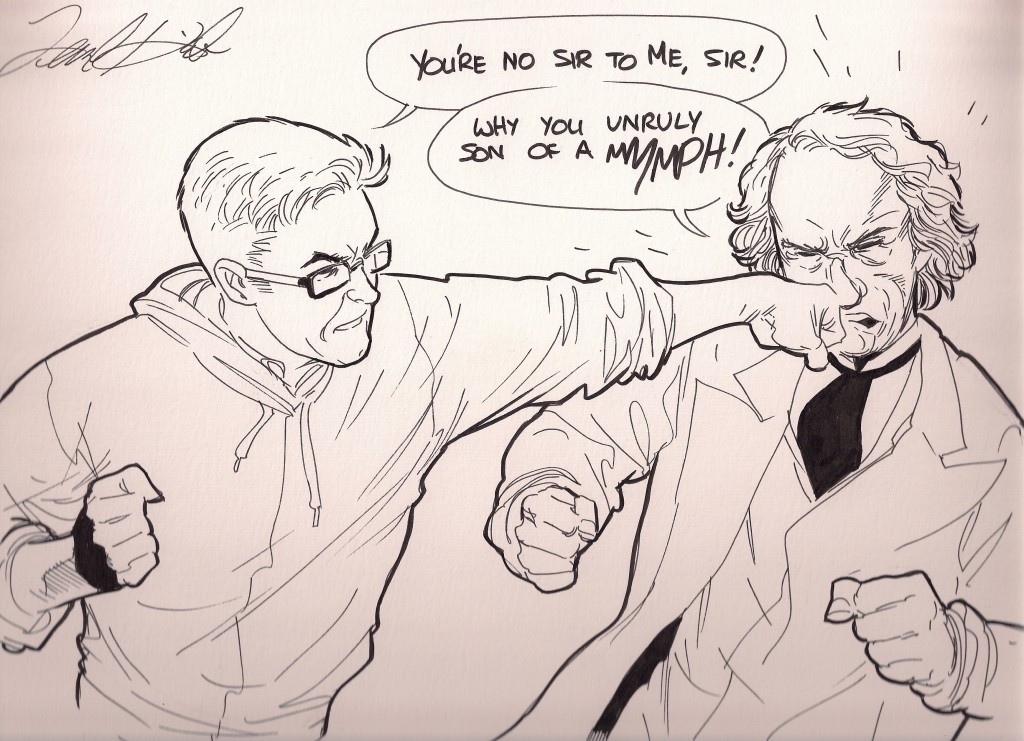
Pete DeCourcy gives Sir John a hard left.  Drawn by Leonard Kirk.  ComicBookDaily