Showing posts with label drugs. Show all posts

Thursday, February 5, 2015

1930s Insulin Shock Therapy - Snippet from the work of Edward Shorter

Ladislas Meduna,, 1955,
 UofIllinois Archives
Before the days of electroconvulsive therapy, experimentation was conducted in the interwar years inducing convulsions in schizophrenic patients.  In the late 1920s, Polish psychiatrist Manfred J. Sakel had experimented with insulin coma therapy for use on schizophrenics and others.  Camphor was one drug that was used, but it was found unreliable in its reactions, and patients reported great feelings of anxiety before the fits, not to mention the drug's tendency to induce vomiting. Metrazol, or Cardiazal was discovered by Ladislas von Meduna to be a superior drug to induce therapeutic seizure.

Before the 1930s, it was largely sedatives and hypnotics that were being used on psychiatric patients, with opiates and barbiturates coming to the fore in the nineteenth and twentieth centuries respectively.  If one counts laxatives as drugs, evidence exists for their use as psychiatric treatment as far back as the middle ages, and one could likely find similar uses in ancient times.  While we might like to think of Prozac as a revolutionary change in mental health treatment, it certainly had its forebears.  

Insulin shock therapy is given in
 Lapinlahti Hospital, Helsinki in 1950's
In the 1930s there were brief experiments with convulsive drug treatments, before these were swept away by the tide of electroconvulsive therapy.  Ladislas von Meduna was a Budapest psychiatrist who in 1934 was breaking ground in the use of insulin induced comas for the treatment of schizophrenia.  Seizures were an occasional side-effect of insulin comas, and some psychiatrists thought these were therapeutic, and induced them using cardiazol or camphor.  An account of one of Meduna's early patients gives an idea of the gap between the sanitized official record and the lived experience of the patient.  Meduna noted of his thirty-three-year-old patient that he had been committed to the Budapest State Hospital in 1930 on the basis of his delusions and hallucinations.  He had reportedly spent 1933 hidden under his bedcovers, and in January 1934, he had stopped eating.

Meduna administered camphor, and 45 minutes later the patient had his first seizure.  In the next couple of weeks, he would have five more injections.  Meduna reported:

 On the morning of February 10, the patient spontaneously arises from bed, is lively, speaks, and asks for something to eat.  He is interested in everything going on about him, asks about his illness and realizes that he has been sick.  He asks how long he has been in the hospital, and as we tell him that he has already been there four years he cannot believe it. (Shorter, 214-217)

Edward Shorter’s work A History of Psychiatry: From the Era of the Asylum to the Age of Prozac (New York: 1997) relays the after-effects of the treatment:


In reality, the patient felt so good that he escaped from the institution, went home, ‘and found out that the cousin living with his wife was not a relation at all but his wife’s lover.  He beat up the cousin and kicked him out of the house; proceeded to beat up his wife and told her that he … preferred to live in the state mental hospital where there is peace and honesty.’ (Shorter, 214-217)

Shorter's work argues against the disciples of Foucault who since the 1970s have damned psychiatry as a state tool to incarcerate the disruptive.  Shorter emphasizes that mental illness was real, and could be cured by various biology-based methods.  It is interesting to note, that Meduna's 1934 convulsive shock experiments reported that of 110 patients treated (presumable schizophrenics), half went into remission.  As the above account suggests, "cure" was not always synonymous with completely positive outcomes, and the dangers of inducing seizure and the low vital signs connected to insulin sleep therapy were always clear.

Southern Albertans interested in psychiatry and its history may wish to attend a couple upcoming talks.  Edward Shorter is in Calgary for a few days in early February 2015, and presenting two public talks at the University of Calgary.


The second talk is at 3:30pm. Monday February 9th at the Community Health Sciences department on the third floor of the Teaching Research and Wellness (TRW) building on the University of Calgary's Foothill's campus.  RSVP to Beth Cusitar bcusitar@ucalgary.ca.  The talks is as follows:


“DSM:  The History of a Train Wreck”


Diagnosis in psychiatry was once dominated by the German heavyweights.  After the Second World War, the United States becomes the world champion of psychiatry, and American diagnoses take over, first in the DSM-1 in 1952, then in the revolutionary DSM-3 in 1980, which was a dramatic break from psychoanalysis and offered hope for the diagnostic future.  But buffeted by institutional politics, the demands of patient organizations, pressures from niche marketers within the field, and the profit horizons of the pharmaceutical industry, the diagnostic promise of DSM-3 failed to be realized, and the entire diagnosis machine of DSM has started to run out of control.  We are now at DSM-5 (2013).  There probably will not be a "DSM-6."

Saturday, December 13, 2014

Drugging Soldiers: Bennies and Battle

Using mind-altering substances to promote combat motivation and performance has been a longstanding feature of warfare.  While the practice of drugging soldiers wasn't widespread until the Second World War, the use of alcohol to boost morale and calm nerves long precedes modern drug use.  Pharmaceutical amphetamines, however, were an innovation of the interwar years.  In 1933, Benzedrine, was first marketed as a nasal decongestant.  The euphoric effects of "Bennies" were quickly seized upon by recreational users, and it did not take long for military forces to consider their use in battle.

Vendel Era Bronze Plate
Precedents certainly exist for  non-pharmaceutical military drug use. If one expands beyond the amphetamine category, lore has it that mind-altering "drugs" go back at least to the middle ages.  The most popular legend of  stoned soldiers tells of blood-crazed Viking beserkers eating dried fly agaric (the hallucinogenic mushroom Amanita muscaria) to inspire their savage attacks.  While drugging a medieval warrior and inciting him to behave like a bear might improve his will to fight, one has to wonder about the effects on hand-eye coordination.  Instead, the adrenaline-like effects of therapeutic doses of amphetamine, such as wakefulness, increased muscle strength, improved memory, and cognitive control, made the drug much more useful on the modern battlefield than hallucinogens.

Use of amphetamines by the military, then, began in the Second World War.  Richard Holmes, in Acts of War: The Behaviour of Men in Battle (1985), writes that in that conflict, Benzedrine was commonly administered to soldiers of various nations, noting ten percent of American soldiers used amphetamines in the conflict. 

An excellent treatment of Allied research and use of amphetamines is found Nicolas Rasmussen's 2011 article "Medical Science and the Military: The Allies' Use of Amphetamine during World War II" Journal of Interdisciplinary History 42:2 (Autumn 2011) Rasmussen suggests that despite the popular conception that drugs were prescribed by the Allies as physically performance-enhancing, the reasons behind amphetamine distribution was based on mood-altering effects such as "increased confidence and aggression" and the promotion of morale.  Until very late in the war, research had yet to conclusively prove the physical effects of the drugs.

Amphetamine Molecule
Nazi Germany was the first state to embrace military amphetamine use, to keep soldiers awake.   Rasmussen notes that during the Blitzkrieg of 1940, the German's took the lead in methamphetamine distribution to soldiers, with 35 million tablets distributed in three months from April-June 1940, and a sharp decline in use thereafter.  

Spiegel
As Adam Tooze wrote in  Wages of Destruction (2006), the intense operational tempo during the Fall of France led to the need for stimulating expedients.  With the call for German armoured forces to push constantly for three days and nights, armoured crews needed "uppers" to continue operating.  As Tooze writes, "to ensure that the drivers could go without sleep, the quartermasters of the advanced units stocked up with tens of thousands of doses of Pervitin, the original formulation of the amphetamine now know as 'speed', but more familiar in the 1940s as 'tank chocolate' (Panzerschokolade)."  Amphetamine use was reported in the press which intensified research interest for the Allies.

Rasmussen records that General Bernard Montgomery was an early enthusiast for amphetamine prescription after observing the results of field trials.  A drugged ambulance unit had proven quicker on the march when administered Benzedrine, and an infantry squad had not only won a race against a "sober" squad in a variety of military tasks, but had also proven to have a certain "snap and zest". (Rasmussen, p. 216) For the 1942 Battle of El Alamein, large quantities of amphetamine were authorized.
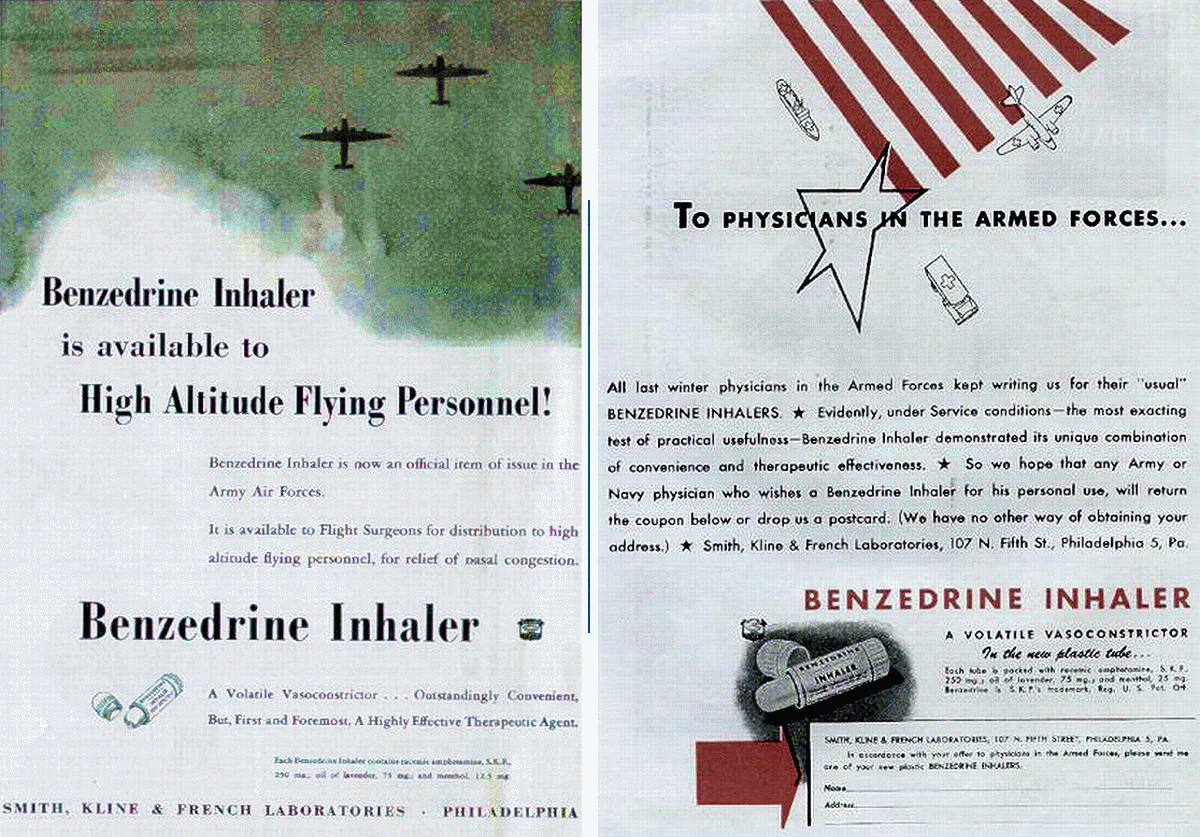
Benzedrine advertisements, 1943 & 1944.
Journal of the American Medical Association, Vol. 123, No. 10; Vol. 124, No. 12.
http://www.bonkersinstitute.org/medshow/benzedrinearmy.html

In 1943, the Americans came to the same conclusion on Benzedrine sulphate "pep pills" as a boost to morale and alertness and began to distribute them widely to all services. When Eisenhower learned that 100,000 six-tablet packages of "Bennies" were available for the North African theatre, he immediately requested 500,000. (Rasmussen, p. 226)  Rasmussen suggests that the drugs were widely abused for recreational purposes and may have been the cause of battlefield atrocities in the Pacific theatre.  (Rasmussen, p. 230-32)


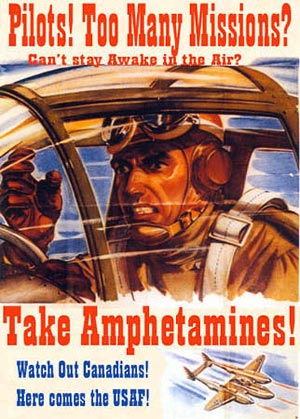
Remixed Propaganda by Micah Wright
The use of drugs by the military continues to the current day.  The American practice of popping amphetamines like candy was continued in Korea and Vietnam, where soldiers were administered Dexedrine before action.  More recently, lawyers for two American pilots who bombed Canadian soldiers in Afghanistan, argued that errant judgment may have been impaired by amphetamines.

Drugs, then, have a long relationship with the military, especially in years after 1940 as the pharmaceutical industry and pharmacological practice expanded at pace.  Beyond stimulants for combat, medical use has been made of barbiturates, sedatives and pain-killers.  Illicit, recreational drug use extends beyond amphetamines as well, with marijuana and heroin use in Vietnam as the most notorious example.  One need not look too far to find accusations regarding the negative effects of this military narco-love-affair.  

A version of this page was first posted on 28 July 2011.