Showing posts with label Montgomery. Show all posts

Saturday, December 13, 2014

Drugging Soldiers: Bennies and Battle

Using mind-altering substances to promote combat motivation and performance has been a longstanding feature of warfare.  While the practice of drugging soldiers wasn't widespread until the Second World War, the use of alcohol to boost morale and calm nerves long precedes modern drug use.  Pharmaceutical amphetamines, however, were an innovation of the interwar years.  In 1933, Benzedrine, was first marketed as a nasal decongestant.  The euphoric effects of "Bennies" were quickly seized upon by recreational users, and it did not take long for military forces to consider their use in battle.

Vendel Era Bronze Plate
Precedents certainly exist for  non-pharmaceutical military drug use. If one expands beyond the amphetamine category, lore has it that mind-altering "drugs" go back at least to the middle ages.  The most popular legend of  stoned soldiers tells of blood-crazed Viking beserkers eating dried fly agaric (the hallucinogenic mushroom Amanita muscaria) to inspire their savage attacks.  While drugging a medieval warrior and inciting him to behave like a bear might improve his will to fight, one has to wonder about the effects on hand-eye coordination.  Instead, the adrenaline-like effects of therapeutic doses of amphetamine, such as wakefulness, increased muscle strength, improved memory, and cognitive control, made the drug much more useful on the modern battlefield than hallucinogens.

Use of amphetamines by the military, then, began in the Second World War.  Richard Holmes, in Acts of War: The Behaviour of Men in Battle (1985), writes that in that conflict, Benzedrine was commonly administered to soldiers of various nations, noting ten percent of American soldiers used amphetamines in the conflict. 

An excellent treatment of Allied research and use of amphetamines is found Nicolas Rasmussen's 2011 article "Medical Science and the Military: The Allies' Use of Amphetamine during World War II" Journal of Interdisciplinary History 42:2 (Autumn 2011) Rasmussen suggests that despite the popular conception that drugs were prescribed by the Allies as physically performance-enhancing, the reasons behind amphetamine distribution was based on mood-altering effects such as "increased confidence and aggression" and the promotion of morale.  Until very late in the war, research had yet to conclusively prove the physical effects of the drugs.

Amphetamine Molecule
Nazi Germany was the first state to embrace military amphetamine use, to keep soldiers awake.   Rasmussen notes that during the Blitzkrieg of 1940, the German's took the lead in methamphetamine distribution to soldiers, with 35 million tablets distributed in three months from April-June 1940, and a sharp decline in use thereafter.  

Spiegel
As Adam Tooze wrote in  Wages of Destruction (2006), the intense operational tempo during the Fall of France led to the need for stimulating expedients.  With the call for German armoured forces to push constantly for three days and nights, armoured crews needed "uppers" to continue operating.  As Tooze writes, "to ensure that the drivers could go without sleep, the quartermasters of the advanced units stocked up with tens of thousands of doses of Pervitin, the original formulation of the amphetamine now know as 'speed', but more familiar in the 1940s as 'tank chocolate' (Panzerschokolade)."  Amphetamine use was reported in the press which intensified research interest for the Allies.

Rasmussen records that General Bernard Montgomery was an early enthusiast for amphetamine prescription after observing the results of field trials.  A drugged ambulance unit had proven quicker on the march when administered Benzedrine, and an infantry squad had not only won a race against a "sober" squad in a variety of military tasks, but had also proven to have a certain "snap and zest". (Rasmussen, p. 216) For the 1942 Battle of El Alamein, large quantities of amphetamine were authorized.
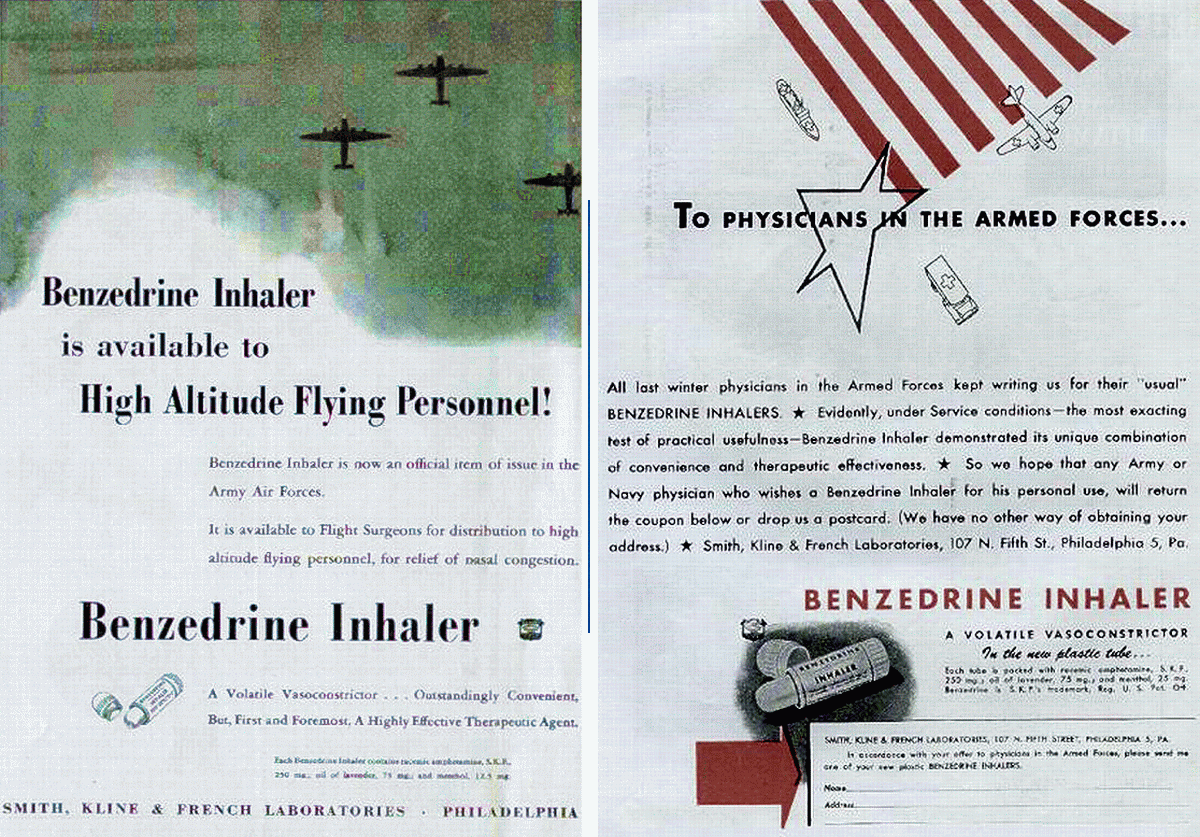
Benzedrine advertisements, 1943 & 1944.
Journal of the American Medical Association, Vol. 123, No. 10; Vol. 124, No. 12.
http://www.bonkersinstitute.org/medshow/benzedrinearmy.html

In 1943, the Americans came to the same conclusion on Benzedrine sulphate "pep pills" as a boost to morale and alertness and began to distribute them widely to all services. When Eisenhower learned that 100,000 six-tablet packages of "Bennies" were available for the North African theatre, he immediately requested 500,000. (Rasmussen, p. 226)  Rasmussen suggests that the drugs were widely abused for recreational purposes and may have been the cause of battlefield atrocities in the Pacific theatre.  (Rasmussen, p. 230-32)
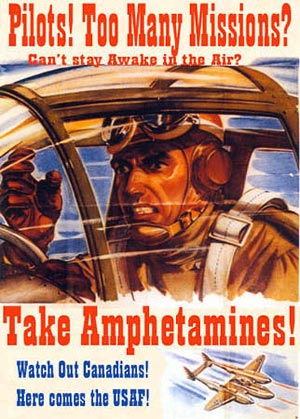


Remixed Propaganda by Micah Wright
The use of drugs by the military continues to the current day.  The American practice of popping amphetamines like candy was continued in Korea and Vietnam, where soldiers were administered Dexedrine before action.  More recently, lawyers for two American pilots who bombed Canadian soldiers in Afghanistan, argued that errant judgment may have been impaired by amphetamines.

Drugs, then, have a long relationship with the military, especially in years after 1940 as the pharmaceutical industry and pharmacological practice expanded at pace.  Beyond stimulants for combat, medical use has been made of barbiturates, sedatives and pain-killers.  Illicit, recreational drug use extends beyond amphetamines as well, with marijuana and heroin use in Vietnam as the most notorious example.  One need not look too far to find accusations regarding the negative effects of this military narco-love-affair.  

A version of this page was first posted on 28 July 2011.

Wednesday, September 26, 2012

Military Mascots: Auchinleck, Rommel, and Monty in the Western Desert

Jonathan Fennell’s Combat and Morale in the North African Campaign (2010), traces the complex web of factors which influence military morale. One kernel in this cornucopia is the cult of personality surrounding the high commander. In the case of British and commonwealth troops in the Western Desert, it seems that a certain notorious German commander stole a march on the British.
 
General Erwin Rommel's charisma still effects the observers of military history, especially due to the popularization of his opposition to George Patton, as portrayed in the 1970 film Patton.  Problems arose in 1942, when British troops recognized the charismatic German general over their own commanders.  General Claude Auchinleck was an unknown entity to troops under his Middle East Command as long as a year after he took control.

Generalfeldmarshschall Erwin Rommel (1892 - 1944):
 Rommel at a staff conference in the Western Desert.
© IWM (B 6541)
Fennell records that Rommel approached “folk hero” status, among troops. One officer wrote during a slow period in the desert that, “there is no news of interest here at the moment except that I have often heard fellows say ‘I wish we had Rommel on our side.’” (Fennell, p. 212) Attempts to confront the Rommel legend by Middle East Command came from the “MEF Weekly Military Newsletter no. 74”. “Axis propaganda had gone to considerable pains to build up the legend of Rommel, one of the aims being to give us a feeling of inferiority in the face of this photogenic General who is supposed to be master of the Libyan desert”.

The Auk.Creator Eves, Reginald Grenville (RA)
© IWM (Art.IWM ART LD 729)
Auchinleck’s personal reaction betrays his own concerns about the power of his opposition's celebrity. Auchinleck wrote,

 “I wish to dispel by all possible means [the idea] that Rommel represents something more than an ordinary German general…The important thing now is that we do not always talk of Rommel when we mean the enemy in Libya. We must refer to “the Germans”, or the “Axis powers”, or “the enemy” and not always keep harping on Rommel…PS. I am not jealous of Rommel.”(Fennell, p. 214, cited from Nigel Hamilton, The Full Monty, p. 544)

It seems that Auchinleck’s best efforts at becoming a military idol were in vain. The situation was reversed with the coming of the flamboyant and press-savvy Montgomery, who “actively pursued publicity and the press limelight and purposely took on the Rommel legend.” (Fennell, p. 214)

As Montgomery wrote after the war:
The Eighth Army consisted in the main of civilians in uniform, not of professional soldiers. And they were, of course, to a man, civilians who read newspapers. It seemed to me that to command such men demanded not only a guiding mind but also a point of focus: or to put it another way, not only a master but a mascot. And I deliberately set about fulfilling this second requirement. It helped, I felt sure, for them to recognize as a person – as an individual – the man who was putting them into battle. To obey an impersonal figure was not enough. They must know who I was. (Fennell, p. 214)
Monty with "Hitler" (l) and "Rommel" (r) © IWM (B 6541)
That Montgomery bought in to the cult of Rommel can be gleaned by the questionable honour of naming his dog after the general.  The distinction is only heightened by noting the moniker of his other canine comrade: "Hitler".  Monty, as against Auchinleck's policies would long personalize the German forces he opposed as "Rommel", and emphasized that he knew the "Desert Fox" better than anyone else.  

Fennell does acknowledge  Montgomery's success in becoming part mascot, claiming that he was the first British celebrity general, with the possible exception of Kitchener. (Fennel, p.5) It appears at least one prominent military historian disagrees with awarding full celebrity status to any British general.  Writing in the 1970s in his pivotal work Face of Battle, John Keegan suggests that Robert E. Lee was "the only cult general in the English-speaking world". (Keegan, 1976, p. 54)  So much for Kitchener of Khartoum and Montgomery of Alamein!  It seems that at least honorable mention is due to the Duke of Wellington, or even Sir Garnet Wolseley, whose name was incorporated in the British soldiers' pantheon of slang as synonymous with doing all right.  In overcoming the cult of Rommel, however, it appears that things were not "all Sir Garnet" for the desert generals!