Friday, October 7, 2011

Montgomery's Terse Advice to the Secretary of State for the Colonies: Malayan Emergency 1951

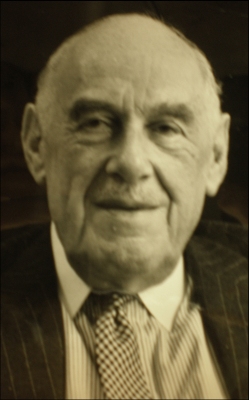
Oliver Lyttelton.  Peerage.com
Upon the return of the Conservatives to the British government in 1951, Mr. Oliver Lyttelton was appointed as the Secretary of State for the Colonies, and visited Malaya on a tour of inspection.  Malaya, recently reduced to a colonial backwater due to the emergence of hostilities in Korea, had been the scene of a communist insurgency for a number of years.  As John Coates notes in Suppressing Insurgency: An Analysis of the Malayan Emergency, 1948-1954,  Lyttelton quickly learned that the government in Malaya was in shambles, with control divided between the British Officer Administering the Government, and the military and paramilitary.  It was hard to discern how government administration and military operations were separate.  In hopes to implement broad reforms in administration, education, and training, Lyttelton decided that a strong leader was needed to run the show.

Looking first to General Sir Brian Robertson who hastily declined, and Field Marshal Slim, who claimed he was "too old to go flipping around in an Auster aircraft in the trying climate of Malaya", the report was forwarded to Prime Minister Churchill's office. (Coates, 111)  It just so happened that Field Marshal Montgomery was lunching with the PM that day, and the press speculated that Monty would be asked to take the task.

The next day Lyttelton recieved the following letter:
Montgomery at the Coronation, 1953.
NAM 1992-10-143-1600

Dear Lyttelton,
Malaya: we must have a plan.
Second, we must have a man.  When we have a plan, and a man, we shall succeed.
Not otherwise.
     Yours Sincerely,
     (signed)
     Montgomery, Field Marshal.


Lyttelton's response, a classic example of crisp British understatement was, "I may, perhaps without undue conceit, say that this had occurred to me." (Coates, 112)

Dumbo takes a Bullet: Odd Duties of a Second World War Staff Officer

Wanted Scrap Metal...To Make Tanks, Guns, Ammunition :  Canada's war effort and production sensitive campaign. Credit: Library and Archives Canada, Acc. No. 1983-30-72
Austerity measures during the Second World War meant tightening belts and conserving materials.  One such sacrifice was made by a local zoo near Aldershot, England, where beginning in the bitter winter of 1939-40 the 1st Canadian Division was stationed overseas.  The zoo phoned the Canadians to inform them that they were unable to feed their elephant, and that the services of a soldier were needed to put the animal down.

John  Buchan, 2nd Baron Tweedsmuir PostalHistoryCorner Blog
John Buchan, later Baron Tweedsmuir, was the unfortunate officer to whom the deed fell to.  Buchan had proven an excellent shot during service in Africa, and was assigned to perform the unfortunate execution.  As Dominick Graham writes in The Price of Command, "permission was granted by CMHQ, but [GSOI] Turner made it a condition that the entry in the war diary show that it was in response to a request.  The sad deed was done.  Later the war diary was found to have the bald entry under the date "Leatherhead, 1531 hours.  The G 3 Intelligence shot an elephant."
Belfast Zoo's elephant managed to survive the war in a friendly zookeeper's backyard. BBC story.

An Ignorant Hobo that Needs a Good Thrashing: Canadian Army Medical Jargon, 1942

Copp and McAndrew's Battle Exhaustion, now over twenty years old, is still the only serious work on Canadian medical psychiatry in the Second World War.  The work is full of interesting information regarding the fledgling psychiatric organization in the Royal Canadian Army Medical Corps, and their attempts to run a system which sorted the mild and amenable stress cases from those irreparable psyches which required permanent evacuation from the combat zone.  One noted difference between the Canadian and British psychiatric establishments was that the British linked psychiatry with personnel selection and psychology, whereas the Canadians associated their psychiatrists with the medical side of war.  These difference withstanding, the Canadian Army did use some psychiatric principles in efforts to psychologically screen personnel. Copp and McAndrew's feelings about personnel selection can be summed up as such: "In Canada, staff officers of the personnel selection directorate - young men given commissions on the basis of university degrees or some university attendance - were testing, interviewing, and diagnosing other young men with the kind of assurance that only profound ignorance can provide."

An unidentified parachute candidate undergoing a medical examination at A35 Canadian Parachute Training Centre, Camp Shilo, Manitoba, Canada, 20 March 1945. Credit: Capt. Frank Royal / Canada. Dept. of National Defence / Library and Archives Canada / PA-188829
In 1942, problems were identified with the young personnel examiners using pseudo-medical jargon in their assessment forms.  Bill Line, having credentials from the Toronto National Committee for Mental Hygiene, urged the examiners to avoid "diagnostic terms (or phrases that smack of diagnosis) [such as] psychopathic inferior, feeble minded, mental defective, moron, imbecile, neurotic, hysterical, sexual pervert, psychotic, [and] insane."  Line had to further outline several slang phrases of the day which should not be written in records which soldiers may have had access to.  Strictly forbidden were the phrases, "ignorant hobo", "needs a good thrashing", and "should be put through the mill." (Copp, 34).

Sunday, September 18, 2011

Italian Campaign - 1 Canadian Corps Jeep Platoon

The jeep was a versatile vehicle which aided mobility in a Second World War campaign which was notorious for poor vehicle going.  With high clearance and four-wheel drive, the jeep was able to go places where other vehicles were mired in the Italian muck.  The Canadians in Italy never formed a permanent jeep-equipped unit for supplying troops at the frontlines, but an ad hoc unit was established for use in the Hitler Line that was disbanded during the pursuit, and reincarnated during the Gothic Line attack.  The No. 1 Canadian Corps Jeep Platoon had thirty jeeps and around forty-five soldiers, which was attached directly to the battalion and company headquarters of the infantry.  Arnold Warren wrote his RCASC history that the sections identified with the units they served whilst hauling anti-tank guns, ammunition, and hot rations.  Innovation was no stranger to the group, who placed wet sandbags on the floors of their jeeps to protect the driver from mines.

Personnel of the Loyal Edmonton Regiment filling a jeep with gasoline, San Lorenzo in Monte, Italy, ca. 22 September 1944. Canada. Dept. of National Defence / Library and Archives Canada / PA-177531

An excerpt from the war diary after the breaking of the Gothic Line shows that the group saw no shortage of incoming fire:

"14 Sep 44
...One L/Cpl having to dive for a ditch receives a cut on forehead from heel of boot of a man trying to beat him to it.  Our DR, Pte Sage A., never before under shell fire, leaves his MC in a hurry, dives into ditch to save himself and finds two other men there.  He turns to say it rather hot, but it turns out they are both dead; presto, leaves for more pleasant company.  One man finds it very comfortable to get jeep moving slowly ahead and driving it from the ditch on hands and knees."

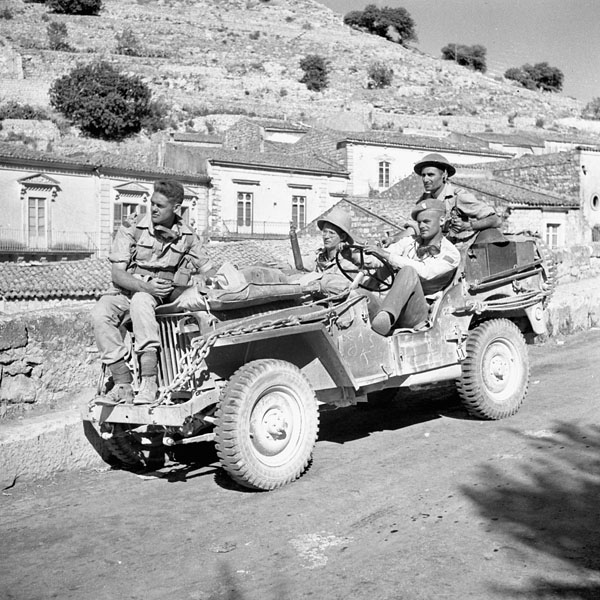
Pictures at Library and Archives Canada show that the jeep was a prevalent vehicle in many organizations.

Canadian war correspondents in a jeep, Modica, Italy, 13 July 1943. (L-R): Peter Stursberg, Canadian Broadcasting Corporation; Ross Munro, Canadian Press; Captain Dave MacLellan, Public Relations Officer; Lieutenant Al Fraser, Canadian Army Film and Photo Unit. Credit: Capt. Frank Royal / Canada. Dept. of National Defence / Library and Archives Canada / PA-204808
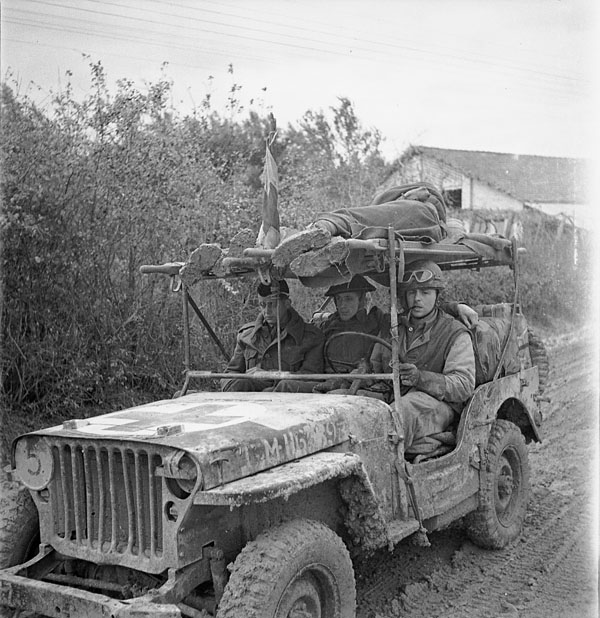
The medical corps was another formation which used the manoeuverability of the vehicle offroad to extract casualties under fire.
A jeep ambulance of the Royal Canadian Army Medical Corps (R.C.A.M.C.) bringing in two wounded Canadian soldiers on the Moro River front south of San Leonardo di Ortona, Italy, 10 December 1943. Credit: Lieut. Frederick G. Whitcombe / Canada. Dept. of National Defence / Library and Archives Canada / PA-180097

Sunday, September 4, 2011

Lord Strathcona's Terrifying Eyebrows


Sir Donald Smith, Lord Strathcona, Montreal, QC, 1895
Wm. Notman & Son II-110266.0
© McCord Museum
Donald Smith seems to be everywhere in Canadian history.  Notorious for betraying Sir John A Macdonald during the Pacific Scandal, Pierre Berton wrote that "If, in 1878, the Member for Selkirk had risen in the House to support motherhood, it is concievable that Macdonald and his followers would have been strongly tempted to opt for matricide." Getting his start in the Hudson Bay Company, Smith eventually became one of the primary shareholders in the Canadian Pacific Railroad, was accepted into the peerage as Lord Strathcona, and organized a regiment of cavalry for service in the Boer War.  How did he become so powerful?  Perhaps, as Pierre Berton wrote in The National Dream, it was something in his face.

Manitoba Historical Society


"There was something a little frightening about Donald A. Smith. Perhaps it was the eyebrows - those bristling, tangled tufts that jutted out to mask the cold, uncommunicative grey eyes and provide their owner with a perpetual frown. At fifty-eight, his face leathered by the hard glare of the Labrador snows, his sandy locks and flowing beard frosted by the years, Smith had the look of a Biblical patriarch."
Glenbow Museum Archives NA-2597-13
 Lord Strathcona and Father Lacombe, Edmonton, Alberta. September 7, 1909 Photographer/Illustrator: Byron-May Company Limited, Edmonton, Alberta