Saturday, May 12, 2012

Details of the Canadian Pork Trade, 1890s

Michael Bliss' biography of Joseph Flavelle, A Canadian Millionaire (1978) offers not only an intimate perspective on an archetypal Canadian capitalist, but also explains much of the changing pork industry in Toronto where he got his start.


Bliss writes that "the pig was and is man's best friend in the animal world". (p.37)  He goes on to cite that swine store 35% of the energy they consume on their body, while sheep and cattle only convert 11% of their diet into mass.  More of the pig is usable than cattle, and the protein is also better from pork providing the greatest energy value.  Pork is also the easiest meat to preserve.  No pigs were interviewed to determine their thoughts on this "friendship".


Twelve typical bacon hogs (2,200 lbs. together).
 The Wm. Davies Co., Toronto.Topley Studio / 
Library and Archives Canada / PA-026091
Canada could never compete with the United States and Argentina in selling chilled and frozen beef overseas.  New Zealand and Australia had cornered the sheep and lamb market.  With pork left, Canadians could still not compete with the fat salt pork producers south of the border.  Bliss noted that costs were kept down in the Mississippi Valley corn belt in an unappetizing manner.  These farmers, "supplied Chicago with mountains of cheap hogs grown wonderfully fat and round from following cattle and eating the corn in their excrement." (p.39)


William Davies, the namesake owner of a meatpacking company which Flavelle would come to dominate, discovered that the peas, grains, and skim-milk refuse from dairies that Ontario farmers fed their pigs developed a superior meat.  Davies left the cheap salt pork to others and specialized in the British market for bacon and ham.

Pen of hogs. The Wm. Davies Co.  
Topley Studio / Library and Archives Canada / PA-026094
Davies and Flavelle could not initially meet the supply of leaner hogs they needed.  Bliss wrote, "Not any old porker would do.  Ontario farmers had to get over their North American preconception that the ideal hog was a two- or three-hundred-pound symmetrical ball of lard." (p.39)  In the early days, Davies purchased the small number of undersize hogs that showed up in Chicago.


Animal husbandry responded to the growing demand created by this market as Davies introduced of the Improved Yorkshire into Canada.  As prices were higher for these leaner English breeds, Davies is said to have effected, "the Anglicization of the Canadian hog." (p.40)  Bliss writes, "his parentage, length, leanness, and lightness now sharply distinguished him from his corpulent American neighbour.  There were some Canadian who took a certain national pride in not raising hogs fed on cattle turds.  It was an altogether cleaner business north of the border."
Purebred Yorkshire sow purchased by William D. Albright, Beaverlodge, Alberta. NB-15-47
 The Glenbow Museum has chose an interesting placement for their archival brand in the above shot of a Yorkshire.  Perhaps with all the recent government cuts in the heritage sector, they are considering the meat packing business?

Friday, May 11, 2012

Terry Copp Keynote 2012 LCMSDS Conference Huron College

Terry Copp's keynote address to the annual Canadian Military History Colloquium was a sneak peak into his article for the Canadian Historical Review, which gives a retrospective on his career.  He joins Desmond Morton and Margaret Conrad on the list of heavy-hitting historians examining their own pasts in recent CHR articles.  One must be slightly wary when asked to write one of these "career in hindsight" pieces, as the inference is that you are not only learned, but aged!

Cleghorn 2010- Langemark German War Grave Cemetery

 Copp sees the light at the end of the tunnel?  Canadian military historians certainly hope not!

"Cleghorn 2010- Langemark German War Grave Cemetery" by Nick Lachance

Copp's address noted that after a rocky high school career he was mentored as a young scholar in Montreal by Robert Vogel.  Copp's early social history was inspired in part by a late 1950s stint teaching junior high school in Montreal and his exposure to the conditions at Weredale House, where some of his students resided. His experience there shaped his attitudes against E.P. Thompson's  celebratory approach towards working class culture.  Copp assumed most working people would prefer to be upwardly mobile!


A visit to the Leopold canal inspired Copp to begin questioning interpretations of the Canadian Army in the Second World War.  In the 1980s, military history was a perversion in the academy, but Copp soldiered on.  Fortunately the students were not as anti-war as the professoriate.


The Maple Leaf Route series, co-written with Vogel, was hard-core operational military history, and received a cool reception in the book-world.  To all intents and purposes the first instalment in the series was self-published.  Explanation of the difficulties co-authoring Battle Exhaustion with William McAndrew gave an insider's view to an important book in the field.

Copp eventually got around to addressing the history of Brigadier Bill Megill,which his keynote nominally took for its subject.  He used the controversies over Megill's reputation, inflamed by the Valour and the Horror CBC series, to emphasize his own methodology.  No one  minded that Megill took a sideshow to Copp's autobiography, and the release of a festschrift dedicated to the speaker was announced by the Laurier Centre after his excellent keynote.


The theme for this year's conference was pedagogy, and numerous digital additions to the classroom were debated.  The Laurier Centre seem as committed to solid history teaching as they are to their impressive web presence.  


The 21st Military History Colloquium - April 29th to The 21st Military History Colloquium -10

"April 29th to The 21st Military History Colloquium -10" Nick Lachance photo

An old podcast is available for Copp's 2011 keynote which addresses the capture of Walchern Island by the First Canadian Army.  That talk embodied a sober strategic and operational analysis of the combined assault on the Island.  They also have a great blog which features the text to Copp's 2010 keynote on the Italian Campaign. His methodology has a healthy respect for operational research, and like C.P. Stacey, favours message logs as the best sources to build "logical answers to clear questions."

Wednesday, May 9, 2012

CP Stacey on the tardy American entry into the First World War

C.P. Stacey is a giant among Canadian military historians, and rightfully so.  Having penned the official histories of the Canadian Army in the Second World War, and innumerable works on the Canadian armed forces, his impressive oeuvre speaks for itself.  One would not expect Stacey to share the common knee-jerk anti-Americanism that is so wrapped up in Canadian identity.  In Canada and the Age of Conflict. Stacey's sober analysis notes that in 1903, the Alaska boundary dispute sowed seeds of distrust for Americans which may have played a role in Canadian rejection of the Liberal's 1911 reciprocity plank.  Stacey notes that the First World War did little to warm Canadian-American relations, and uses a autobiographical anecdote to prove his point:


Toronto Normal School. 1911? 
William Jame Fonds 1244, Item 1702
City of Toronto Archives
"In the school year 1918-19 the writer was in the top form of the Normal Model School in Toronto.  One of our academic exercises was known as 'oral composition'.  A classmate of mine took as his topic 'The United States in the War'.  My recollection is that it was a pretty scarifying presentation, and that it was universally acclaimed.  I remember specifically one point, the story with which the boy ended.  It concerned General Pershing in Paris.


General John J. Pershing. General Headquarters

 Chaumont, France., 10/19/1918. NARA.

The general, it seems, called a taxi, and it did not arrive quite on time.  When it did arrive, Pershing protested to the driver, who was a female: 'My good woman, you're three minutes late.' And the lady replied, 'My good man, you're three years late.' We twelve-year-olds thought that a sparkling piece of repartee; and I am sure that in this we were fairly representative Canadians of that day." (Stacey, 1977, p.234)

Stacey seems little effected in the long run by his peer's anti-American rhetoric.  The scholar earned his PhD in Princeton, and lectured there from 1933-1940.

Tuesday, May 8, 2012

Upton Sinclair's THE JUNGLE: Slaughterhouse Expose, 1906

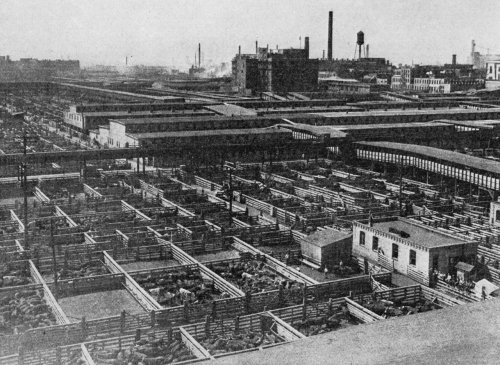
The muckraking journalists of the progressive era set their sights on the worst facets of industrialization and urbanization.  They sought to expose the exploitation of the workers and the working and living conditions of the urban poor.  A classic example, and one that led to reforms in the food industry was Upton Sinclair's The Jungle (1906) which sought to show the world the  conditions in the Chicago slaughterhouses.
Union Stockyards, Chicago 1920 Pax Canadiensis

One particularly revolting facet of the industry was the use of beef which had developed cysts due to the use of cheap fodder.  Upton wrote

"It seemed that they must have agencies all over the country, to hunt out old and crippled and diseased cattle to be canned.  There were cattle which had been fed on "whisky-malt," the refuse of the breweries, and had become what the men called "steerly" - which means covered with boils.  It was a nasty job killing these, for when you plunged your knife into them they would burst and splash foul-smelling stuff into your face; and wean a man's sleeves were blood, and his hands steeped in it, how was he ever to wipe his face, or to clear his eyes so that he could see? It was stuff such as this that made the 'embalmed beef' that had killed several times as many United States soldiers as all the bullets of the Spaniards, only the army army beef, besides, was not fresh canned, it was old stuff that had been lying for years in the cellars."  As quoted in (Hofstadter, Richard, ed. The Progressive Movement, 1900-1915. New Jersey: Prentice Hall, 1963.)

Monday, May 7, 2012

Algonkin Toll Booth, 1650

In theory, toll booths are used to pay for the expensive upkeep of infrastructure.  They can also be used for local authorities to extort those passing through.  Anyone who has been forced to pay a toll motivated by the armament of the checkpoint constabulary will know that coercion can at times be an important facet of "user fees".


Jim Miller's Skyscrapers Hide the Heavens notes that coercive toll booths in North America go back at least to the seventeenth-century.  Miller wrote,


"Particularly well-situated groups, such as the Algonkin of Allumette Island in the Ottawa River, used their position and power to exact tolls from canoe brigades, including those of traders, who passed through their territory.  The mastery they exercised was demonstrated graphically by their leader Le Borgne in 1650.  Offended by the efforts of a group of Huron under Jesuit leadership to evade his toll collection, Le Borgne had the priest 'suspended from a tree by the arm-pits.'  He told 'him that the French were not the masters of his country; and that in it he alone was acknowledged as chief.'" (p.37)
Champlain with Astrolabe on the West Bank of Ottawa River, 1613 (C.W. Jefferys, Library and Archives Canada/Charles William Jefferys fonds/C-073632) Champlain visited Allumete Island in 1613. Ontario Heritage Trust