Wednesday, June 6, 2012

D-Day Prayer in Calgary, 6 June 1944

Crowds on 1st Street SW, Calgary 6 June 1944
Canadian thoughts on the anniversary of D-DAy, are focused on the beaches of Normandy.  Those on the homefront during the Second World War also gave their thoughts to the men in France, and many took to the streets to show their solidarity.  Calgarians on 6th June 1944, took time from their day for a public prayer, in a show of concern for the soldiers, hopes for victory and a lasting peace after the conflict.

The display was not exactly spontaneous, having been organized by the Calgary Ministerial Association, and sanctioned by the mayor of Calgary.  An estimated 15,000 people who gathered on 1st Street West at 7-8th Avenues abandoned their daily duties to join in prayer.  Author Grant MacEwan, in his Calgary Cavalcade : From Fort to Fortune (1975), estimated that one sixth of the city's total population showed up that day to show their support. MacEwan wrote,
As if by magic the word went around downtown Calgary.  Stores closed at 11.20 a.m., and at 11.35 a military band led the huge host of earnest people in the singing of "O Canada." Usual street noises having ceased, the singing could be heard at Mount Royal College, almost a mile away.   (MacEwan, p.174)
The Calgary Herald  reported that the ceremony had a number of symbols familiar to Remembrance Day.  One Reverend Morley noted that it had been twenty-six years since the, "fallen heroes of the last war" in John McCrae's "immortal poem" had pleaded "to you from failing hands we throw the torch, be yours to hold it high." In keeping with Remembrance Day rituals, a minute of silence was held.


The Herald recorded the reaction from a cross section of Calgarians, most of whom were confident of success.  Worried mothers were happy, if concerned, and servicemen wished they were with their buddies on the beaches of France.  The Herald noted that there had been great anticipation of the event,
The announcement that today was D-Day did not surprise many Calgarians.  Most of them had expected that the invasion would be timed by the capture of Rome.
'Besides being a moral victory for us, the fall of Rome proved that our force in Italy do not need further support, and that our troops are now free to concentrate on France,' said a man who had been a major in the last war.
Advertising for War Savings Certificates shows the invasion was much anticipated.  6 June 1944 Calgary Herald.
The public ceremony, and its press reportage, is interesting for the what it does and does not say.  Were the protestant hymns happily sung by those who did not practice the faith? Did Calgarians really have the confidence of success that news articles portrayed? Some may not have believed this was the real show at all after false rumours of the invasion had been previously leaked.

As an instance when the fighting in Europe and the Canadian homefront are clearly linked, the public display frames an interesting moment in the Canadian experience of the Second World War.  Yet, as might be expected, the historical record cannot answer a myriad of questions regarding how thousands of diverse citizens understood the war.

Saturday, June 2, 2012

Old Black Joe Flavelle: Condemning the Great War Profiteer


 Library and Archives Canada/C-23692
Joseph Wesley Flavelle was a self-made millionaire whose business interests extended far beyond the meat-packing industry.  It was his profits from interests in the William Davies Company during the Great War, however, that drew a broadside of condemnation from the Canadian press and public.

The accusations were especially pointed from a man who in late 1916 had told Toronto manufacturers to ignore profit during the war.  Flavelle harangued the businessmen:


"Profits! I have come straight from the seat of a nation where they are sweating blood to win this war, and I stand before you stripped of many ideas. Profits! Send profits to the hell where they belong."(Bliss, p, 295)


Nevertheless, it was due to profits that the country found their villain in Flavelle.  Michael Bliss' biography noted that a man that started his fortune in the pork industry lent himself to gluttonous metaphors.  Bliss notes, "there were bitter jokes about baconets and baconeers, hogging the profits and wallowing at the trough." (Bliss, A Canadian Millionaire, xi) 

The story was broke by Saturday Night, and a reprinted pamplet shows the vindictive vitriol poured out on the Canadian businessman.
From "Joseph Discovered by his Brethren", Gadsby, H. Franklin.


Cover of Saturday Night pamphlet
The scandal killed Flavelle's reputation.  Despite his role in organizing the munitions industry, cleaning up the mess of inefficiency and patronage from the Sam Hughes days, Flavelle was the war's most notorious profiteer.  As he stated after a commission had cleared his name, "Shall we close this chapter[?] It is all over except the unfortunate remembrance in every part of Canada that I am [...] a profiteer." (CBC)

Saturday, May 26, 2012

Raucous Procession: Montreal Protests and Charivari

Montreal street protest
Flickr xddorox
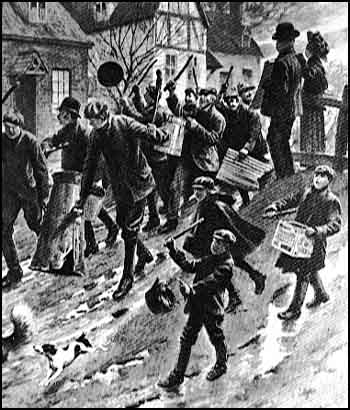
The spring 2012 Quebec protests have expanded beyond their focus on student tuition hikes in part due to the backlash against Bill 78.  In response to the law, which necessitates police approval for protest and assembly, Quebecois of various backgrounds have taken to the streets armed with various culinary noisemakers.  Banging pots and pans in protest has a long history in the province.  French-Canadians imported these practices from Europe, where the "charivari", a raucous procession used to shame a moral offender, dates back to the Middle Ages.

G. Desplat, Charivaris en Gascogne.1982.Darby's Diary

Brian Palmer outlines the practice of charivari in its earlier European forms in a 1978 article in Labour/Le Travail, "Discordant Music: Charivaris and Whitecapping in Nineteenth-Century North America."  Palmer wrote that, "the demonstration was most often initiated under the cover of darkness, a party gathering at the house of the offender to beat pans and drums, shoot muskets, and blow the ubiquitous horn, which butchers often rented out for the occasion. Sometimes the guilty party was seized, perhaps to be roughly seated on a donkey, facing backwards, and then paraded through the streets, passers-by loudly informed of his/her transgression.  (p.9) The ritual was "most often used to expose to the collective wrath of the community adulterous relationships, cuckolded husbands, wife and husband beaters, unwed mothers, and partners in unnatural marriage."


Palmer notes that in England, the term "rough music" was applied to the ritual, and that if warnings for bad behaviour were not heeded, the procession would set out for the house of the deviant.  "Under the cover of darkness a procession formed, headed by two men with huge cow-horns, followed by an individual with a large old fish-kettle around his neck, representing the trumpeters and big drum of a serious parade. The legendary neo-marxist historian E.P. Thompson described the procession as, "a motley assembly with hand-bells, gongs, cow-horns, whistles, tin kettles, rattles, bones, frying-pans, everything in short from which more and rougher music than ordinary could be extracted.''  Palmer notes that the different forms of charivari in early-modern Europe were "a pre-political form of class action" used for social control.  (p.15).


In North America, the charivari was first prominent in Lower Canada, Lousiana and Alabama (Palmer, p.17)  At times the practice could manifest in racist actions where citizens felt racial boundaries had been overstepped.  On occasion the rite was used as a form of political protest, but Palmer argues this was rare. Palmer notes that around 1890, North American charivari practice died down, replaced in part by white-capping, or vigilante justice against moral offenses.


Allan Greer disagreed with Palmer on the importance of charivari as a mode of political protest.  In his 1990 Social History article "From folklore to revolution: charivaris and the Lower Canadian rebellion of 1837", he notes that the rebellion changed the charivari procession from its traditional role of social protest to more explicit political purposes.  Prior to the rebellion, charivaris were used specifically against marriages which were considered ill-matched.  Yet during the failed uprising of the Patriotes, the charivaris could take a aggressive stance towards local Loyalist officials.


Greer cites the case of one Lieutenant Dudley Flowers of St Valentin, whose house was subject to a particularly violent form of charivari, where the Patriots sought his resignation.  Flowers wrote in 1837,

On the following day (Sunday) about seven in the evening, some sixty or seventy individuals attacked my house a third time in the same manner and with the same threats as on the former occasions but if possible with much more violence, beating kettles and pans, blowing horns, calling me a rebel, saying it would be the last time they would come as they would finish me in half an hour. They had in a short time with stones and other missiles broken in part of the roof of my house and boasted that it would soon be demolished. Fearing that such must inevitably be the case, I opened the door and told them that if four or five of their party would come in and give their names I would give them up my commission. (Greer, p.38)


flag
Flickr: alexsnaps
It appears that it is this form of political protest that has inspired Montrealers to take their pots and pans to the streets.  Some mention has been made of the Chilean cacerolazo protest of the 1970s and 1980s, and a facebook callout linking the Montreal protests to this practice.  It seems odd that charivaris would be downplayed as the logical cultural precursor to this form of protest.


Western Canadian First Nations Midwives

The role of the plains Native midwife is an interesting aspect of aboriginal life, which offers insight into spiritualism, medicine, and early native-newcomer contact. Maureen Lux’s Medicine that Walks: Disease, Medicine, and Canadian Plains Native People, 1880-1940 (2001) is largely a social history of medicine which plots the devastating demographic effects of disease and malnutrition. Lux notes that aboriginal birth has been largely unstudied, due the morbid focus inherent in the tragedy of the early-reserve era.
Glenbow Museum File number: NA-1241-296
Title: Mrs. Thomas Lefthand, Stoney.
Date: [ca. 1940]

Lux notes that many aboriginal midwives were also considered healers with connections to the spirit world. The details of the birthing process show that birth was a group effort.

The mother kneeled with her back against a chest-high support and was attended by three other women. The primary midwife stood behind the mother and supported her; another received the newborn and cut the umbilical cord; the third assisted the other two. To speed the birth of the placenta, hot water was placed under the woman as she knelt. The umbilical cord was cut ‘at a point one hand grip and one thumb’s breadth’ from the abdomen. A light dressing made from the powdery centre of the prairie puffball (Lycoperdon gemmatum batsch) was applied to the navel; this acted as a styptic (Lux, p.92)

The umbilical cord itself was considered a special part of the process. As Blackfoot elder Russell Wright noted,

When a child was born, it was traditional for the midwife to cut the umbilical cord and the child’s aunt or older sister would clean and dry it. Then she made a hide pouch in the form of a turtle or some other animal, beaded it, and sewed the cord inside. The child wore it for the first five years of life at special occasions when people gathered together. The pouch reminded people the child had many parents and everybody was responsible to help the child grow to become worthy to the tribe.

Image No: NA-1271-2
Title: Mrs. Adam Callihou, Metis at Hazelmere, Alberta.
Date: 1955
Remarks: Mrs. Callihou, nee Veronique Gladu, was born at Lac St. Anne in 1856
. First married to Francis Hambler and after his death to Adam Callihou.
 They farmed at Flying Shot Lake, southwest of Grande Prairie, Alberta and
 Mrs. Callihou acted as midwife and nurse for the first settlers in the area.

An interesting cultural facet of the childbirth itself was the expectation that a mother would show no pain. Women were expected not to announce that they were in labour until the last moment. Independence was emphasized and women were to prepare for the moment by themselves. They were to maintain their composure and remain quiet during the birth. (Lux, p.94) Europeans often mistook such control for a painless or effortless childbirth.

File number: NA-1030-4
Title: Mrs. David McDougall.
Newcomers also benefited from the experience of plains Native midwives. In Manitoba, Annie McKenzie McDougall married the trader David McDougall in 1871 and shortly thereafter birthed their first child. She remembered her native friend Mary Cecil acting as her midwife. In the Rocanville district of Saskatchewan, a Cree woman by the name of Bastien acted as midwife to new immigrants. One woman recalled she was the “nearest thing to an angel on earth”. (Lux, 98) Later, in the 1930s, women reportedly used Native midwives when they couldn’t afford going to the hospital.

Midwifery is still an important factor of First Nations life.  The National Aboriginal Health Organization released a series of pamphlets on the subject in 2009.

Friday, May 25, 2012

Wall Street: The Embodiment of Evil in the 1880s

The portrayal of Wall Street as the embodiment of an evil capitalist is as familiar to the reader of 2012, as to an American of the mid-west in the late nineteenth-century.  Russel B. Nye's Midwestern Progressive Politics (1959), notes that it did not take long for the alienated Midwest to strike back against the colonial pressures of "the triple alliance of railroads, banks and tariff-protected industry." (Nye, 12)  Nye noted that

 'Wall Street' became very real to the Midwest as a general term including the entire body of Eastern influence - the moneylender, the high-tariff manufacturer, the market speculator, the railroad king, the trust holder, the mortgage owner.  It might mean Minneapolis, Chicago, Kansas city, St. Louis, or Boston as well as New York, but "Wall Street" was a living entity, a major influence in Midwestern thinking after 1865.


The evil Rockefeller depicted in"What a Funny Little Government" Horace Taylor 1899 Haley Ghiringhelli's Blog

One Granger writer wrote of the Midwestern concept of a meeting of the directors of one of these nefarious corporations.  The sinister meeting agenda would read thus:

"Order of Business:
bankrupt farmers,
form new monopoly,
rig market,
fix prices;

Resolutions Passed:
raise interest rates,
lower farm prices,
instruct business through interlocking directorates to raise prices on all goods sold to farmers,
order newspapers to support regular party candidates,
allot money to 'educate' legislatures,
declare dividend,
adjourn."


Nye notes that Midwestern Americans of the late nineteenth-century expressed, "the feeling that the average Midwesterner had entertained for some time, that something (he was not certain what) was riding him hard.  He called it variously the Money Power, the Rich, Invisible Government, Plutocracy, Wall Street, the Trusts, the Interests, or the Gold Bugs." (Nye, 106)