Showing posts with label review. Show all posts

Tuesday, December 18, 2012

Review - James Wood's "Militia Myths"


James Wood.  Militia Myths: Ideas of the Canadian Citizen Soldier,
1896-1921.  Vancouver  University of British Columbia Press, 2011. 
368 pp.  $35.95 (paper), ISBN 978-0-7748-1766-0.

Reviewed by William Pratt (University of Calgary)
Published on H-War (December, 2012)
Commissioned by Margaret Sankey

The patrimony of the Canadian militia myth is conventionally traced back to the first Anglican bishop of Toronto, John Strachan (1778-1867), who attributed British success in the War of 1812 to the stalwart Loyalist militia. The notion that citizen soldiers were the best way to defend the country has resonated in the country ever since. Indeed, Jack Granatstein's survey _Canada's Army: Waging War and Keeping the Peace_ opens with the statement that, "the central myth in the history of Canadian arms is, and always has been, that the colonists and citizens provide their own defence."[1] In the twentieth century, the old story of a Canadian Expeditionary Force composed of sturdy woodsmen, farmer's sons, and other pastoral citizenry that answered the call of Britain in 1914  has long been refuted by Canadian military historians. A recent work in the Studies in Canadian Military History series, co-published by the University of British Columbia Press and Canadian War Museum, proves, however, that Canada's militia myth has a much longer intellectual genealogy, and was by no means a static concept. As its author writes, "Although Canadians retained their confidence in citizen soldiers throughout the first decade of the twentieth century, the range of justifications they expressed in defence of that faith points not to a single all-encompassing militia myth but, rather, to a collection of competing and even contrary ideas by which they ordered their understanding of war" (p. 143).


James Wood's _Militia Myths: Ideas of the Canadian Citizen Soldier, 1896-1921_ examines the ideal of the trained militiaman in military rhetoric of the day, and the eventual replacement of this icon after the First World War by the archetype of the untrained civilian. The idea of the citizen soldier is defined by Wood as "a belief in the conviction that good citizens should provide for their own defence" (p. 10). Wood focuses largely on the literary and cultural elements of Canadian military journals, especially rhetoric found in the _Canadian Military Gazette, _which is systematically analyzed here for the first time_. _The work stems from the author's dissertation at Wilfrid Laurier University supervised by Roger Sarty, which is indicated by exhaustive citation and academic prose.


In search of the lineage of the militia myth, Wood delves much further than the War of 1812 into the traditions bestowed to the North American colonies in the seventeenth and eighteenth centuries. After the English Civil War and the Glorious Revolution of 1688, regular soldiers were regarded with a "mix of contempt and fear" (p .5). Oliver Cromwell's New Model Army connected standing armies to tyranny in the minds of many, and such ideas, when transplanted to North American soil, encouraged praise for the British North American militia in the War of 1812, and later the Dominion of Canada's nascent military exploits in the late nineteenth century. After noting these British antecedents, however, Wood writes that "In its Canadian context, the militia myth refers to a dangerously faulty memory of the War of 1812 and the ill-founded confidence of Canadians in the abilities of amateur citizen soldiers" (p. 11).
“Militia Training on the King’s Birthday,” by C.W. Jefferys, from The Picture Gallery of Canadian History, Vol 2. Toronto : Ryerson Press, 1945, p. 116. http://1812.kfpl.ca/war-of-1812-may-5/

In the Dominion this myth did not go unchallenged. The small instructional cadre of the Permanent Force and representatives of the British Army (especially the British General Officer Commanding the Canadian Militia) fought against the notion that partially trained citizen soldiers were enough for the purposes of Canadian defense. To these groups, Wood adds "an identifiable group of professionally minded militia officers whose efforts Canadian historians have mostly overlooked," who did not call for a professional standing army, yet railed against public apathy towards defense (p. 6).

Before the Boer War, the Canadian militia ideal was rooted in the home defense tradition, and strongly connected to marksmanship. Public apathy was shaken with the Venezuela Crisis of 1895-96 and the outbreak of the Spanish-American War in 1898. A revival of military interest emerged in the early years of the Laurier government. This enthusiasm was largely expressed in the proliferation of rifle shooting, both in paramilitary rifle clubs, and as formal training endeavors. Military reform was stifled by an aversion to standing armies until general officer commanding, Major General Sir Edward Thomas Henry Hutton, skillfully used the rhetoric of a "national army" to promote change. Hutton is shown to leverage a national appeal for the militia, working hard to popularize it in Quebec. He urged Canadians to take up universal military training on the Swiss model and encouraged marksmanship. Wood argues that while Hutton was successful in invigorating militarism in Canada, he was influenced by ideas that were already rooted in the debates of colonial militiamen. 

Despite this awakening, before the Boer War, the Canadian militia was, "more deeply involved in its social role than its military function" (p. 29).

The Boer War itself fostered notions that an armed citizenry could best regular soldiers, yet raised the problem of deploying a home defense militia overseas. Instead of the notion in the historical literature which suggests that militia officers believed in an untrained citizen soldier, the debate after the Boer War was instead focused on what degree of training was required (p. 94). The Dominion Militia Act of 1904 enshrined ideas that the colonial troops had performed well in the Boer War, and promoted the idea of a citizen army.

Wood argues that despite the contentions of historian C. P. Stacey, the period before 1909-10 was characterized by a conception of home defense against an American invasion. With the outbreak of the Great War, the focus shifted from a home defense force to an expeditionary force, and the eclipse of the active militia in popular esteem by the Canadian Expeditionary Force. In the years before the war, rhetoric increasingly dwelt on the responsibilities of citizenship when promoting military participation. As Wood notes, "Conditioned before the war to accept military service as a duty of citizenship in time of war, when the war in Europe turned into a national crusade and the CEF became a symbol of the nation-in-arms, this pre-war understanding of a citizen's duty became one of the foundations of conscription in 1917" (p. 212). Up to 1917, Canada's "home defence orientation" was associated with the "citizen soldier ideal" (p. 1). After conscription, the long-serving prewar militiaman was overshadowed by the notion of the innately talented civilian going straight from civvy-street to the battlefield with a modicum of training.While a host of newspapers and journals are listed in the bibliography, the main source of analysis is the _Canadian Military Gazette. _This was the only military journal to continue publication for the period studied. The journal was self-proclaimedly nonpartisan and reprinted articles on military themes from across the country. As with any discursive study of a print source, ascertaining the extent to which views expressed in the journal were read and accepted by Canadians is problematic. Wood notes that hundreds of men may have read a single copy in the mess, but it may be equally true that copies moldered without ever being read. That the journal was quoted by newspapers across the country is a good indicator that its columns carried some weight, as are frequent references in the _Canadian Annual Review of Public Affairs _(pp. 14-16).


In addressing the historiography of the ideas surrounding the Canadian militia, Wood grapples with both historical heavyweights and a new breed of contenders. Carl Berger's classic work on imperialist thought in Canada, _A Sense of Power _(1971), posited that Canadian nationalism was heavily influenced by, and compatible with, imperial ties to Britain. Wood challenges these imperial connections when applied to the militia, suggesting that, "the indigenous citizen soldier traditions of the country" were highly influential in forming imperial notions in Canada (p. 55). Militia criticisms of the Permanent Force often hinged on the British character of the regulars, blaming them for bending to the whims of patronage (pp. 58-64). Wood notes that while military reformers couched their criticisms in rhetoric which emphasized duty to the British Empire, the specific reforms they promoted advocated home defense (p. 143). Wood is especially set against the utility of gender studies in examining the militia. For example, he considers the approach of Mark Moss's _Manliness and Militarism: Educating young Boys in Ontario for War _(2001) to be ahistorical. While Moss argues that the cadet movement was an exercise in socialization and control, fostering militarism and patriotism, Wood contends that the long-term military aims were never overshadowed by progressive social prescriptions (p.163).


The extent to which the ideas in the _Canadian Military Gazette _and those expressed in the speeches of the Canadian Defence League or various general officers commanding were shared by the general public is, of course, questionable. Wood convincingly suggests that while at the beginning of the Laurier era, the general public was little interested in military affairs, by the time of the Dreadnought crisis in 1909-10, Canadians had awakened to military demands. The degree of sophistication of the civilian public's thoughts are challenged, however; Wood notes that "many Canadians simply enjoyed a good parade and felt, almost instinctively, that maintaining a national army was simply something that 'grown up' nations did" (p. 3).

Wood's work expands our knowledge of the Canadian militia beyond the elite imperialists and general officers commanding. By a close study of the _Canadian Military Gazette _and the speeches of militia officers and advocates, he shows the complex varieties of thought regarding the role of the citizen soldier in Canadian defense. By doing so he muddies the waters of the traditional historiography surrounding imperialism and the militia in Canada. More a history of military thought than a discursive study of popular conceptions, the work will appeal to academic military historians, while leaving gendered analysis and discourse and identity studies to the social historians.

Note

[1]. Jack L. Granatstein, _Canada's Army: Waging War and Keeping the
Peace _(Toronto: University of Toronto Press, 2004), 3_._

Citation: William Pratt. Review of Wood, James, _Militia Myths: Ideas of the Canadian Citizen Soldier, 1896-1921_. H-War, H-Net Reviews.
December, 2012.
URL: https://www.h-net.org/reviews/showrev.php?id=34351

This work is licensed under a Creative Commons
Attribution-Noncommercial-No Derivative Works 3.0 United States
License.

Sunday, April 3, 2011

Review - Cameron Duder - Awfully Devoted Women

Duder, Cameron. Awfully Devoted Women: Lesbian Lives in Canada, 1900-1965. Vancouver: UBC Press, 2010.

Cameron Duder's Awfully Devoted Women: Lesbian Lives in Canada, 1900-1965, traces same sex relationships of middle-class women from the period of early-twentieth century romantic friendship, through to the post-Second World War era of working-class lesbian bars. The work uses several collections of letters and interviews of middle-class and lower-middle-class women to correct a historiography which focuses largely on post-war bar scene and the rise of political and community groups from the late 1960s. Awfully Devoted Women notes that the experiences of women need not fit into the dichotomy framed by the literature of the allegedly nonsexual "romantic friendship" or sexually charged butch-femme relationships. Duder also notes that, contrary to the historiographical consensus, there is evidence that women in pre-war romantic friendships were physically intimate.
Dr. Duder.  Photo: Social Photography
        Duder's goal is to describe women's lives not to theorize about lesbian identity, yet identity issues are breached in addressing the "medicalized discourses of sexuality" in the post-war era and especially in the power of social expectations. For lower-middle-class lesbians, concerns of respectability, class and safety meant that the bar scene was an unacceptable place to socialize. As the author states, "it would be incorrect to portray these women whether as closeted middle-class women whose place in lesbian history is therefore marginal or as [...] faultless heroines who countered the odds and formed community in the face of homophobia. They are at once both of these things and neither. Their stories indicate, rather, that class and sexual orientation are always entwined and that they can work with and against each other in the same individual and simultaneously."
       Sources are a tremendous limitation for those who would wish to take Duder's emotional and personal analysis further in the pre-war period. In this way, Awfully Devoted Women may be a one-off study. The question arises as to whether universal conclusions can be drawn about visibility and physicality of pre-war lesbian lives from Frieda Fraser's papers at the University of Toronto archives (the "richest collection" of papers in Canadian lesbian history), and the handful of smaller collections available. Duder may be content with correcting historiographical notions, which posit that there was no genital contact in romantic friendships, by offering select cases which suggest otherwise. The reader is left wondering if the few relationships that Duder features were typical of the time. In showing the sexual naivety of lower-middle-class women in the post-war years, the Lesbians Making History collection of interviews, and personal testimony from women themselves, allows Duder to assert a more authoritative statement, from a wider body of evidence. Despite the rise of sex education, a lack of knowledge about sexuality meant that women necessarily experimented when forming sexual relationships.
"Queer Affair" Lori Newdick. Heroines Series. Library and Archives Canada.
        Awfully Devoted Women traces the history of same-sex relationships on emotional, sexual, and social levels. The narrative is driven by the voices of the women subjects, in their letters and interviews, which makes for a very readable account. Bedroom details of genital contact are sure to keep pages turning, but details of how lesbians remained visible to like-minded women, yet still remained respectably distanced from the bar-scene, as well as  relationships with families who were still expected to provide for their lesbian children, are equally interesting. Academics will perhaps rail for more gender-theory, but Duder does address interesting historiographical and theoretical currents without writing explicitly for the expert. A particularly interesting theoretical construct is seen in the use of queer theory in analyzing how pre-war lesbians used Freudian language to describe their "libidinal desires", yet remained aloof from these text's pathological implications of deviant sexually.
        Awfully Devoted Women was selected for the 2011 Over the Rainbow Book List, by the Gay, Lesbian, Bisexual, and Transgendered Round Table of the American Library Association. As an important work in Canadian gender history, and perhaps the book on early-twentieth century middle-class lesbianism, it is sure to also grace the reading lists of graduate seminars for some time.


Friday, March 25, 2011

Review - Frances Swyripa - Storied Landscapes

Frances Swyripa's Storied Landscapes: Ethno-Religious Identity and the Canadian Prairies (Winnipeg: University of Manitoba, 2010), examines memory, meaning, and identity in a broad range of European immigrant groups. A series of connections frames the work, which link immigrant groups to other Canadian westerners, Canada as a whole, the mother country and the diaspora. At times these various "imagined communities" could be "overlapping....incompatible and competing." (8) For Swyripa, Ethno-religious identity is a major theme in Canadian regionalism which varies with each group's experience.  In tracing the history of heritage, Swyripa notes, "the landscapes are both physical places and places of the mind, the stories the multilayered, sometimes contested narratives and material legacies that immigrant settler peoples mobilized in shaping and claiming those places. "
      The attachment to the land and the manner in which it was ordered to gain meaning is an important theme in Storied Landscapes. Immigrant groups that arrived en masse are shown to often invoke the location of arrival as an important place. An interesting aspect of this relationship to the land is described in Ukrainian "cultural conditioning", which could affect selection of homesteads. Life on the steppe had taught that where there were trees there was fertile soil and firewood, yet in the prairie context this land demanded great labour to clear. Many homesteads were chosen in the infertile Interlake region of Manitoba. (43)
Sacred and secular symbols could be appropriated to bond ethnic groups. Numerous types of places served as artifacts which bound ethno-religious groups in a common identity. Communal pilgrimages to shrines could bolster faith, "but also reaffirmed the ethnic community in its primal connection to a specific place and its history." (66) Cemeteries also "helped create psychological and physical bonds to the new country". Founding fathers and arrival places were often a powerful secular symbol for those groups whose history featured a mass immigration.
Swyripa Lecturing at UofA. CIUS.
      Swyripa also examines the relationship between immigrant groups and other Canadian westerners. At times this is portrayed as a minority hoping to shape its own way of life within a society dominated by the majority. In other cases, the immigrant pioneer is integrated into the greater national narrative of western settlement. On the regional level, the prevalent use of the symbol of wheat and the grain elevator, (on tombstones, municipal logos, and public sculptures), linked the group to the specific lived experience of the prairie and "erased ethno-religious boundaries." (183) Wheat's history as a Christian symbol of "fruitfulness, the staff of life, or...the body of Christ", helped cross the divide between sacred and secular identity. Swyripa also notes conversely, the greater group can at times appropriate the symbols and myths of ethno-religious identity. Originally exclusive and Anglo-Canadian, by the 1930s, "the “old West” relished its diversity, proudly proclaiming cultural pluralism one of the defining features of the regional society." (22)
CPR Poster in Ukrainian, 1910-1930, GA.
      Swyripa treads wide expanses opening questions for others to explore. Canada's long-running discourse on peasants is one such theme.  Swyripa notes that Clifford Sifton's late nineteenth-century immigration policy recruited the eastern-European workers of the soil.  How was this notion related to earlier considerations of the Indian Department's Hayter Reed and the peasant farming model which brought severalty to the reserves in the late 1880s? How did later stories about European peasants in memory interact within the larger group's conception of the yeoman pioneer? The relationship between these prairie newcomers and the greater western region are addressed in brief, but a more in-depth consideration of how the experience of these newcomers interacted within western alienation, the rise of Social Credit and the C.C.F., and broader historical changes awaits another book. As a work in the booming field of historical memory which examines the similarities and differences of identity-creation across a range of ethno-religious groups, Swyripa's work is to be recommended.

Thursday, February 3, 2011

Review - Sean Mills - The Empire Within: Postcolonial Thought and Political Activism in Sixties Montreal

Sean Mills' The Empire Within: Postcolonial Thought and Political Activism in Sixties Montreal (McGill: Montreal, 2010), traces the discourse of decolonization throughout the rise of diverse Montreal protest groups in the 1960s. The work shows that activism during the period was dynamic and complex, and moves far beyond a simplified popular version of the era centred on the FLQ's radicalism. Revising a historiography which shows the period as a reaction to the social conditions of 1950s Quebec, Mills contextualizes the intellectual ferment in Montreal with that of international dissident political movements and thinkers. Despite the diversity of groups struggling for empowerment across racial, linguistic, economic, and gender divides, Mills observes that "hovering over all of the conversation of leftists throughout the city was Montreal's relationship to empire." (51)


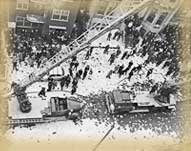
Sir George Williams Riot, 1969

Intellectuals such as Jacques Bergue, Albert Memmi and Frantz Fanon developed a conceptual framework which saw colonialism divide human groups. The colonizer systematically suppressing the culture, language and history of the colonized. Such a process leads to the internalization of racist structures by both sides of the power relations, which can still persist in neo-colonial forms. The Quebec protest movement would infuse these ideas with the specificity of anti-colonial Marxism, which Robert Young claims "emphasizes [...] the untranslatability of revolutionary practices, the need for attention to local forms, and the translation of the universal into the idiom of the local." (34) Mill sees the Partis Pris as having the largest impact on the "language of dissent" in Quebec. This publishing house cum political party saw the Catholic Church as a primary mechanism of colonial power and adopted a program of secularization, independence and socialism. With these ideas and the demographic transition fuelled by increased immigration, the post-war baby boom, and urbanization, Montreal became a hot-bed of criticism against what was increasingly characterized as a unjust colonial system.

         Mills traces the rise of social protest groups which differentiated themselves due to race, gender, language and class, emphasizing their shared international influences in the realm of post-colonial thought. The emphasis is on the writers of the manifestos and the intellectual leadership, and it is noted that the postcolonial message is diluted when analysis strays from these "elites" to the rhetoric of the street protest. As militant protest rose after 1968, a blend of socialist decolonization, Marxism and the old "tropes of traditional nationalism" were prevalent in popular protest. (158) While an underlying nostalgia seems impossible to avoid in dealing with the sixties era, Mills does not romanticize his subjects. The macho and masculine discourse of black-power is shown to exclude women, the FLQ's accusations against Trudeau are denounced as homophobic, and women's groups are seen splintered along the lines of whether to include men in their struggle. It seems that the non-hierarchical and democratic nature of many protest groups made for unification against a common enemy at first, but then led to dissipation and internal conflict. Ultimately, leftist protest and their post-colonial framework was usurped by the class-based analysis of the labour movement.
Student Protest Montreal, October 1968
        Mills' work approaches a stand-alone history of the Quiet Revolution, yet its focus is clearly on the left, leaving the provincial and Catholic Church's reactions to the protest movement to other monographs. Also remaining unexplored is the intertwined conceptual framework of Marxist structures with post-colonial thought, which is perhaps germane to a history of leftist protest. The extent to which the post-colonial thought of the manifesto writers was on the public's mind is left ambiguous by Mills' brief comments on the rhetoric of street-protest, but an analysis of the broader public discourse during the era is perhaps another book awaiting its author. The clean sweep of historical awards granted The Empire Within shows that historical establishment is favourable to Mills' work. For moving beyond an exceptional Quebec in this transnational approach, rising above a historiography focused on the radicals behind the October Crisis, and providing an excellent readable history of a fascinating period of Quebec, Mills' work is a necessary addition to the literature of the period.

Sean Mills, The Empire Within: Postcolonial Thought and Political Activism in Sixties Montreal (McGill: Montreal, 2010).