Showing posts with label Armour. Show all posts

Thursday, May 24, 2012

24 May 1944 Lord Strathcona's Horse CONNOLLY tank casualties

The horrible burning deaths suffered by tank crews in the Second World War, are uncomfortable to comprehend.  The breaking of the HITLER LINE in the Second World War is usually treated as a triumph, but as per usual on the battlefield, tragedy was a part of victory.


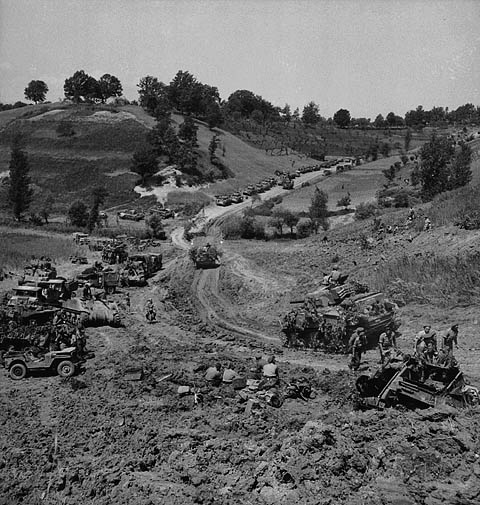
Forces canadiennes avançant de la ligne Gustav vers la ligne Hitler.
Credit: Strathy Smith / Canada. Ministère de la défense nationale / Bibliothèque et Archives Canada / PA-140208

The Lord Strathcona's Horse war diary lists the soldiers killed in the confrontation on 24 May 1944. John Milroy recorded the casualties in his CMH article: "The battle cost the Strathcona's 17 tanks for the destruction of five German tanks, eight selfpropelled guns and various other equipment. Two officers and 18 other ranks were killed; seven officers, including the second-in-command and the "A" and "C" Squadron commanders, and nine other ranks, were wounded."

The Strathcona's had advanced by using ground considered not-tank-country, and surprised German Panther tanks and guns on the far side of the Melfa River which were covering a more passable ford.  The action was an anomaly of armoured combat in the Italian campaign as a tank duel erupted between the panthers across the river and 'A' and 'C' squadrons of the Straths.  The confrontation would be a rough initiation to the grim side of warfare for many of the Canadian soldiers.  Some would not live through it.

Four crew would perish in the tank CONNOLLY, reported "hit by 88" on 24 May, and burned with its crew inside.  The men were commanded by Capt R.G. Crimes whose next of kin was listed as his father who lived in Halifax, but may have been from St. Thomas, Ontario.  Captain Crimes commanded a western crew whose driver had the remarkably low army identification number of, H-46. Thirty-year old Trooper Albert P. "Bud" Lee's wife, Mrs. Rita Pearl Lee, lived in Portage la Prairie, Manitoba.  The bow gunner A.A. "Smitty" Smith was said to "chum" with "Bud" Lee.  His father resided in Saskatoon.   Trooper George.T.Davis  "Davey" was the gunner operator.  His father lived in Vermillion, Alberta.

The men were first interned in a cemetery on the Melfa, but were transferred to the Cassino War Cemetery.  They were four men out of the millions who perished in the Second World War.  The Commonwealth War Graves lists 27 men with the name of A.A. Smith alone.  Despite the immensity of the conflict, the individuals who lived and died are important.  A glimpse into their lives gives a human meaning to the casualty figures.
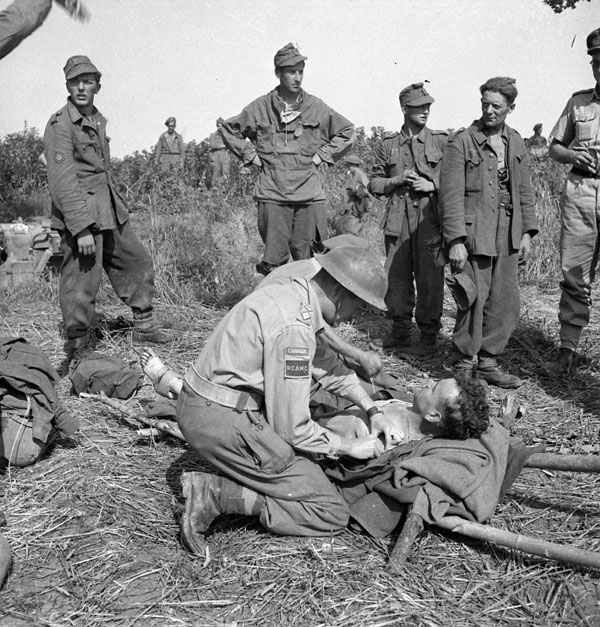
Captain J.A. Gardner talking with a wounded German soldier in the Liri River valley, Italy, 24 May 1944.  Credit: Lieut. Strathy E.E. Smith / Canada. Dept. of National Defence / Library and Archives Canada / PA-144981

Thursday, February 9, 2012

Hard Working Tramps: Second World War Canadian Tank Transients, 1942

The romantic image of the hobo is well entrenched in the North American mind.  The ideal of the good-natured transient, riding the rails with a gunny sack tied to a pole, paints a pastoral scene which fails to capture the hunger, squalor, and desperation of unemployment.  The pages of a Canadian Second World War service magazine, however, link the techniques of survival in the Great Depression to the lived experience of modern warfare.

The Tank was the Canadian Armoured Corps' magazine, operating out of the Armoured Fighting Vehicles School in Borden, Ontario.  A self-styled "transient", wrote in to express the not-so-patriotic motivations behind his enlistment.
"DEAR MR. EDITOR:
     One dollar and thirty cents a day, in which you get three meals, a roof over your head, and clothing on your back.  That's why I'm in the army.  The C.A.C. just happened.
     It's a lot better than being a transient.  I joined up at the first place that would take me.
     I was on the trek for three years.  You ride the rods, hitch-hike or tramp.  You work when you can get it.  You eat when you can get it, sleep where you are, panhandle when you've got to, and duck the bulls.
  [...]
I was a good transient and good transients are not lazy.  I do my work, keep clean, and I'll show them how a transient can fight if I get the chance.  But, if they'd had those work camps, I'd had to work harder than I do in the army.
     We'll win the war.  Do you think we'll win some common sense?
 * * * * * TRANSIENT"
The Tank - Canada, June 1942


Another letter from the Ontario Regiment overseas noted that the skills of the homeless were particularly useful on the many schemes and exercises.  In August 1942 The Tank reported:
"Living as we did in the open, old time campers and men who had seen "civilized-jungle" life were great teachers.  On one occasion a civilian car killed a duck in the road, one minute later it was in a tank, a few minutes later on reaching a harbour it was over a fire, and shortly after that, inside the tank crew.  It is not that starvation rations had been issued, but who wouldn't prefer roast duck to bully-beef?"

It seems that the techniques of scrounging were as applicable to Second World War army life as they had been to unemployment in the 1930s.

Friday, December 16, 2011

Affectionate Vehicle Names: Crerar vs. Vokes, 1944.

Crerar goes to France
Department of National Defence /
Library and Archives Canada.
Many of us name our vehicles.  They do seem to be animate enough to deserve a nickname, be it "Ol Betsy", "Rusty", or "The Green Bandit."  Soldiers, too, wished to name their vehicles and for the Canadians in Italy, their right to do so became a contentious issue as the I Canadian Corps was being formed.  General Harry Crerar, known for spit and polish discipline, arrived in the Italian theatre convinced that the 1st Canadian Division needed to shape up, and the painting of non-standard letters on vehicles was one aspect which needed to go.

General Chris Vokes, took a different attitude towards the naming of vehicles.  As Vokes put it, "in war a soldier craves affection.  He also craves something on which to lavish his affection: Jeeps, trucks, dogs, women, any damn thing he can get his hands on, even ducks and geese." (Vokes, My Story, 153)  He noted that for the truck driver, this need to show his affection to his vehicle was an extension from the days of the cavalry, when a soldier loved his horse.  Vokes explained in his direct manner, "he'll paint his girl's name on the engine hood, or his wife's, or some old whore's name, it couldn't really mater.  The vehicle is henceforth called by that name, and given tender loving care - proper maintenance."

Crerar finally yielded on the naming of vehicles, but insisted that names would have to be in letters no more than one inch high, inside the cab, on the dash.  Reportedly, in a weeks time, acts of defiance were all too visible.  Names were scrawled loud and proud, "once more sprouting from engine hoods, in the largest possible letters."

The naming of tanks had long been practiced in the Canadian Armoured Corps.  Tanks usually started with the squadron letter.  Tanks of "A" squadron would all begin with the letter A.  An entry in the 5 Canadian Armoured Brigade diary, noted that in the multi-ethnic Eighth Army, one tank's name would have to be altered for reasons of religious sensitivity.  The intelligence officer wrote, "A tk which was named ALLAH has had the name changed to ATILLA.  Indian tps may have been offended at the original name."

Lance-Corporal M. R. Leonard examining the "Little Henry" painting on a Sherman tank of the Three Rivers Regiment near Lucera, Italy, 21 October 1943.Credit: Lieut. Frederick G. Whitcombe / Canada. Dept. of National Defence / Library and Archives Canada / PA-201363

Friday, November 25, 2011

Canadian Smokes for English Girls: Strathcona's Ladies' Auxiliary, 1942

A December 1942 issue of the Canadian Armoured Corp's journal The Tank notes the appreciation of the soldiers of the Lord Strathcona's Horse for the cigarettes sent overseas from the Ladies' Auxiliary in Calgary and Winnipeg.  Notes from the Sergeants' Mess stated:

"Our sincere thanks are due to the Ladies' Auxiliary in Calgary and Winnipeg who have done wonders, with the help of the Navy, in keeping us supplied with cigarettes.  The shortage of smokes is not as acute as it was when we first arrived over here but just the same the cartons from Canada are very welcome - there seems to be no smoke like a Canadian one.  Even the girls over here have developed a taste for them and when one of the English girls gets romantic over a strapping Westerner it's hard to tell if it's love at first sight or a desire to light up.  To the Ladies we say thank you."

An ad from Dec. 1942 "The Tank"


One can only assume that the Ladies' Auxiliary were none too pleased that their cigarette contributions were being used to court young English women.  Wives back in Canada, would have been justified in asking the Brits to butt out!

Saturday, April 2, 2011

The Public Discourse of Mechanization: the Buy-A-Tank Campaigns

The Canadian idea of mechanization as the means to save soldier's lives was greatly heightened after the fall of France in May 1940. The so-called Blitzkrieg seemed to be irrefutable proof for arguments that the tank was the war-winning weapon. By the summer of 1940, a portion of the Canadian public had become disenchanted with the scale of Canada's war effort, and sought to raise money to equip the Canadian army with the tools deemed necessary for mechanical, motorized warfare.
The tank, in popular opinion,was deemed the technology necessary for the Canadian Army to modernize and overcome the mechanized German menace.  This public discourse of mechanization is evident in Kitchener, Ontario's "Buy-A-Tank" campaign. Fundraisers called for private donations for the purpose, and set up carnival games which had a particular war-time flavour. One newspaper account noted that "would-be archers pay 25 cents for three bow-and-arrow shots at a likeness of the German chancellor.
Miami Daily News, 4 June 1940.
The Regina Leader Post reported that such enthusiasm was encouraged by Minister of National Defence, J. L. Ralston's announcement that the government welcomed the donation of money and war materials.   A campaign to buy-a-tank was also underway in Prescott, Ontario.  Money was donated from industry, municipalities, and individuals.  The Leader Post reported that a tank from Camp Borden would be featured in the parade that would end the drive.  The paper noted, "firms that wish to have the tank stop in front of their offices for the taking of publicity pictures will pay $10 for the privilege."  The two-week drive in Kitchener was estimated to reach $25,000 total, which would provide for two tanks at the government's official figure of $12,000 at tank.
A year later, the Montreal Gazzette reported boys in a youth parade displaying their patriotism mixed with a strong dose of boyish fascination with the tank.  The sign on the front of their "armoured vehicle", constructed of corn-flakes boxes and bicycle parts, read "Help Buy a Tank, Buy Victory Bonds."


"Operator Offers Slot Machines to Aid Buy Tank", Regina Leader-Post, 13 June 1940, page two.

Monday, February 21, 2011

Limitations of the "Canadian" Ram Tank


BC Regiment and Ram Tank, July 1944, England. Libary and ArchivesCanada.
The story of Canada's Second World War "Ram" tank emphasizes the connection between the American and Canadian automobile industries.  While the direction of C.D. Howe's Department of Munitions and Supply is not to be understated, Canadian industry was not without its weaknesses.  Canada's official historian of the Second World War, C.P. Stacey noted that those industries which were established before the war were strongly turning out materiel for the war effort by 1941.  Stacey's tally includes, "over 383 million rounds of small arm ammunition, some 17,800 Bren guns, more than 1300 field guns and, above all - for Canada had a well-developed peacetime automotive industry - over 189,000 mechanical transport vehicles."  (Stacey, 48-49)  All of the above figures were increased in the following year and artillery munitions, naval and anti-aircraft guns, small arms, airplanes and ships were added to the growing production numbers.
A Ram II tank of the Royal Canadian Armoured Corps during a training exercise, England, 22 December 1942. Library and Archives Canada Online.


With this herculean effort in mind, when it comes to the Ram tank's production, the dependence of Canadian industry upon American parts betrays a key weakness.  No engines for tanks or aircraft were built in Canada.  The Ram was also reliant on American cast steel hull tops, cast steel turrets, engines, transmissions and Browning machine-guns.  The Ram's design, (purportedly influenced by the British Tank Mission to the United States), may have had great influence on the American Sherman.  It was the Sherman which Canadians would use on active operations.

Kangaroo at the Tank Museum, Bovington, England.
The Ram was distributed, for a brief period, to the troopers of the 1 and 2 Canadian Armoured Brigades.  Anecdotal evidence suggests that the Ram was not admired by the front of line troops.  Some troopers claimed it was necessary to stand behind the tank with a fire extinguisher when starting the engine up.  The ultimate fate of a number of Ram chassis was conversion to a type of armoured personnel carrier, called the Kangaroo. While the Ram is THE ultimate Canadian tank, historical investigation shows that it had its limitiations.


C.P. Stacey, Arms, Men, and Governments (Ottawa: Queen's Printer, 1970).