Showing posts with label Liri Valley. Show all posts

Thursday, May 24, 2012

24 May 1944 Lord Strathcona's Horse CONNOLLY tank casualties

The horrible burning deaths suffered by tank crews in the Second World War, are uncomfortable to comprehend.  The breaking of the HITLER LINE in the Second World War is usually treated as a triumph, but as per usual on the battlefield, tragedy was a part of victory.


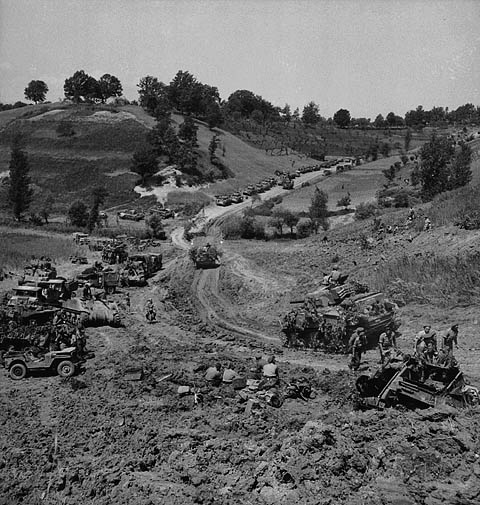
Forces canadiennes avançant de la ligne Gustav vers la ligne Hitler.
Credit: Strathy Smith / Canada. Ministère de la défense nationale / Bibliothèque et Archives Canada / PA-140208

The Lord Strathcona's Horse war diary lists the soldiers killed in the confrontation on 24 May 1944. John Milroy recorded the casualties in his CMH article: "The battle cost the Strathcona's 17 tanks for the destruction of five German tanks, eight selfpropelled guns and various other equipment. Two officers and 18 other ranks were killed; seven officers, including the second-in-command and the "A" and "C" Squadron commanders, and nine other ranks, were wounded."

The Strathcona's had advanced by using ground considered not-tank-country, and surprised German Panther tanks and guns on the far side of the Melfa River which were covering a more passable ford.  The action was an anomaly of armoured combat in the Italian campaign as a tank duel erupted between the panthers across the river and 'A' and 'C' squadrons of the Straths.  The confrontation would be a rough initiation to the grim side of warfare for many of the Canadian soldiers.  Some would not live through it.

Four crew would perish in the tank CONNOLLY, reported "hit by 88" on 24 May, and burned with its crew inside.  The men were commanded by Capt R.G. Crimes whose next of kin was listed as his father who lived in Halifax, but may have been from St. Thomas, Ontario.  Captain Crimes commanded a western crew whose driver had the remarkably low army identification number of, H-46. Thirty-year old Trooper Albert P. "Bud" Lee's wife, Mrs. Rita Pearl Lee, lived in Portage la Prairie, Manitoba.  The bow gunner A.A. "Smitty" Smith was said to "chum" with "Bud" Lee.  His father resided in Saskatoon.   Trooper George.T.Davis  "Davey" was the gunner operator.  His father lived in Vermillion, Alberta.

The men were first interned in a cemetery on the Melfa, but were transferred to the Cassino War Cemetery.  They were four men out of the millions who perished in the Second World War.  The Commonwealth War Graves lists 27 men with the name of A.A. Smith alone.  Despite the immensity of the conflict, the individuals who lived and died are important.  A glimpse into their lives gives a human meaning to the casualty figures.
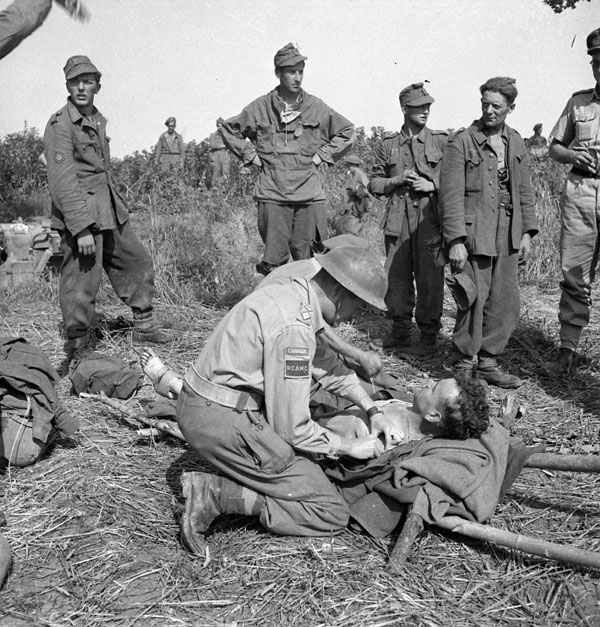
Captain J.A. Gardner talking with a wounded German soldier in the Liri River valley, Italy, 24 May 1944.  Credit: Lieut. Strathy E.E. Smith / Canada. Dept. of National Defence / Library and Archives Canada / PA-144981

Saturday, March 19, 2011

Culling of the Melfa

John Mahony VC
The Battle of the Melfa Crossing of 24 May 1944, was a hard-fought action of the 5th Canadian Armoured Division, during the exploitation of the 1 Canadian Infantry Division's rupture of the Hitler Line.  In this legendary river-crossing, the reconnaissance troop of the Lord Strathcona's Horse and a small group of infantry from the Westminster Motorized Regiment scraped out a small bridgehead and sustained several armoured counterattacks which failed to eject the force.  The most publicized hero of the battle, Major J.K. Mahony, was awarded the Victoria Cross for his bravery.

A lesser known member of this force, was the twenty-three year-old Private, John William Culling of Bluffton, Alberta, an infantryman of the Westminster Regiment.  Culling's actions on that day, single-handedly destroying a German Self-Propelled 88mm gun.  Culling's platoon had been the first across the Melfa.  Before they were done frantically digging their slit trenches, German tanks and self-propelled guns appeared and began opening fire.
L/Cpl J.A. Thrasher, Westminster Regiment and the Self-Propelled 88mm he knocked out with a PIAT, near Pontecorvo.
Culling slid into his thinly scraped slit-trench and awaited his fate.  Moments later a self-propelled 88mm gun rumbled next to the Private, and its commander appeared, attempting to assess the chaotic situation.  A proposed press release reported his subsequent actions:

"Culling grasped this heaven sent opportunity and his Bren gun.  First he wiped out the commander with the Bren then tossed a grenade into the open top of the vehicle, killing the driver.  Two more of the crew were shot with the Bren and the remainder called it a day and surrendered."

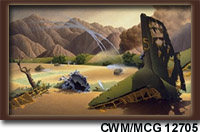
Melfa River Crossings Lawren Harris. CWM
Curiously, accounts gleaned from the Maple Leaf, Mark Zuehlke and Daniel Dancocks slightly alter the Culling story as recorded in the pre-press report for the unit war diary.  For Dancocks, Culling is from Swift Current, Saskatchewan, and never wields a Bren gun, but kills the crew commander with a grenade.  John Grodinksi in his essay in More Fighting For Canada has another variation of the circumstance adding that Culling tosses two grenades and kills the rest of the fleeing crew with his rifle.

A modern account in the Maple Leaf puts the story as such:

"The tank commander opens his hatch and starts to climb out, and Pte Culling throws a grenade, killing the officer and getting the attention of the gunner, who swivels the turret toward his slit trench. Pte Culling takes another grenade, pulls the pin and tosses it at the hatch, where it rolls around like a basketball on the hoop before dropping in."

Here we have a tank, not a self-propelled gun, not to mention the slightly different circumstance of Culling's feat.  One is left wondering, whether the war correspondent's initial account, or that gleaned from later personal testimony is legitimate.  Then again, perhaps such analysis is merely nitpicking.  Culling dispatched an armoured vehicle that day in a hard pressed situation, with a well-placed grenade. It is clear that he deserves the Military Medal that was awarded to him for the action.

5th Canadian Armoured Brigade War Diary. Appendix 5.  3 Jun 1944
Daniel Dancocks, The D-Day Dodgers, 268.
Maple Leaf War Time Story