Thursday, May 24, 2012

24 May 1944 Lord Strathcona's Horse CONNOLLY tank casualties

The horrible burning deaths suffered by tank crews in the Second World War, are uncomfortable to comprehend.  The breaking of the HITLER LINE in the Second World War is usually treated as a triumph, but as per usual on the battlefield, tragedy was a part of victory.


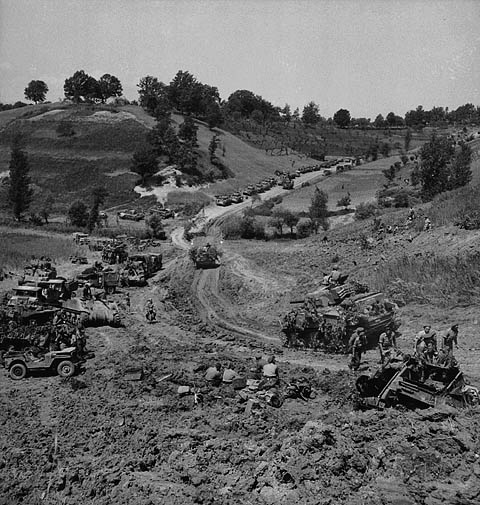
Forces canadiennes avançant de la ligne Gustav vers la ligne Hitler.
Credit: Strathy Smith / Canada. Ministère de la défense nationale / Bibliothèque et Archives Canada / PA-140208

The Lord Strathcona's Horse war diary lists the soldiers killed in the confrontation on 24 May 1944. John Milroy recorded the casualties in his CMH article: "The battle cost the Strathcona's 17 tanks for the destruction of five German tanks, eight selfpropelled guns and various other equipment. Two officers and 18 other ranks were killed; seven officers, including the second-in-command and the "A" and "C" Squadron commanders, and nine other ranks, were wounded."

The Strathcona's had advanced by using ground considered not-tank-country, and surprised German Panther tanks and guns on the far side of the Melfa River which were covering a more passable ford.  The action was an anomaly of armoured combat in the Italian campaign as a tank duel erupted between the panthers across the river and 'A' and 'C' squadrons of the Straths.  The confrontation would be a rough initiation to the grim side of warfare for many of the Canadian soldiers.  Some would not live through it.

Four crew would perish in the tank CONNOLLY, reported "hit by 88" on 24 May, and burned with its crew inside.  The men were commanded by Capt R.G. Crimes whose next of kin was listed as his father who lived in Halifax, but may have been from St. Thomas, Ontario.  Captain Crimes commanded a western crew whose driver had the remarkably low army identification number of, H-46. Thirty-year old Trooper Albert P. "Bud" Lee's wife, Mrs. Rita Pearl Lee, lived in Portage la Prairie, Manitoba.  The bow gunner A.A. "Smitty" Smith was said to "chum" with "Bud" Lee.  His father resided in Saskatoon.   Trooper George.T.Davis  "Davey" was the gunner operator.  His father lived in Vermillion, Alberta.

The men were first interned in a cemetery on the Melfa, but were transferred to the Cassino War Cemetery.  They were four men out of the millions who perished in the Second World War.  The Commonwealth War Graves lists 27 men with the name of A.A. Smith alone.  Despite the immensity of the conflict, the individuals who lived and died are important.  A glimpse into their lives gives a human meaning to the casualty figures.
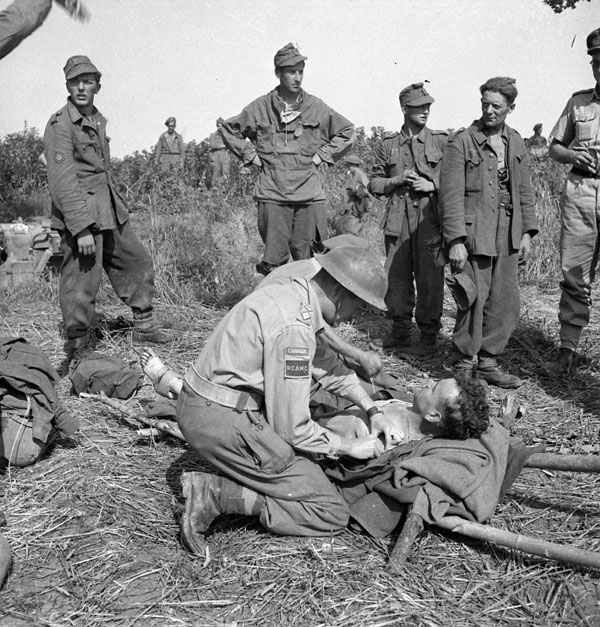
Captain J.A. Gardner talking with a wounded German soldier in the Liri River valley, Italy, 24 May 1944.  Credit: Lieut. Strathy E.E. Smith / Canada. Dept. of National Defence / Library and Archives Canada / PA-144981

Wednesday, May 23, 2012

Sam Hughes the Sure Shot : Of Ranges and Ross Rifles

Sam Hughes was the irascible Minister of Militia and Defence responsible for the mobilization of the Canadian Expeditionary Force in August of 1914.  Hughes was a fiery Orangemen, whose trenchant belief in the value of the gun-slinging, rough-riding, amateur militiaman never faltered. Ronald Haycock noted in his 1986 biography of Sam Hughes that "Nearly everyone in Ottawa had a favourite story about Hughes which was half-fiction, half-truth, but which captured the essence of the Minister's personality." (Haycock, Sam Hughes, 1986,p. 3)  One 1912 anecdote came from W.A. Griesbach, who would become the commanding officer of Edmonton's 49th Battalion:


Lieutenant General Sir Sam Hughes, K.C.B., M.P.
Painted by Harrington Mann
Beaverbrook Collection of War Art
CWM 19710261-0394
Some weeks ago I met an old man in my part of the country who told me that he had learned to shoot while serving in Sam Hughes' battalion of infantry....He said one day when the men were shooting badly Sam Hughes, who was then a Sergeant, picked up one of the rifles and lay down on the mound.  He fire and missed the target.  Turning to one of the men he said "That's the way you shoot."  Firing again, he again missed the target and turned to another man and said "That's the way you shoot." Firing for the third time, he scored a bull's eye.  Speaking to the men, he said: "That's the way I shoot" and walked on.


Hughes' bulls-eye was no lucky shot.  He was a member of several shooting societies and president of the Dominion Rifle Association (Haycock, p. 4).  During the Laurier years, Hughes reputation was welded to the manufacture of the Ross rifle, a weapon adopted by the Canadian militia at the end of the Boer war.  From 1901 on, Hughes would support the rifle against numerous complaints in the House of Commons regarding its manufacture.  The British were none too pleased about the Dominion straying from their standard Lee Enfield rifle, and disqualified many Canadian shooters at the British National Rifle Association's competitions for light triggers or heavy barrels. (Haycock, p. 123)
"Interior View of Ross Rifle Factory" 1900-1905 Credit: Library and Archives Canada / PA-107378


The unfortunate results of these British rebuttals was the altering of the Mark III Ross Rifle to insure victory at these marksmanship competitions.  As Haycock notes, "Machine tolerances were tightened; fit was made better; and the weapons won.  But close bearing surfaces, complicated and fragile target-type sights, and tight chambers capable of firing only exact dimension ammunition changed the rifle from an efficient combat weapon to an efficient target one." (p. 123)


The failure of the Ross rifle in the swampy conditions of the First World War, and Hughes' persistence that the weapon was sound, would contribute to Hughes' final dismissal as Militia minister in 1916.

Saturday, May 19, 2012

Victoria Day May Long Weekend in Canada

The Victoria Day long weekend is a long tradition in Canada, which has come to be largely separated from Her Majesty Queen Victoria's birthday of 24 May 1819.  Now, "May 24" is sooner associated with the convenient coincidence that there is 24 beers in a flat (or a case if you are Ontarioan), and has slightly less pomp and ceremony than earlier celebrations.

The weekend itself, of course, has had different flavours in different eras.  In 1902, the North West Mounted Police band paraded down the clap-board streets of Dawson, Yukon.  One must assume that God Save the Queen was on the playlist.

NWMP Band and Personnel, Victoria Day Parade, May 24th, 1902, Dawson, Yukon Territory.
Credit: Library and Archives Canada / e008128928
A Great War era poster of 1917 uses familiar imagery to promote an Ottawa fund raiser for veterans featuring a camp fire and "circus of sports".  This image of the rejoicing soldier, is central to a celebratory language of the war connecting the conflict to earthly triumph, which continued in Canada into the 1930s.   (Vance, Death so Noble, p.14)


Credit: Library and Archives Canada, Acc. No. 1983-28-518
Canadian weather does not always cooperate with a late May celebration.  A 1953 photo of some young Calgarian women who bravely donned their bathing suits for a Bow River fishing session, shows that winter conditions were not too far in the past. Presumably they chose a warmer fishing spot, when the camera left the scene.
Glenbow Archives Image No: NA-5600-6194b
Title: Girls in swimsuits sun bathing and fishing on snow at the edge of the Bow River, Calgary, Alberta.
Date: May 1953
Photographer/Illustrator: De Lorme, Jack, Calgary, Alberta.
The May long weekend, in the age of auto-tourism is the first time of the year to pile the kids in the camper van and head out to the "wilderness".  In 1971, cartoonist Leonard Norris poked fun at the growing traffic issues accompanying this supposed tranquil escape.
"We promised the kids, if we get a break in the traffic we're going away for the long weekend." 
 Credit: Library and Archives Canada, Acc. No. 1988-243-690
Copyright: Estate of Leonard Norris

Friday, May 18, 2012

Spoilt Reputations: Swine metaphors in Joseph Flavelle's profiteering scandal

The Edmonton Bulletin,

 July 13, 1917, Page 1

In 1917, Joseph Flavelle ran what was effectively the largest business in North America through his chairmanship of the Imperial Munitions Board.  Flavelle's reputation was never to fully recover from an expose of his business interests in the William Davies meat-packing industry.

On 13 July 1917, the Ottawa Journal was the first newspaper to leak news of Flavelle's profits which they headlined as "Huge Margins Shown on Bacon Trade".  Michael Bliss' biography of the capitalist takes a sympathetic approach to the scandal, noting the government report which fuelled the outrage in the press was "in a many ways...a misleading, in fact stupid, document", which showed no comprehension of the  meat-packing industry.

Bacon Export Trade examination.  Flavelle far right.  Redcliff Review, November 8, 1917, Page 3


The press couldn't resist the metaphors on a scandalous profiteering in industry whose product was synonymous with gluttony.  As Bliss writes,

Foods That Will Win The War And How To Cook
Them (1918), by C. Houston Goudiss
 and Alberta M. Goudiss Gutenburg

the bacon scandal was prime fare for editorial writers.  The Globe was glad to see that the O'Connor report had generated too much heat to be put in cold storage.  The Star  thought the order of Baronets needed to be supplemented by a class for Baconets; the Ottawa Citizen accused the packers of having hogged everything but the squeal.  The Regina Leader, on of the most bitter Liberal papers, wrote of "price hogs" and the need to treat profiteers as traitors. (Bliss, p.343-44)


On 6 September 1917 William Henry Taylor of the Toronto World waxed poetic in a piece he titled "The Patriotic Hog".


He swallows all the food that he can hold-
When presto! change! the meal is turned to gold;
No doubt his pride will swell when he has found
That bacon sells for fifty cents a pound.

Thursday, May 17, 2012

Legendary Paratrooper : The Leadership of Marcel Bigeard, 1956

Syndey Morning Herald Obit 2010
Marcel Bigeard was one of the legendary paratrooper leaders of the Algerian conflict.  His training regime was as rough as they come, and his leadership style was a text-book example of leading from the front.

Bigeard's introduction to the Second World War shared the disapointment of many of his French compatriots, but he quickly rose to prominence.  Captured in 1940 in the Maginot Line, he managed to escaped the next year to Senegal joining a colonial infantry unit in De Gaulle's Free French Forces.  In 1944, he parachuted into France, and spent the postwar years in French Indo-China.
Bigeard in Indo-China. Independent.
On his third combat tour to Vietnam, it was Bigeard's misfortune to be dropped into Dien Bien Phu.  Again he showed his determination in commanding what Alistaire Horne called in his Savage War of Peace, "one of the most inspired counter-attacks."(1987, p.168)
Bigeard was subjected to three months of brainwashing, and this may have inspired his belief that the "subversive warfare" in Indo-China was the beginning of a world-wide attack of which Algeria was a part.

Rama CeCILL
Arriving in Algeria, Bigeard commanded the 3rd Regiment of Colonial Parachutists, which immediately was purged of the weakest members.  Others who did not wish to be in the unit were offered transfers.  Those that remained were subjected to a brutal training regime in the dry lands of Algeria.  They returned a new breed of Para, sporting a long-brimmed camouflage cap, causing the pied noirs (Algerians of european stock) to nick-name them, the "lizards".  Bigeard denied the use of torture during the conflict, but did admit to "muscular interrogations."


Alistair Horne doesn't pull his punches in describing the paras as, "on their way to becoming a crack force; one of the most effective in the Western world". (p. 168)  An early construction of the Bigeard legend was the book The Centurions (1960) by Jean Lartéguy, which featured a character modelled after the commander.
A film based on The Centurions.
Bigeard led from the front, conducted his own reconnaissance and jumped with the first wave.  Horne notes, "tall and powerful, with a beaked nose that imparted a look of a bird of prey, Bigeard had that particularly French quality of allure essential to an outstanding commander.  He seldom did anything without panache.  Instead of arriving by staff car, or even helicopter, his favourite manner of inspecting a unit was to drop by parachute, arm at the salute as he touched down."

Imitators of the Bigeard command-style should, however, be wary.  Horne notes that in later life, when Bigeard was approaching sixty, one such troop inspection went wrong.  In Madagascar, Bigeard was dropped into shark-infected waters, breaking an arm.  His unfortunate yet "faithful" staff, who parachuted into the water with him, managed to save the General from the waters.