The origins of one of Rudy Wiebe's old workshas some interesting detail about the writer's own roots. Wiebe has not been relegated to the has-been dusty classics section just yet. He was recently featured on the television series Extraordinary Canadians, presenting the case of Cree chief, Big Bear. As the author of Governor General's Award winning The Temptations of Big Bear (1973), Wiebe was a natural choice to write on this well-known chief for the show's sister series of Extraordinary Canadians books. His comments in a 1975 collection of essays give an intimate look at the creation of the original ground-breaking biography. Written in Wiebe's experiential voice, the essay shows that First Nations' history in the 1970s was only beginning to be told.
Wiebe's, "On the Trail of Big Bear", published in Western Canada Past and Present, the proceedings of the Western Canadian Studies Conference,is as interesting for its insight into the state of Canadian historical scholarship as it is for providing a window into Wiebe himself. The essay sheds interesting light on the path by which Wiebe came to Big Bear as the source of his literary non-fiction, and contains some visceral prose in-itself. Of his difficulties telling the story of Big Bear, Wiebe wrote that when thinking historically the novelist had to attempt to let the senses "be his guide through the maze of life and imagination."
Through the smoke and darkness and piled-up factuality of a hundred years to see a face; to hear, and comprehend, a voice whose verbal language he will never understand; and then to risk himself beyond such seeing, such hearing as he discovers possible, and venture into the finer labyrinths opened by those other senses: touch, to learn the texture of leather, or earth; smell, the tinct of sweetgrass and urine; taste, the golden poplar sap or the hot, raw buffalo liver dipped in gall (Wiebe, p. 183)
Wiebe writes that it was in 1967 that he remembered his earlier reading of William Cameron's The War Trail of Big Bear, and recognizing a connection between the events of the 1885 Rebellion and his own prairie origins. Wiebe writes,
it was from reading Cameron in the '50s that I first realized that the bush homestead where I was born in northern Saskatchewan probably was traversed in June, 1885, by Big Bear and his diminishing band as among the poplars they easily eluded the clumsy military columns of Strange and Middleton and Otter and Irvine pursuing them; that I first realized that the white sand beaches of Turtle Lake, where Speedwell School had its annual sportsday with Jackpine and Turtleview Schools, right there where that brown little girl had once beaten me in the grade four sprints, a race in which until then I was acknowledged as completely invincible: perhaps on that very beach Big Bear had once stood looking at the clouds trundle up from the north (Wiebe, p. 184)
Wiebe's 1973 Temptations of Big Bear
Wiebe's comments also speak of the lack of First Nations in the history taught in schools during his day. He wrote:
Of course, thanks to our education system, I had been deprived of this knowledge when I was a child; we studied people with history - like Cromwell who removed a king's head, or Lincoln who freed slaves - but I can see now that this neglect contained an ambiguous good. For in forcing me to discover the past of my country on my own as an adult, my public school inadvertently roused an anger in me which has ever since given an impetus to my writing which I trust it will never lose. All people have history. (Wiebe, p. 184-85)
Writing in 1975, Wiebe seems to premeditate the direction that Canadian history would soon turn, from the nation-building heroes of the majority towards the untold story of the "other". He wrote of the difficulty in discovering the life of Big Bear, who had been neglected by the works focused on founding fathers.
Beneath the giant slag heap left by the heroic white history of fur trader and police and homesteader and rancher and railroad builder (O, the heroism of that nineteenth-century computer Van Horne as sung by that twentieth-century computer Pierre Berton Incorporated!), somewhere, under there, is the story of this life. Can I dig it out? Will I dare to look at it once I have, if I dare, unearthed it? (Wiebe, p. 185)
Wiebe's new work on Big Bear for the Extraordinary Canadians series.
The Military Voter’s Act of 1917 is one of the most notorious political manoeuvres of the Borden government in the First World War. The act would extend the vote to soldiers families, deny the franchise to certain ethnic groups, and would presumably secure further support for the government. Prior to this monumental legislation, in 1915, the right to vote by mail was given to military members overseas. As Desmond Morton noted that the postal ballot, “excluded women and minors in the CEF from the franchise, allowed soldiers to choose any constituency in which they had spent at least thirty days prior to enlistment or, if that failed, any other.” (Morton, p.131) In 1917, with the Wartime Elections Act and the Military Voters Acts, the vote was given to all active or retired members of the Canadian armed forces, including women, minors, and First Nations. Men who were not landowners, yet had a son or grandson in the forces were extended the franchise, as were women with relatives who were soldiers.
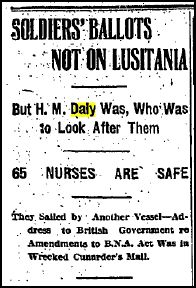
In 1915, an interesting connection between the postal ballot and the sinking of the Lusitania is noted by Morton. He writes, “On 5 May the British cabled their approval but two days later the soldiers’ vote was, quite literally, sunk. Armed with a militia commission and a large supply of ballots, Harold Daly, a former Vancouver lawyer and now a Hughes aide and all-purpose fixer, had embarked on the Lusitania."
The Globe, 8 May 1915
The Globe, 8 May 1915, p.7.
On 7 May 1915, Daly's voyage ended in the frigid waters of the Irish Sea. Unlike 1,198 of his fellow passengers, Daly survived to cable Minister of Public Works Robert Rogers from London: “I am still quite willing to die for the Conservative Party but am glad I didn’t drown for it.” Morton notes that Daly’s “vestigial rank” could have given the Germans justification for claims that the ship was full of soldiers and munitions, so the mission was kept hush-hush. The Globe reported that Daly was on the ship, but had sent the ballots via another boat. The discerning reader may have wondering why this was the case if he "was to look after them".
Daly was the son of a former mayor of Brandon Manitoba, and the Daly House there is now a museum. Family lore has recorded his last moments upon the ship, as interpreted here by the Lusitania Resource:
On the day of the disaster, Daly was playing solitaire, which another passenger had taught him to play. During the last few moments, he bought a cigar from the bartender who told him to get out. No sooner did Daly exit the door of the lounge, the water washed him overboard. He said the curious thing was that he was among a different set of people than who he had seen on deck when the ship sank, to which he attributed to the ship striking bottom, before she sank.
The sinking of the Lusitania inflamed public opinion against the Germans, and served as a major propaganda coup. Posters of women and children sinking in the waters were used for enlistment purposes which channelled the revenge instinct over outrage at the torpedoing of a civilian liner. The attack on the ship has been cited as a cause of the American entry into the war.
Mais Quelle Flotte Formidable a pu Conduire Ici Une Parelle Armée? - Le Lusitania / But! What Tremendous Fleet Could Ever Have Brought Over Such An Army? - The Lusitainia. Crédit: Library and Archives Canada, Acc. No. 1983-28-3486
Jonathan Fennell’s Combat and Morale in the North African Campaign (2010), traces the complex web of factors which influence military morale. One kernel in this cornucopia is the cult of personality surrounding the high commander. In the case of British and commonwealth troops in the Western Desert, it seems that a certain notorious German commander stole a march on the British.
General Erwin Rommel's charisma still effects the observers of military history, especially due to the popularization of his opposition to George Patton, as portrayed in the 1970 film Patton. Problems arose in 1942, when British troops recognized the charismatic German general over their own commanders. General Claude Auchinleck was an unknown entity to troops under his Middle East Command as long as a year after he took control.
Generalfeldmarshschall Erwin Rommel (1892 - 1944): Rommel at a staff conference in the Western Desert.
Fennell records that Rommel approached “folk hero” status, among troops. One officer wrote during a slow period in the desert that, “there is no news of interest here at the moment except that I have often heard fellows say ‘I wish we had Rommel on our side.’” (Fennell, p. 212) Attempts to confront the Rommel legend by Middle East Command came from the “MEF Weekly Military Newsletter no. 74”. “Axis propaganda had gone to considerable pains to build up the legend of Rommel, one of the aims being to give us a feeling of inferiority in the face of this photogenic General who is supposed to be master of the Libyan desert”.
Auchinleck’s personal reaction betrays his own concerns about the power of his opposition's celebrity. Auchinleck wrote,
“I wish to dispel by all possible means [the idea] that Rommel represents something more than an ordinary German general…The important thing now is that we do not always talk of Rommel when we mean the enemy in Libya. We must refer to “the Germans”, or the “Axis powers”, or “the enemy” and not always keep harping on Rommel…PS. I am not jealous of Rommel.”(Fennell, p. 214, cited from Nigel Hamilton, The Full Monty, p. 544)
It seems that Auchinleck’s best efforts at becoming a military idol were in vain. The situation was reversed with the coming of the flamboyant and press-savvy Montgomery, who “actively pursued publicity and the press limelight and purposely took on the Rommel legend.” (Fennell, p. 214)
As Montgomery wrote after the war:
The Eighth Army consisted in the main of civilians in uniform, not of professional soldiers. And they were, of course, to a man, civilians who read newspapers. It seemed to me that to command such men demanded not only a guiding mind but also a point of focus: or to put it another way, not only a master but a mascot. And I deliberately set about fulfilling this second requirement. It helped, I felt sure, for them to recognize as a person – as an individual – the man who was putting them into battle. To obey an impersonal figure was not enough. They must know who I was. (Fennell, p. 214)
That Montgomery bought in to the cult of Rommel can be gleaned by the questionable honour of naming his dog after the general. The distinction is only heightened by noting the moniker of his other canine comrade: "Hitler". Monty, as against Auchinleck's policies would long personalize the German forces he opposed as "Rommel", and emphasized that he knew the "Desert Fox" better than anyone else.
Fennell does acknowledge Montgomery's success in becoming part mascot, claiming that he was the first British celebrity general, with the possible exception of Kitchener. (Fennel, p.5) It appears at least one prominent military historian disagrees with awarding full celebrity status to any British general. Writing in the 1970s in his pivotal work Face of Battle, John Keegan suggests that Robert E. Lee was "the only cult general in the English-speaking world". (Keegan, 1976, p. 54) So much for Kitchener of Khartoum and Montgomery of Alamein! It seems that at least honorable mention is due to the Duke of Wellington, or even Sir Garnet Wolseley, whose name was incorporated in the British soldiers' pantheon of slang as synonymous with doing all right. In overcoming the cult of Rommel, however, it appears that things were not "all Sir Garnet" for the desert generals!
A soldier's morale is contingent upon numerous factors. He may just need a hot mug of tea to cheer him up, or perhaps some bacon and oatmeal to replace his bully beef breakfast. Most take support from their primary group, the men of their immediate working environment, whose esteem is critical to their emotional well-being. Some may seize a greater ideology to keep them satisfied with their place in the greater war machine. Nearly all soldiers keep some connection with their loved ones in distant communities. Mail from home could be the greatest morale booster for men in far-flung and isolated theatres.
Mail being unloaded from an Army Post Office lorry in the Western Desert, 16 July 1941.
Jonathan Fennell's Combat and Morale in the North African Campaign (2010) examines the many factors effecting the rise of the British Eighth Army's morale as the pivotal battle of El Alamein approached in the fall of 1942. Fennell writes, "it was not just the arrival of the mail that was important but also the contents of the written correspondence, with all that this entailed in regard to relationships and family affairs.
As it was pithily put by one officer, 'the two main factors affecting morale of the soldier overseas are the mail and the female.'" (Fennell, p. 165) Historians have noted that the long build-up of Canadian troops in England had a negative effect on the morale of Canadian citizens and soldiers alike. It appears, due to the Canadians' amorous assault on the island nation, that a reciprocal decline of morale was experienced by British troops in the Western Desert. One officer wrote in September 1941, of his soldiers' perceptions of the Canadians in England:
The boys are getting very scared of the Canadians upsetting their domestic life at home. We have three instances of it in this unit during the last month. It started when I got a letter addressed to the O.C. Would I be good enough to inform Pte. X that his wife was an expectant mother and had gone to live with another man...Poor chap...He couldn't speak for three days. Since then two more have had letters breaking off engagements. What with that and the delay in the mail, the whole crowd are worried to death. (Fennel, p.165, from "British Troops in Egypt no. 100 Field Censorship Report Week Ending 23 September 1941, p.4, AWM 54 883/2/97)
Fennell notes that by January 1942, censorship summaries recorded a "hysterical pandemic of worry and jealousy among the troops in the desert". That summer, one soldier wrote to his wife, "I tell you what our tent is called now, love, it is called the 'Jilted Lovers Tent,' because there are four chaps in this tent who were engaged, but now their girls have broken it off and in three cases the girls have married Canadians."
The stress over infidelity may have caused physiological distress as well. In April 1942, medical officers noted that disease could be brought on by psychological friction noting "marital infidelity" and "broken homes" as particularly effective in wearing a man down. This stress was linked directly to a decline in morale.
Bing Coughlin cartoon as published in "The Half Million". Allies in War.
One might assume there was nothing the War Office could do to combat such natural feelings arising from dislocation. Fennell notes, however, that the Directorate of Welfare effectively used the Soldiers, Sailors, Airmen and Families Association (SSAFA) as a liaison between soldiers and families, to initiate a reconciliation scheme. SSAFA would visit wives and attempt to ameliorate domestic issues in lieu of withdrawing family allowances, legal action, or divorce. (Fennell, p. 170) Free legal aid was offered in the Middle East for men filing for divorce. SSAFA dealt with sixty known cases and thirty suspected cases of infidelity daily! Fennell suggests that as only 53% of the divorce cases ended in marital dissolution, the efforts of the War Office to soothe anxieties were fruitful.
Mail normally dampened the agony and longing for connection with distant loved ones, but it is clear that when promises were broken, morale could plummet. Men would invest great hope in the life that they would return to after the war, and their partner was central to the sentiments which allowed them to endure the privations of campaigning. In a sense mail could be a double edged sword. While fostering an idealized and romanticized civilian past, mail could just as easily dash these dreams and leave soldiers with nothing but grim combat to look forward to.
There is no beverage as definitively English as tea. In the harsh environment of the Sahara Desert during the Second World War, the comfort of a warm cup of tea was supremely important to the soldiers of the British Eighth Army. Tea could make foul water drinkable, and monotonous life bearable. Jonathan Fennell noted in Combat and Morale in the North African Campaign (2010), that tea was one of the few pleasures in a theatre where, "the empty days of static warfare could melt into one indefinable consciousness." (Fennell, p.128)
Three shallow open graves containing uniformed bodies. Behind them the burial party are are looking on drinking tea.(Art.IWM ART LD 3035)Ardizzone, Edward Jeffrey Irving
The boring grind of soldiering in the desert was related in the memoir of Len Tutt. Fennell cites a conversation that Tutt had with a fellow member of the 104th Regiment (Essex Yeomonry) Royal Horse Artillery while garrisoned at Tobruk:
'Is it Monday or Tuesday today Dump?'
'I thought it was Thursday,' I answered, 'but I'll look in the log in the Command Post.'
When I returned I said, ' We're well out. It's Saturday'
'Yes. But Saturday of this week or last?' (Fennell, p. 128, as cited from L.E. Tutt "Gentleman Soldier" p. 168.)
While in some theatres of war, foraging or downright pillaging could provide a number of the supplies needed for an army, the desert provided nothing but sand. Demand for water was especially massive. In the days before Operation Crusader, Eighth Army was supplied with 600 tons of water daily from a 147 mile long army-built pipeline. Daily rations were two gallons a day, but there were times when these sunk to two pints per soldier. (Fennell, p. 131-32)
The quality of what little water was provided was poor, further emphasizing the need to flavour it with a "brew-up" of "char", or tea. Tutt noted that it was, "foul stuff to drink in its natural form [and it was] much more satisfying to have as a brew." (Tutt, p. 201, from Fennell, p. 134)Historian John Ellis noted that the use of gas and oil cans to carry the highly chlorinated water was a major factor in its awful taste. Even that water uncontaminated by gas could absorb the interior coating of the containers made of paraffin wax or bitumen and benzine. (Fennell, p. 134 as cited from Ellis, The Sharp End, p. 285.)
Gas was needed for brewing tea as well, and Fennell notes that a battalion could burn a hundred gallons of gas in a day for this purpose. The so-called "Benghazi cooker", was a ration box cut so that a mix of sand and gasoline could be burned in one end and a pot brought to boil on the other. As Fennell notes, "A match thrown from a safe distance was all that was necessary after that. It would burn for half-an-hour with no more attention than an occasional stir with the point of a bayonet. (Fennell, p.136)
Fennell claims that improved morale was critical to the fighting performance of the Eighth Army at the Battle of El Alamein, noting that tea was one of many factors which could play a role in forming personal bonds between the men. Ultimately Fennell argues that the primary group bond between soldiers has been overestimated in the literature and that numerous factors such as: confidence in weapons technology; supply of provisions such as water; the harsh desert environment itself; and better man-management practices in part associated with the coming of Bernard Montgomery, all contributed to Eighth Army's improved morale in the fall of 1942.
Tea itself was part of the industrial quantities of provisions required by British soldiers in all theatres. In 1942, the British government purchased the world's entire tea crop. Stock in Britain climbed to 30 million tons. This is enough tea for approximately 1.5 trillion cups of desert char! In the harsh environment of the desert, tea was a simple pleasure which could alleviate the strains of soldiering. It was more than caffeine addiction that caused one soldier to claim that, "tea had become a drug to us." (Fennell, p. 134, as cited from Tutt, p. 201.)