Tuesday, March 31, 2015

Soldiers Disturbing the Peace: Crime and Drunkeness in Nova Scotia, 1941-45

Military Districts in Atlantic CAN Hyperwar.
It is hard to deny the overarching narrative of the Second World War as the "good war".  In the reduced, synthesized, and simplified version of the conflict, Nazi villains are thwarted by the Anglo-American heroes in a clean story of right and wrong.  Individual experience, of course, rarely matched this crisp moral contrast, as lives are lived in the complex blur of intentions, identities, and circumstance.  In Military District No. 6 (Nova Scotia and P.E.I.) during the war there is plenty of evidence to support Kipling's thesis that, "single men in barracks don't grow into plaster saints."


VE Day Riots, Halifax. Life as a human blog.
Halifax was clearly a disciplinary problem during the war, and the major efforts to keep the peace made by Military District (MD) No. 6 and Atlantic Command were in the capital city.  The most celebrated incident of military misdemeanour was the VE Day Riot of 7-8 May 1945, but there were plenty of  disturbances before the end of the war in Europe.  Almost a year earlier, on 3 June 1944, the Halifax Daily Star reported:

In some parts of Halifax the misconduct of service personnel has already become notorious. [...]
         So far as most citizens can see, the Provost Corps is more concerned with raising vegetables within the precincts of Citadel Hill than in patrolling the streets and apprehending offenders. [...]
            The plain fact of the matter is that discipline among military personnel in this community just isn't being maintained in the manner that citizens have a right to expect.
            Far too many instances of women being accosted, insulted and exposed to ridicule have taken place for authorities to admit of the least complacency.

The military and civilian police in Halifax simply couldn't keep up with massive influx of service personnel.  There was a lack of provost to police them, and a lack of accommodations to entertain them.

Smaller towns across Nova Scotia also had their problems with rowdy soldiers.  Places like Kentville, New Glasgow, Debert and Tormentine, towns on the railway line or near training bases, experienced troubles with late-night revelry getting out of hand.  Restaurants and hotels were ransacked and goods stolen.  Fights were a common occurrence.

That Canadian soldiers acted contrary to a sanctified memory which puts them on a pedestal is no surprise to the student of military history.  John Baynes in his 1967 classic Morale: A Study of Men and Courage notes that even first-class battalions could cause troubles in their local garrison town.  Baynes wrote in reference to British regiments before the First World War that, "The experienced officer knows almost by instinct whether the trouble is due to poor morale or high spirits.  Good soldiers must have a bit of devilment in them, and it is no good becoming alarmed at occasional outbursts of misbehaviour." (95)

In January 1943, the St. Peter's Anglican Church in Eastern Passage Nova Scotia was the site of soldierly debauchery.  The organist there discovered property damage, spilled beer, and vomit around the altar, "from which there was a odor [sic] of liquor".  (RG24 Vol. 2189) Other evidence left at the scene of the crime, as reported by an inspector on the case, borders on the absurd:

"INVESTIGATING THIS MATTER FURTHER THE WRITER again contacted Rev. E.A. KINGSBURY, at this time he informed the writer that there was still a package of hot dogs in the church which he though had been left there by the persons responsible for the desecration of the church.  Rev. KINGSBURY went to the church with the writer and handed these hot dogs over.  Further enquiries were then made at Murdock's Canteen and Miss FAULKNER recalled that these three men, whom she had identified on January 19th, had ordered some Hot Dogs done up so as they could take them out with them, also that one of the men had asked her to put a cigar in one of the buns instead of a sausage so that he could play a joke on someone.[...]
Three empty beer bottles, and the two hot dogs are contained on the attached [form] 246. and are held at this office pending further developments in this case."(Inspector TW Chard to the Deputy Attorney General, Province of Nova Scotia, "Re: Desecration of St. Peter's Anglican Church, Eastern Passage, N.S. Complaint of Rev. A.E. Kingsbury","Disturbances M.D. No. 6 - Canadian Active Service Forces", Folder HQ-54-27-63-7, Library and Archives Canada, RG24 Volume 2189, 22 February 1943.)


Aside from weenies and beer bottles, there was testimony that singled out the culprits, identifying one man as having returned to barracks wearing a priest's gown and ordering his fellow soldier to "get down and say his confession." One gunner was given twenty-one days detention with forfeited pay, and the other reverted to the rank of gunner permanently."Statement No. 2: Statement of Reg. No. B.600160 Gnr. Samuel MONTAGNA, R.C.A. Devils Battery, Eastern Passage, Nova Scotia", RG 24 Volume 2189,  19th January 1943.


Trouble around military pay-day was common, and there was no lack of business proprietors calling for guards to be stationed near their properties.  Having one's premises placed out of bounds was another possible remedy, but this action was clearly not favoured due to the loss of military business.

Alcohol was almost always involved in these disturbances.  Several early incidents surrounded bootlegging establishments, with soldiers getting drunk and causing trouble.  In Sydney Mines, Nova Scotia on 14 June 1940, Antonio DiVito's candy store, where bootleg liquor was refused to soldiers, became the site of a quarrel and some petty property damage.  Ethnicity was a factor in this case.  DiVito was an Italian naturalized in 1922 (or '23) and a woman had attempted to incite the crowd to destroy Italian businesses by suggesting that since she had a son in uniform that DiVito should be enlisted as well."Proceedings of a Court of Inquiry assembled at Sydney Mines, N.S. on the 16th June, 1940. by order of Lieut.-Col. W.H. Dobbie, D.S.O., R.C.A. Commanding Sydney Fortress. for the purpose of inquiring into and reporting upon the circumstances surrounding a disturbance in Sydney Mines, N.S. on Friday, 14th June 1940 in which troops of the Sydney garrison are alleged to have taken part.", RG 24 Volume 2189, 16 June 1940.


Soldiers training in New Glasgow, 1940.
The Memory Project.
In New Glasgow in early February 1941, a number of soldiers on leave got into a huge brawl and burned the house of a bootlegger.  Race again was a major factor here, as the African-Canadian bootlegger worked and lived in a black neighbourhood.  Much racist vitriol was exposed in the court proceedings.  A Mr J.C. Dorrington, who sold beer from his house, had denied the soldiers drink as he was closing up his shop.  When they forced entry into his home, he and some friends beat them up.  Soldiers returned later with a  mob and drove Dorrington and his family out of his house, destroying it.

The prime culprits were members of the Essex Scottish regiment.  Judge-Advocate General R.J. Orde's comments on the incident suggest that racist attitudes by southern American personnel in the unit may have prompted the destruction of the house.  The Royal Hamilton Light Infantry were also involved in the incident, and it appears that there was also brawling between members of the two regiments that night in New Glasgow.  The court martial proceedings of this case are rich enough to be quoted at length in a future blog post. RJ. Orde, [likely to Adjutant-General] "The trouble in New Glasgow",  RG 24 Volume 2189, 11 February 1941.
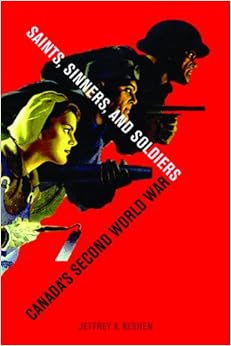
 
What are we to glean from these cases of soldiers gone wild?  Jeff Keshen's work Saints, Sinners, and Soldiers: Canada's Second World War, takes issue with the notion of the good war, and discovered a great deal of Canadian soldiers and civilians alike behaved in unpatriotic and even criminal ways.  The record of disturbances in Nova Scotia certainly confirms this.  Perhaps Keshen's categories, however, of saint, sinner, and soldier, are not mutually exclusive.  While the racist clash in New Glasgow, with its drunken vitriol and violence, are not the stuff of military heroism, is it not possible that some members of the Essex Scottish regiment or the Royal Hamilton Light Infantry acted bravely in battle in August 1942 when they stormed the beaches in the ill-fated Dieppe raid?  Were the saints of Dieppe past sinners at New Glasgow?

The Canadian Encylopeida
 on the Dieppe Raid
Our conception of military valour takes a snap-shot of a life and defines an individual by it.  It would be ridiculous to suggest that one of the men awarded the Victoria Cross at Dieppe, (a Lieutenant Colonel and a padre), were involved in these previous digressions, yet it is not unreasonable to believe men who behaved very poorly on that drunken night in Nova Scotia, later proved themselves as brave soldiers under fire.  Military crime scuffs the polished finish of military memory, betraying a tarnished halo adorning the statuesque good war.  To take time to consider transgressions of military discipline, however, is not to smear the name of the Canadian soldier in the Second World War, but to humanize him.

Thursday, February 5, 2015

1930s Insulin Shock Therapy - Snippet from the work of Edward Shorter

Ladislas Meduna,, 1955,
 UofIllinois Archives
Before the days of electroconvulsive therapy, experimentation was conducted in the interwar years inducing convulsions in schizophrenic patients.  In the late 1920s, Polish psychiatrist Manfred J. Sakel had experimented with insulin coma therapy for use on schizophrenics and others.  Camphor was one drug that was used, but it was found unreliable in its reactions, and patients reported great feelings of anxiety before the fits, not to mention the drug's tendency to induce vomiting. Metrazol, or Cardiazal was discovered by Ladislas von Meduna to be a superior drug to induce therapeutic seizure.

Before the 1930s, it was largely sedatives and hypnotics that were being used on psychiatric patients, with opiates and barbiturates coming to the fore in the nineteenth and twentieth centuries respectively.  If one counts laxatives as drugs, evidence exists for their use as psychiatric treatment as far back as the middle ages, and one could likely find similar uses in ancient times.  While we might like to think of Prozac as a revolutionary change in mental health treatment, it certainly had its forebears.  

Insulin shock therapy is given in
 Lapinlahti Hospital, Helsinki in 1950's
In the 1930s there were brief experiments with convulsive drug treatments, before these were swept away by the tide of electroconvulsive therapy.  Ladislas von Meduna was a Budapest psychiatrist who in 1934 was breaking ground in the use of insulin induced comas for the treatment of schizophrenia.  Seizures were an occasional side-effect of insulin comas, and some psychiatrists thought these were therapeutic, and induced them using cardiazol or camphor.  An account of one of Meduna's early patients gives an idea of the gap between the sanitized official record and the lived experience of the patient.  Meduna noted of his thirty-three-year-old patient that he had been committed to the Budapest State Hospital in 1930 on the basis of his delusions and hallucinations.  He had reportedly spent 1933 hidden under his bedcovers, and in January 1934, he had stopped eating.

Meduna administered camphor, and 45 minutes later the patient had his first seizure.  In the next couple of weeks, he would have five more injections.  Meduna reported:

 On the morning of February 10, the patient spontaneously arises from bed, is lively, speaks, and asks for something to eat.  He is interested in everything going on about him, asks about his illness and realizes that he has been sick.  He asks how long he has been in the hospital, and as we tell him that he has already been there four years he cannot believe it. (Shorter, 214-217)

Edward Shorter’s work A History of Psychiatry: From the Era of the Asylum to the Age of Prozac (New York: 1997) relays the after-effects of the treatment:


In reality, the patient felt so good that he escaped from the institution, went home, ‘and found out that the cousin living with his wife was not a relation at all but his wife’s lover.  He beat up the cousin and kicked him out of the house; proceeded to beat up his wife and told her that he … preferred to live in the state mental hospital where there is peace and honesty.’ (Shorter, 214-217)

Shorter's work argues against the disciples of Foucault who since the 1970s have damned psychiatry as a state tool to incarcerate the disruptive.  Shorter emphasizes that mental illness was real, and could be cured by various biology-based methods.  It is interesting to note, that Meduna's 1934 convulsive shock experiments reported that of 110 patients treated (presumable schizophrenics), half went into remission.  As the above account suggests, "cure" was not always synonymous with completely positive outcomes, and the dangers of inducing seizure and the low vital signs connected to insulin sleep therapy were always clear.

Southern Albertans interested in psychiatry and its history may wish to attend a couple upcoming talks.  Edward Shorter is in Calgary for a few days in early February 2015, and presenting two public talks at the University of Calgary.


The second talk is at 3:30pm. Monday February 9th at the Community Health Sciences department on the third floor of the Teaching Research and Wellness (TRW) building on the University of Calgary's Foothill's campus.  RSVP to Beth Cusitar bcusitar@ucalgary.ca.  The talks is as follows:


“DSM:  The History of a Train Wreck”


Diagnosis in psychiatry was once dominated by the German heavyweights.  After the Second World War, the United States becomes the world champion of psychiatry, and American diagnoses take over, first in the DSM-1 in 1952, then in the revolutionary DSM-3 in 1980, which was a dramatic break from psychoanalysis and offered hope for the diagnostic future.  But buffeted by institutional politics, the demands of patient organizations, pressures from niche marketers within the field, and the profit horizons of the pharmaceutical industry, the diagnostic promise of DSM-3 failed to be realized, and the entire diagnosis machine of DSM has started to run out of control.  We are now at DSM-5 (2013).  There probably will not be a "DSM-6."

Sunday, December 28, 2014

Mental States and Discipline in 3rd Canadian Infantry Division, 1942-43

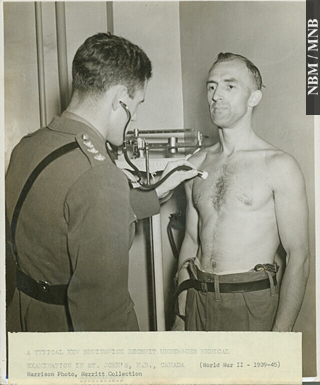
Second World War psychiatric evaluation in the Canadian Army exposes the institution as an modern disciplinary apparatus where the lines between medical evaluation and criminal sentencing are blurred.  A number of medical evaluations in the Army were directly linked to crimes, the most obvious being self-inflicted wounds.  Medical officers were always on the watch for malingering, balancing the age old tension of care for their soldier-patients and supplying the military machine with healthy manpower.  In the 3rd Canadian Infantry Division, a number of letters in February 1943 show how personnel testing and medical evaluation could greatly influence a soldiers' disciplinary outcomes.
3rd Canadian Infantry Division Shoulder Patch http://www.rcasc.com/world_war_ii_1939-1945/3rd_canadian_division_1939-1945

Recruit Undergoes Medical Examination,
 Saint John, New Brunswick - 1939-1945
New Brunswick Museum
Louis Merritt Harrison Collection (1989.83.1165)

Large numbers of men were allowed to enter the army that never should have been enlisted in the first place.  Before the 3rd Division left Nova Scotia, it was estimated that around 10% of personnel needed to be medically boarded and downgraded out of fighting units which demanded high grade personnel.  As the division set sail in July 1941, however, it is clear that this process was not complete.  The medical war diary wrote that "All soldiers not showing definite disability will be categorized A." (3rd Canadian Infantry Division, Assistant Director Medical Services, War Diary, Library and Archives Canada, RG24 Vol. 15,660)
  
More than a year later, men who were not fit for army life remained.  One soldier who had lost his kit and gone away without leave several times was judged in the psychiatric lingo of the day, a "low grade moron".  He was sentenced to serve 21 days detention, but due to the psychiatrist's report, medical officers recommended that he be struck off strength.  The officer commanding a Field Dressing Station wrote, "he seems totally unfit to look after himself."
Maj. TC Gibson, OC 5 Field Dressing station, RCAMC to [...] Cdn Detention Barracks, “F 88716, Pte. Maclean, G.A. – Disciplinary Action”, 3CID ADMS War Diary Appendix, 25 February 1943.

 Other soldiers had mental difficulties and neurological disorders with more grave and violent consequences.  It was not uncommon for epileptics to conceal their symptoms so that they could join the army.  One soldier who appeared to be having a manic episode or seizure had to be forcibly removed from his home.  His wife had called the authorities when the private had been knocking his head on the floor and kitchen sink and pulling handfuls of hair from his head. She had to trick him into believing they were going for a walk, so that provost and ambulance staff could seize him. 

The details of a another tragic case are few, but clearly indicate signs of mental collapse.  Jonathan Scotland has indicated (on the Active History blog) that soldier suicide is an important field hardly explored by historians.  The case of a suicide in the Regina Rifle Regiment in July 1942 shows strong connections between mental instability and suicide in the army.  The verdict of the coroner's report stated, "Death from [Gun Shot Wound] of head by own hand while of temporarily unsound mind."
Capt. RE Ralph, MO, Regina Rifle Regiment to Col. LH Leeson, ADMS 3CID, “REPORT ON FATALITY L28177 Rfn. Gilliland, A.”, 3CID ADMS War Diary, LAC RG24 Vol 15,660, 4 July 1942.

Tapscott, Globe and Mail,
17 December 1941, p. 5


One final case from February 1942 shows a unique example of what today would be called post-traumatic stress disorder.  The soldier in question was serving with the Royal Canadian Army Service Corps, but had come to that service through a tragic mishap at sea.  Private Robert G. Tapscott was originally from Bristol, and had served in the merchant marine until August 1940 when his ship was sunk through enemy action.  With six other survivors, he managed to find a life-boat which went adrift for two months in the South Atlantic.  When they were found by a native of the Bahamas, only Tapscott and another man were alive.  Tapscott subsequently was shipped to Halifax and found his way into one of the 3rd Canadian Infantry Division's petrol supply companies.

After arriving in England, Tapscott overstayed his leave to visit his family in Cardiff, and racked up a series of away without leave charges along with one for theft of an army truck.  His medical examination suggests that he had not recovered from his harrowing experience after the Atlantic sinking.  "He is a very nervous individual and states that he has been so since his experience at sea.  He states that he is afraid of the dark and, especially when he is left alone, this dates back from the time of the sea incident."  Tapscott had problems with his officer commanding, who insisted on putting him on night sentry duty, despite his lingering phobias. 

2001 edition of Two Survived
Interestingly enough, Tapscott's story was turned into a book by Guy Pearce Jones called Two Survived (Macmillan, 1941).  A review of the work in the Globe and Mail of August 23rd 1941 (p.10) wrote, "Tapscott, a stolid type, was plunged into melancholia after his rescue and took far longer to recover."  The book itself highlights other items regarding mental health.  The Globe columnist notes that in the life raft the "mentally deficient cook had gone insane and finally tumbled overboard. Twice Widdicombe and Tapscott had decided to end it all together, but in them the love of life was strong and each time they lowered themselves into the sea they felt so refreshed that they climbed back aboard to struggle further."  Another newspaper account suggested that two other men in the life raft were, "crazed by the heat and thirst, jumped overboard.  They were left with a companion who finally committed suicide by cutting his throat." (Globe and Mail, 14 January 1941, p. 9)

Mental health and discipline,then, were connected in important ways in Canadian Army administration during the Second World War.  While the army had ramped up its attempts to "weed out" formations of those that were considered too mentally unstable, or unintelligent to soldier, the 1942-43 records of the 3rd Canadian Infantry Division, and indeed the later reports of psychiatrists from active theatres of war, show that there were still a number of men in the Canadian Army who, for a variety of reasons, could not handle the strains of army life.  Many of these men would not receive a medical diagnosis, and would be simply recorded as disciplinary statistics, and sent to the detention barracks.  Others would be medically down-graded and sent to a pioneer company which sought to harness their labour away from the stresses of combat.

Saturday, December 13, 2014

Drugging Soldiers: Bennies and Battle

Using mind-altering substances to promote combat motivation and performance has been a longstanding feature of warfare.  While the practice of drugging soldiers wasn't widespread until the Second World War, the use of alcohol to boost morale and calm nerves long precedes modern drug use.  Pharmaceutical amphetamines, however, were an innovation of the interwar years.  In 1933, Benzedrine, was first marketed as a nasal decongestant.  The euphoric effects of "Bennies" were quickly seized upon by recreational users, and it did not take long for military forces to consider their use in battle.

Vendel Era Bronze Plate
Precedents certainly exist for  non-pharmaceutical military drug use. If one expands beyond the amphetamine category, lore has it that mind-altering "drugs" go back at least to the middle ages.  The most popular legend of  stoned soldiers tells of blood-crazed Viking beserkers eating dried fly agaric (the hallucinogenic mushroom Amanita muscaria) to inspire their savage attacks.  While drugging a medieval warrior and inciting him to behave like a bear might improve his will to fight, one has to wonder about the effects on hand-eye coordination.  Instead, the adrenaline-like effects of therapeutic doses of amphetamine, such as wakefulness, increased muscle strength, improved memory, and cognitive control, made the drug much more useful on the modern battlefield than hallucinogens.

Use of amphetamines by the military, then, began in the Second World War.  Richard Holmes, in Acts of War: The Behaviour of Men in Battle (1985), writes that in that conflict, Benzedrine was commonly administered to soldiers of various nations, noting ten percent of American soldiers used amphetamines in the conflict. 

An excellent treatment of Allied research and use of amphetamines is found Nicolas Rasmussen's 2011 article "Medical Science and the Military: The Allies' Use of Amphetamine during World War II" Journal of Interdisciplinary History 42:2 (Autumn 2011) Rasmussen suggests that despite the popular conception that drugs were prescribed by the Allies as physically performance-enhancing, the reasons behind amphetamine distribution was based on mood-altering effects such as "increased confidence and aggression" and the promotion of morale.  Until very late in the war, research had yet to conclusively prove the physical effects of the drugs.

Amphetamine Molecule
Nazi Germany was the first state to embrace military amphetamine use, to keep soldiers awake.   Rasmussen notes that during the Blitzkrieg of 1940, the German's took the lead in methamphetamine distribution to soldiers, with 35 million tablets distributed in three months from April-June 1940, and a sharp decline in use thereafter.  

Spiegel
As Adam Tooze wrote in  Wages of Destruction (2006), the intense operational tempo during the Fall of France led to the need for stimulating expedients.  With the call for German armoured forces to push constantly for three days and nights, armoured crews needed "uppers" to continue operating.  As Tooze writes, "to ensure that the drivers could go without sleep, the quartermasters of the advanced units stocked up with tens of thousands of doses of Pervitin, the original formulation of the amphetamine now know as 'speed', but more familiar in the 1940s as 'tank chocolate' (Panzerschokolade)."  Amphetamine use was reported in the press which intensified research interest for the Allies.

Rasmussen records that General Bernard Montgomery was an early enthusiast for amphetamine prescription after observing the results of field trials.  A drugged ambulance unit had proven quicker on the march when administered Benzedrine, and an infantry squad had not only won a race against a "sober" squad in a variety of military tasks, but had also proven to have a certain "snap and zest". (Rasmussen, p. 216) For the 1942 Battle of El Alamein, large quantities of amphetamine were authorized.
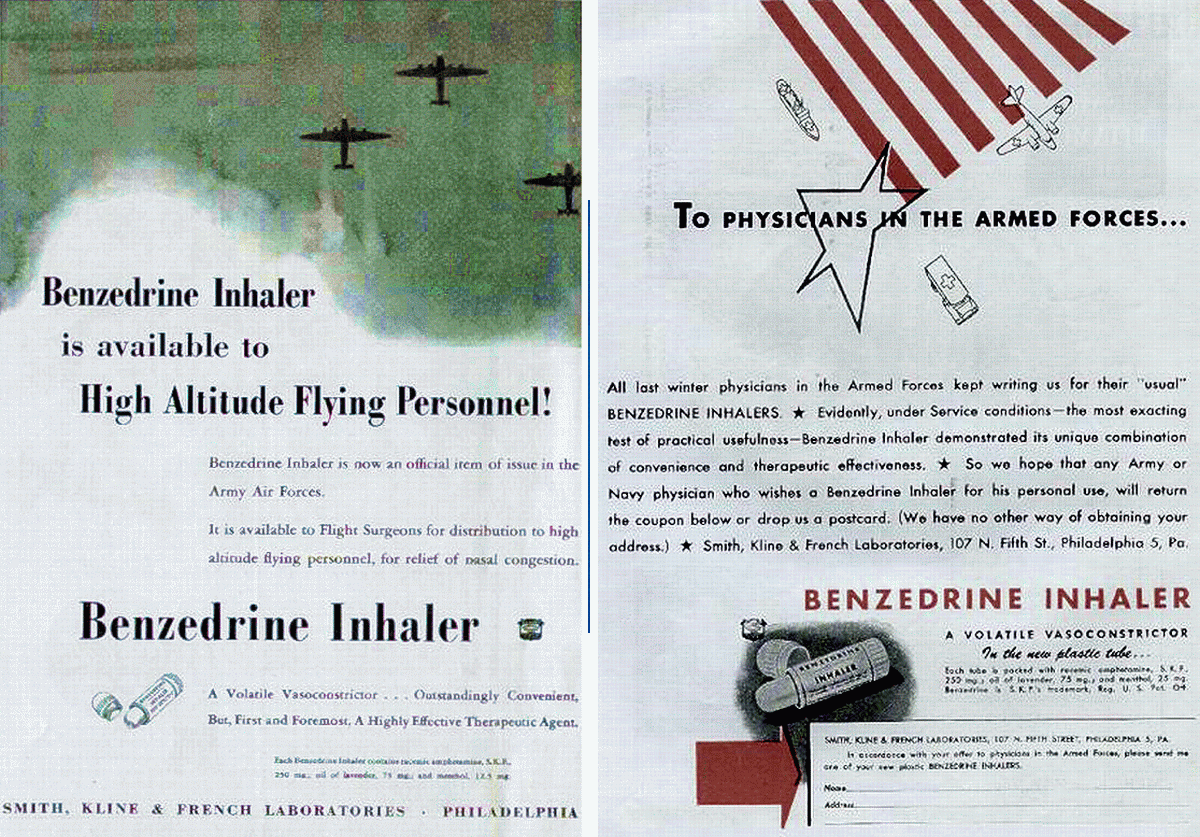
Benzedrine advertisements, 1943 & 1944.
Journal of the American Medical Association, Vol. 123, No. 10; Vol. 124, No. 12.
http://www.bonkersinstitute.org/medshow/benzedrinearmy.html

In 1943, the Americans came to the same conclusion on Benzedrine sulphate "pep pills" as a boost to morale and alertness and began to distribute them widely to all services. When Eisenhower learned that 100,000 six-tablet packages of "Bennies" were available for the North African theatre, he immediately requested 500,000. (Rasmussen, p. 226)  Rasmussen suggests that the drugs were widely abused for recreational purposes and may have been the cause of battlefield atrocities in the Pacific theatre.  (Rasmussen, p. 230-32)


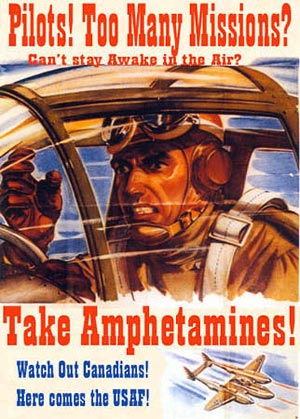
Remixed Propaganda by Micah Wright
The use of drugs by the military continues to the current day.  The American practice of popping amphetamines like candy was continued in Korea and Vietnam, where soldiers were administered Dexedrine before action.  More recently, lawyers for two American pilots who bombed Canadian soldiers in Afghanistan, argued that errant judgment may have been impaired by amphetamines.

Drugs, then, have a long relationship with the military, especially in years after 1940 as the pharmaceutical industry and pharmacological practice expanded at pace.  Beyond stimulants for combat, medical use has been made of barbiturates, sedatives and pain-killers.  Illicit, recreational drug use extends beyond amphetamines as well, with marijuana and heroin use in Vietnam as the most notorious example.  One need not look too far to find accusations regarding the negative effects of this military narco-love-affair.  

A version of this page was first posted on 28 July 2011.