Saturday, October 27, 2012

Buffalo Roundup: Montana Bison for Elk Island and Banff National Parks

Image No: PA-702-33
Title: Eleanor Luxton.
Date: 1928
The story of bison in Banff NationalPark is an interesting tale of the display of wilderness for both conservation and profitable tourism.  Like many aspects of Banff’s history, the story can be linked to the Luxton family. Eleanor Luxton’s  Banff Canada’s First National Park: A History and a Memory of Rocky Mountains Park (Banff: Summerthought, 1974, 2008) is a curious history of the town by an amateur historian and long-term resident.  It features a chronicle of Banff events, and reminiscences regarding the personalities and stories of the region. As an appendix to the work, a piece written by her father, Norman Luxton, “The Pablo Buffalo Herd”, tells the tale of the roundup of a large herd of bison from Montana destined for Banff and Elk Island parks.

The origins of the herd, can be linked to a 1873 hunting trip of  Walking Coyote, of the Pend d’Oreilles (or Kalispel) tribe. Coyote had killed a number of bison, and four calves followed him after the slaughter of their mothers. These beasts were kept as “pets” by the family and by 1884 had bred among themselves, expanding to a small herd of thirteen. Ten of these animals were purchased by Michel Pablo, and C.A. Allard, and these were supplemented by the purchase of twenty-six other bison along with eighteen cattalos.  Luxton learned of the possible sale of the herd through a letter from Alex Ayotte, a Winnipeg Free Press writer, and immigration agent at Missoula. After some discussion with the minister of the interior, it was decided to purchase the herd.
(Luxton, p. 145)
Eleanor Luxton notes the idea was to purchase the bison for shipment to Canadian parks for, “conservation, tourist attraction and a possible source of food for the Indians.” An agreement was made to ship them north to Elk Island Park, and in 1907 Banff Park's superintendent Howard Douglas joined Norman Luxton and Ayotte on the trip. In a characteristic nod to the "real ol' West", Luxton recalled nostalgic stops during the railway trip, “getting off at the stations to examine the bullet holes in the platform, put there by cowboys making tenderfeet dance.” 
(Luxton, p. 146)
Glenbow File number: NA-3581-10
Title: Buffalo cows and calves during Pablo-Allard round-up, Montana.
Date: [ca. 1906-1908]
Upon arriving at the Buffalo Camp, near Missoula, the men met up with a rough and ready crew of around thirty-five “mixed-blood” [presumably métis] cowboys. Eager to test the Canadians' mettle, one of the men asked Luxton to pick out a horse. A rangy grey was saddled for him, and he managed to stick to the bronc show that ensued. As Luxton recalled, “that lucky ride did me more good in the estimation of those cowboys than if I had presented them with a keg of liquor.”  Presumably, very few of the cowboys were teetotallers.
(Luxton, p. 146) 

GMA File number: NA-3581-1
Title: Messieurs Ayotte, 
Allard and Douglas after
Buffalo round-up Ravalli,
 Montana.
Date: 1908
Staying at the mission at the Flathead reservation, an incident occurred which casts light on Luxton’s opinion of Ayotte, his rough sense of humour, and his techniques of “conservation”. Luxton had decided to sleep in a tent outside the mission, but Ayotte opted to inspect the mission house for a bed. Luxton was none too generous in his description of the man claiming that, Ayotte “weighed 275 pounds, every ounce a tissue of selfishness added to an over-bearing manner.” It seems that Luxton knew that Ayotte would quickly discover that the beds in the mission were also inhabited by bed-bugs, and prepared to repel the man from his tent when the bites began to register. As Luxton records the event,
When I saw Ayotte leave for the house I hiked for the tent. I always carried a small twenty-bore shotgun on my trips to collect natural history specimens. Taking two shells I cut them in half leaving only the thin cardboard wad holding the powder. […]Ayotte [came] from the direction of the house, talking and swearing in French. […] Ayotte all but tore the tent-flap off, we saw his face splashed with dead bed-bugs, and I pulled one trigger. I fired the second shot as Ayotte was scrambling to his feet and running as he probably hadn’t done for some years. […] Alex slept in the stable from then on. Our night’s show amused the cowboys and raised us in their estimation.

(Luxton, p. 146)
Glenbow Museum Image No: NA-3581-5 Title: Cowboys circling during Pablo-Allard buffalo round-up, Montana. Date: [ca. 1906-1908] Photographer/Illustrator: Luxton, Banff, Alberta
As might be expected, rounding up a herd of bison is no easy task. The group formed a horseshoe of around forty cowboys, and slowly tried to drive them off their homelands. As Luxton recalled,
Just about the time we thought we would really get them off their regular ground, suddenly, the whole herd would halt as if by command. They would turn around and face the way we had come, stand, not an animal moving in perhaps the hundred we had been following. All the cowboy’s horses stood – no sound. Then from a jump start the buffalo would charge right into the horse-show of riders, never swerving, as if possessed with the devil riding them. Never once was this charge broken, nothing stopped them, not even the river. (Luxton, p. 147)
GMA File number: NA-3581-11
Title: Buffalo being loaded at
 Ravalli, Montana.
Date: [ca. 1906-1908]
The plan was to load the animals into boxcars at Ravalli station. Again, with the beasts weighing up to two tons, this was not quite the same as herding sheep. The cars themselves were custom-built with plenty of reinforcement. As Luxton put it, “the joke was to get the buffalo into the car, for that matter it was a joke to get a buffalo to any wanted place.” A system of ropes was designed to pull the animals into place, but the best laid plans do not always survive first contact with bison! “One bull went straight through the car, he just took the side out as if it had not been there. Another bull broke his legs – well, the Indians had a feast out of that.” (Luxton, p. 148) Eventually driving around twenty-five head at a time, a total of 200 bison were loaded and bound for Canada.

Up to 1912, Eleanor Luxton notes that Elk Island Park received 708 buffalo from Montana. In 1911, the Banff bison paddock received seventy-seven of the beasts. Techniques changed, but the task of rounding them up was never easy. Eventually a system of loading individual bison onto wagons to transport them to the Ravalli station. The results were not always successful.
 ...he strung these wagons together, the crates open at each end except the last one. Four cowboys were on top of each crate to let down a gate effect as soon as a buffalo was in that crate. Sure the buffalo went in – even to the end of the train. Then things happened no one could describe. Talk about cyclone pictures of a town blown to pieces. In minutes not a wagon was on four wheels, kindling wood and cowboys scrambling for ponies were all that one could see.
Glenbow Image No: NA-1241-806
Title: Norman Luxton at Banff Indian Days, Banff, Alberta.
Date: 1942Photographer/Illustrator: Gully, F., Calgary, Alberta
Remarks: At Stoney tipi village, Cascade Park, Banff.
Luxton would long foster a sense that the last vestiges of the old West could be found in Banff.  By promoting Banff Indian days, and keeping the bison paddock stocked with quintessentially Western game, the Wild West was safely on display. He insured that an experience of the romantic West familiar to readers of Fenimore Cooper and admirers of the art of Charlie Russell was obtainable by all who came to the park.  Few visitors who noted the bison grazing from the train would know the hard toil involved in procuring the herd!

Thursday, October 25, 2012

A Burning Passion: Venereal Disease in No. 6 Group RCAF

Library and Archives Canada, Acc. No. 1985-35-8
Venereal disease was a serious problem for Second World War armed forces, which could just as soon render personnel ineffective as other sickness or calamity on the battlefield. When the Americans were sent to Britain, high incidences of gonorrhea and syphilis occurred.  The problem was particularly troublesome for the command staff of No. 6 “Canadian” Group during their aircrew's long stay in England.

No. 6 Group War Diary Sketch.
William Carter in Anglo-Canadian Wartime Relations, 1939-1945: RAF Bomber Command and No. 6 [Canadian] Group (Garland: 1991), noted that there were operational consequences to affections of English women. As Carter suggests, such liaison could have a “dark side to it.” (Carter, p. 96)  One unforeseen effect of the Canadian bases being established in Yorkshire was the rising prices charged byprostitutes.  Carter notes that the amount of time spent with each customer was decreased, presumably due to increased demand, and that the cleanliness of brothels declined.  Royal Canadian Air Force medical staff determined, however, as had medical officers in the First World War, that the predominate form of contraction was not from working girls, but from one-night-stands or "casual pick-ups". (H MacDougall, "Sexually transmitted diseases in Canada, 1800-1992." Genitourin Med. 1994 February; 70(1): 60. 
The Canadians seem to have been particularly effected by venereal disease from such encounters. In 1942 and 1943, the rate of the Canadian group was six to seven times higher than bomber groups generally. Bomber Command as a whole had a high rate of VD, and in August 1943, No. 6 Group doubled the average rates.The Canadian's aircrew rates were generally four times higher than ground crew, suggesting either that a culture of promiscuity had arisen among aircrew, or that the stresses of flying bombers at night over hostile territory lead to lusty forms of escapism.
Perspectives varied on the best way to combat VD. In December 1942, the British government passed Defence Regulation 33B which required those named by two sexual contacts to undergo examination and treatment. Apparently the Canadians pushed to have women examined if only one airman identified her, but they had to acquiesce to the British regulations. Problems getting enough identification on women who were often only passing relations soon arose.

Air Marshal Harris’ “characteristically ruthless” response in January 1943 was to treat all VD cases as malingerers, removing any flights recorded on their tour. (Carter, p. 97) Carter is sympathetic to Harris’ response, noting that “some personnel undoubtedly deliberately contracted VD in order to escape from operations temporarily.” (p. 97)
The RAF’s Director-General of Medical Services did not agree with Harris’ treatment. He argued in January 1943 that VD was caused by boredom and “removal of home influences, leading to drink and its consequences.” (Cited in Carter, p.98) Others were concerned that airmen would conceal their disease and further its transmission.
Explanations for the higher rate of VD within Canadians were also varied. Some noted that it was natural considering the higher rate of the disease in Canada. Higher wages also allowed Canadians to purchase hard liquor, some accusing them of spiking the English women’s drinks. Others chalked it up to the foreign charm, or exoticism of the colonials.
Aircrew of No. 433 (Porcupine) Squadron, RCAF [graphic material] : en route to their Handley Page Halifax B.III aircraft before taking off to raid Hagen, Germany. 
Credit: Canada. Department of National Defence collection / Library and Archives Canada / e005176198
In October 1943, Air Vice-Marshal Clifford “Black Mike” McEwen apparently took a progressive attitude to the disease. As a Canadian base commander, he instituted a prevention programme, emphasizing education and the provision of more acceptable recreation options such as films, sports, and libraries. He wanted compulsory parades for all those leaving their station where men would be expected to carry condoms and and ointment (Carter, p. 101-102)
 
Unfortunately, No. 6 Groups rates never really lowered. In 1945, the RCAF’s VD rate reached its highest yearly incidence level yet at 7.6% of all personnel.  This being said, the sexually transmitted disease rate of Canadian servicemen in general had decreased from 2.2% in the Great War to only 92 per thousand in the Second. (H. MacDougall, "Sexually transmitted diseases in Canada, 1800-1992." Genitourin Med. 1994 February; 70(1): 60.) No. 6 Group clearly did little to bring the average down!

Friday, October 19, 2012

War is a Drag: Female Impersonators in the First World War

The phenomenon of the Great War drag show is somewhat perplexing.  Some argue that soldiers were not just laughing at the gender-bending performances but were actually aroused by the shows.  A broad array of explanations are offered for the cross-dressing phenomenon, ranging from desires for the portrayal of normalized femininity, to sublimation of homosexuality.
 
'The Dumbells' Concert Party. Formed from
 3rd Canadian Division in France.  'Marjorie'
(R.D. Hamilton), and 'Marie' (A.G. Murray),
the two girls of the Dumbells show,
 with the manager, Captain M.W. Plunkett,
 Credit: Canada. Dept. of National
Defence/Library and Archives Canada/
JG Fuller's Troop Morale (Oxford, 1990), notes the importance of music shows to the soldiers when they were at rest, and among these theatrical revues, drag shows were fairly common.  Analyzing a broad range of soldiers' journals, Fuller writes that , "curiously these female impersonators seem to have generated considerable sexual excitement.  He quotes one of the men in the ranks as claiming, "judging from the way [the men] sat and goggled at the drag on stage it was obvious that they were indulging in delightful fantasies that brought to them substantial memories of the girls they had left behind them in London, Manchester, Glasgow, wherever." (As cited in Fuller, p.105)
Apparently, many impersonators did not make a caricature of their roles, but played their parts with candour.  Fuller notes that many journals accounted for the realism of the concert party "girls".  One soldier wrote that, "it all seems to show that English beauty is essentially masculine."  Fuller is more critical of the illusion: "judging from the photographs, it shows the intensity of the desire to believe." (p. 106)


Big Beauty Chorus, Marie and the Boys.  Dumbells troupe.  Library and Archives Canada.  PA-005741
Fuller wonders why this desire to believe in the gender-bending charade was so strong with the relative ease of access to women in the rear areas.  It is true that after the spring of 1917, troops may have gone for weeks without seeing a woman in the farms, hospitals, shops and estaminets. Yet, Fuller suggests that the appeal of the entertainers was likely, "their emphasis put on glamour [not] the sheer fewness of females."  He notes that "peasant girls, working hard at practical tasks with their menfolk away, were often the reverse of 'feminine' in the restricted sense of the age."  A quote from an Australian journal lamented, "Women of shattered Picardy, Why are your boots so flat and vast?"

Of this desire for fancy femininity, Fuller writes
The trappings of elegance and luxury were the negation of war and squalor and, as such, a potent fetish of peace.  The female impersonators therefore took care over the fripperies, having lingerie sent out, or going on special leave to London or Paris to select the items themselves.  On stage they sang the sentimental songs which represented the greatest frippery of all, asserting the idealized stereotype of soft and vulnerable romantic femininity. (Fuller, p.106)

Historian David A Boxwell, in his article "The Follies of War: Cross-Dressing and Popular Theatre on the British Front Lines, 1914-1918" Modernism/Modernity 9.1 (2002) 1-20, disagrees with the thesis that drag performance was strictly a desire for  idealized heterosexual relations.  He identifies two forms of female impersonation which had already developed on British stages by 1914.  He notes that, "Mimicry was most visibly embodied in the pantomime "dame" tradition, a comedic effort to render the female form in its most hypercarnivalized manner: the grotesque, oversized, and voracious body of the raddled, "ugly" woman presented on stage out of a misogynistic animus" (Boxwell, p. 13).   The other form of impersonation was mimesis, which historians have traced back to the 1860s.  Mimesis represented "idealized femininity as closely as possible (Boxwell, p. 14).

'The Dumbells' Concert Party. 
 'Marie' (A.G. Murray)PA-005743
Boxwell argues, "the complex dynamics of men objectifying other men as women does not occur completely within a heterosexual matrix." (Boxwell, p. 16)  Boxwell's argument is formed in analysis of the HC Owen quote that, "it all seems to show that English beauty is essentially masculine."
[Owen] may well have intended to define female beauty in masculine terms, to suggest that British women were at their most beautiful when they most looked like men. The slippage that inheres in the statement effectively eradicates women's existence: male beauty not only exists, but cannot be conceived of in anything other than "masculine" terms. Thus there was an ineradicable trace of homoeroticism at the heart of drag during the Great War.[...] A man watching another man in drag must, at some level, self-reassuringly avow that the "woman" has a penis. But this act of speculation threatens to put the male spectator beyond the boundaries of the heterosexual matrix. (Boxwell, p. 16)
For Boxwell, enjoying a drag show was a cathartic way of releasing homosexual anxieties in a homophobic society.  As may be expected, other historians disagree.


Laurel Halladay, in "A Lovely War: Male to Female Cross-Dressing and Canadian Military Entertainment in World War II Journal of Homosexuality Volume 46, Issue 3-4, 2004 traces drag performances in the Canadian military, and identified in the Great War period, an attempt to reconstruct a heterosexual community.  (Hallady, p.  21)   For Hallady, drag performance was either comedic or dramatic, either mocking perceived female foibles or respecting femininity.  On the issue of sexualization, Halladay writes that, "Perhaps contrary to more modern expectations, drag performers were not the least bit threatening to the taken-for-granted heterosexual practices of their comrades and both contributed to and
enjoyed the homosociability of the battlefield." (Halladay, p.23)  For Halladay, it was only when women were recruited into the Canadian military in the Second World War, that female impersonation was broadly considered deviant.


The debate over the meanings of female impersonators in the First World War is by no means over.  How could it be when analyzing the subjective reception of gendered performances by a broad variety of men?  The work yet to be written on the complex nuances of drag performance is bound to be exciting historical work, addressing the overlap between social, sexual, and gender history.
From John to Jack, Susannah to Susie, Punch (1916).

Thursday, October 18, 2012

Che the Failed Guerrilla

"Che" by Flick User JFabra. License
AttributionNoncommercialShare Alike Some rights reserved by JFabra
Che Guevara has become the ultimate symbol of counter-culture resistence and revolution. Ian Beckett in Modern Insurgencies and Counterinsurgencies, (2001), however, has little praise for the actual success of Che as revolutionary.  Beckett's critique is founded on the failure of Che to spread global revolution.  Others have expressed ethical reservations about Che's pop-hero status.  Writing for Slate magazine in 2004 upon the release of the acclaimed biographical film "The Motorcycle Diaries", Paul Berman moves beyond effectiveness in his critique of "The Cult of Che", calling his fame, "an episode in the moral callousness of our time."  To Berman, "Che was a totalitarian.  He achieved nothing but disaster."  Berman suggests that Che was central to the "hardline pro-Soviet faction" in the Cuban revolution, and was neither tolerant nor discriminant when it came to violence.
Che presided over the Cuban Revolution's first firing squads.  He founded Cuba's 'labor camp' system - the system that was eventually employed to incarcerate gays, dissidents, and AIDS victims.  To get himself killed, and to get a lot of other people killed, was central to Che's imagination.
Ernesto Guevara did not have a particularly revolutionary youth, beginning training in 1947 as a medical doctor at the age of nineteen, and spending summers working as a male nurse on merchant ships. Oddly, in 1950, he failed in an attempt to market an insecticide.  In his youth he travelled across South and Central America and observed the poverty there first hand.  Such experiences hardened his belief in Marxist revolution.
The 1954 American involvement in the overthrow of the Guzman government in Guatemala was a formative experience for Guevara. It was then that he received his nickname “Che”, which was Spanish for “buddy”, due to his frequent use of the term in his speech. In 1955, Che joined Castro in his revolutionary efforts, and led a guerrilla column into the Havana. With Castro's success over Batista in 1959, Che would become president of the National Bank of Cuba and minister of industry, working for the Castro government for a number of years.

Bookworld.
One of Beckett’s main arguments is that insurgency is a product of its time and place, and theory developed to counter insurgents is also a product of its historical setting. He sees Guevara’s revolutionary theory, heavily influenced by the French Marxist philosopher Debray, as failing to note that corruption, inefficiency, military ineffectiveness, and unpopularity were the real causes in the end of the Batista regime  (p. 171) Beckett cites a number of attempts at rebellionin the 1960s which failed to replicate the Cuban revolution in countries such as: Argentina, Brazil, Bolivia, Colombia, the Dominican Republic, Ecuador, Guatemala, Paraguay, Peru, and Venezuela.  Che would leave Cuba in 1965, due to friction there with certain leaders.  He hoped to foment global revolution, but attempts at training guerrilla forces in the Congo failed.


Beckett reserves the title of “the greatest failure of all” for that of Guevara’s attempts in Bolivia. (p. 173) In 1966 Guevara arrived there in hopes to organize resistance, but the 1950s had seen land reform and nationalization of the mining industry which denied Guevara the necessary bedrock of discontent. That Bolivia president Rene Barrientos, was of peasant origin did not help Che’s cause. Even the Bolivia communist party leaders objected to Che’s insistence on military control of the revolution, and abstained from support. Difficulties in the rugged terrain resulted in problems of manoeuvre, and as Beckett puts it, Guevara's force, "spent much of its time lost in the jungle.” (p. 174)
Guevara’s ultimate demise was a product of this lack of support, and the operations of a American Special Forces Mobile Training Team, under Major Robert “Pappy Shelton”. The Green Berets trained a ranger battalion for the Bolivian army which was deployed in fall of 1967. By 8 October 1967, Che’s remaining eighteen guerillas were surrounded at La Higuera. The wounded Che was captured and executed, and his body exhibited in Vallegrande.  Declassified American documents relate the final hours of his life.  A Lieutenant Perez was given the order to kill Guevara, but apparently did not have the heart to do so.   Perez asked Guevera what his last wishes were.
Guevara replied that he only wished to 'die with a full stomach'.  Perez then asked him if he was a 'materialist', by having requested only food.  Guevara returned to his previous tranquil manner and answered only 'perhaps'.  Perez then called him a 'poor shit' and left the room.  By this time, Sgt Terran had fortified his courage with several beers and returned to the room where Guevara was being held prisoner. [...]  'Willy', the prisoner taken with Guevara, was being held in a small house a few meters away.  While Terran was waiting outside to get his nerve back, Sgt Huacka entered and shot 'Willy'.  'Willy' was a Cuban and according to the sources had been an instigator of the riots among the miners in Bolivia.  Guevara heard the burst of fire in his room and for the first time appeared to be frightened.  Sgt Terran returned to the room where Guevara was being held.  When he entered, Guevera stood and faced him.  Sgt Terran told Guevara to be seated but he refused to sit down and stated, 'I will remain standing for this.'  The Sgt began to get angry and told  [...] him.  'Know this now, you are killing a man.'  Terran then fired a burst from his M2 Carbine, knocking Guevara back into the wall of the small house.  "Debriefing of Officers of Company B, 2nd Ranger Battalion"(www.gwu.edu)

The order to kill Guevara was made by General Ovando, the Chief of the Bolivian Armed Forces.  Walt Rostow wrote President Johnson of the execution, "I regard this as stupid, but it is understandable from a Bolivian standpoint."  On the 13th of October, Rostow wired the president that Che was confirmed as dead.  It was long thought the body was discarded into the jungles via helicopter, but in 1997 Guevara’s remains were found under an airstrip in Vallegrande and re-interned in Cuba.
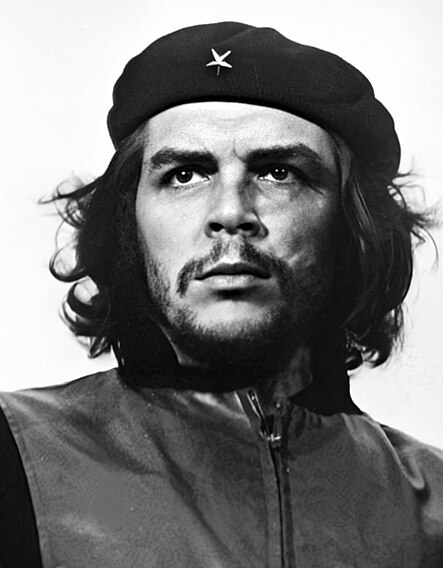
Date     Photo taken on 5 March 1960;
Source     Museo Che Guevara, Havana Cuba
Author     Alberto Korda Copyright

Che's beret-clad and bearded head has been said to be the most repoduced image in the world.  It seems that given his success as revolutionary, that Che as symbol, the Che of the rock t-shirts, and flags adorning teenage bedrooms across the world, is a fairly unlikely figure.  Indeed, one might say that he has inspired many more revolutionaries merely through the religious passion that his idol has evoked, more than any actual savvy regarding guerilla war.  In speaking of the Che's portrayal in "The Motorcycle Diaries", Berman notes "the entire movie, in its concept and tone, exudes a Chistological cult of martyrdom, a cult of adoration for the spiritually superior person who is veering toward death - precisely the kind of adoration that Latin America's Catholic Church promoted for several centuries, with miserable consequences."  The romantic ideal of Che as martyred revolutionary will probably never be excommunicated from the public mind.
"Che Guevara Monument and Mausoleum_Cuba 224" By James Emery.  License
Attribution Some rights reserved by hoyasmeg

Wednesday, October 17, 2012

White Feathered Zeal: Accosting Shirkers in the Great War

In 1915, problems meeting the manpower commitments of the Borden government were quickly discovered by the Canadian army.  Jack Granatstein and JM Hitsman noted in Broken Promises(Oxford: 1977), their fundamental account of conscription in Canada, that standards were quickly lowered when men failed to flock to the recruiting stations.  Medical standards were reduced, the height restriction dropped an inch down to 5'2", minimum chest measurements were decreased, and married men no longer needed permission from their wives to enlist. (p.35)

Chief Justice TG Mathers noted that the strongest motivation to serve was the social pressures put on Western men who were still strolling  civvy-street.  Mathers, a Manitoban pro-conscriptionist, noted that
It is absurd to speak of enlistment at the present day as voluntary.  In the cities of the West the man who is not in uniform is made to feel that he is a sort of social outcast.  No man who joins the ranks today does so voluntarily.  He does so because he can no longer resist the pressure of public opinion.  (Granatstein, p. 38)
 Pierre Van Paassen NYPL th-60174
Patriotic souls took it upon themselves to organize pressure against those not yet serving.  Some women would search for workers and offer to take their place on the job if they would join the army.  As Granatstein noted, "often these patriotic ladies could get carried away."  The memoirs of Pierre van Paasen, a dutchman living in Toronto, testify to the fervour with which shirkers were sought out:
One afternoon I was accosted on the rear platform of a streetcar by a woman, who was dressed in mourning.  She told me that three of her sons had been killed at the front.  She showed me their photographs.  Suddenly she began to talk very loudly.  'Why aren't you in khaki?' She demanded.  'Why do you dare to stand there laughing at my miser? Why don't you go over and fight? Fight, avenge my boys!' she screamed.  'Madam,' I tried to calm her, 'I am not a Canadian.'  That remark set her yelling at the top of her voice.  She screamed that she, the mother of three heroes who had died for their king and country, had been insulted by a foreigner, a slacker, a German spy, a Red, and I don't know what else.
City of Toronto Archives      Fonds 1231, Item 508a
    Close up of 508, T.S.R. Car No. 6
   November 22, 1916
I pulled the cord to bring the street car to a halt.  I alighted. But the woman followed me off and she kept up her screaming about spies and Germans.  A crowd gathered....Somebody stopped me just at the moment when I thought of taking to my heels as the best way out of the predicament.  I was immediately surrounded by a mob.  A group of business men, who had managed to stay five thousand miles away from where the poppies grow, and who were at that moment emerging from the hotel, gallantly rushed to the woman's aid and forced me to submit, as she pinned a white feather through my coat into my flesh: the badge of white-livered cowardice. The last I saw of her was through a pair of badly battered eyes as she laughingly picked up some of the feathers which had dropped from her bag in the scuffle.
...The following day I enlisted.  (Cited in Granatstein, p. 39)
City of Toronto Archives Fonds 1244, Item 687
Title Mother of military personnel, World War I
Date(s) of creation of record(s)        [ca. 1916]
When in 1917, the Borden government finally acknowledged that the robust commitments of Canadian troops would necessitate conscription if the war were to continue grinding on, the position of Canadian women was far from clear-cut.  The attitude of women whose sons were still in Canada would, of course, be much different from that of the mourner Paasen encountered.  In February 1917, the journal Everywoman's World had organized a "woman's parliament", which stated that a 6:1 ratio of members were against compulsory service (Granatstein, p. 80).  The national women's organizations were broadly in support of Union government and conscription, but one should not assume this meant that half the nation's population to have a unanimous opinion on the matter.  The women's groups of feminist legend may not have had the influence on public opinion that historians at times ascribe to them.  It does seem clear, however, that women whose sons were lost in the war were given a status which was leveraged to promote conscription and shame "shirkers".